


The week showed a conflict generating widening political and economic pressure faster than it produced any clear path to closure.
A week that began with more troops, more threats and more leverage politics around the Strait of Hormuz ended with the same central problem still unresolved. Washington signalled both escalation and fatigue. Iran continued to show it could impose costs across the region. Meanwhile the practical consequences of the war spread faster than any credible route to closure. The result was not a clear turning point, but a widening mismatch between military language and strategic reality.
What stood out was less battlefield movement than the expansion of pressure into allied politics, energy systems and market expectations. By the end of the week, the conflict looked less like a campaign moving towards resolution and more like a war producing secondary shocks that were increasingly hard to contain.

The first pattern was that military engagement kept widening even as the stated endgame remained vague. At the start of the week, the United States sent about 3,500 additional troops to the Middle East, lifting the regional total above 50,000, while officials weighed options for opening Hormuz and Iran moved to formalise its leverage over the passage through legislation and fees.
Soon afterwards, Trump signalled he was willing to end the campaign even without reopening the strait, suggesting the military effort had more limited aims than the scale of disruption implied. Yet that did not produce a coherent exit line. By 2 April, his televised address offered no clear end date and no negotiating framework, while oil rose and equities fell.
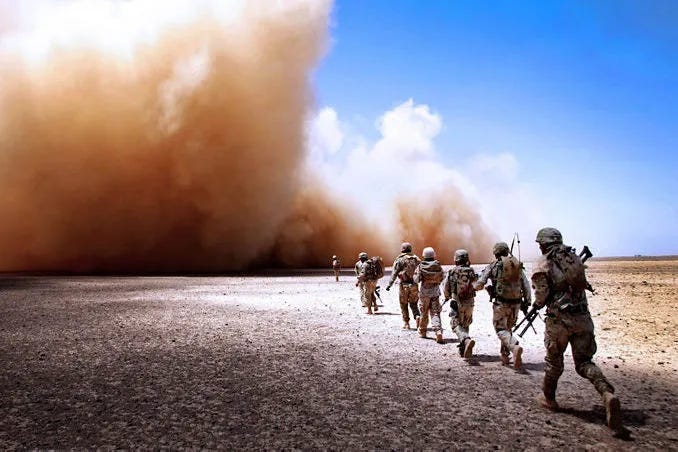
The end of the week, having fired a senior general the US was again threatening further strikes on Iranian bridges and power infrastructure at the same time as intelligence assessments said Iran still retained substantial missile, drone and coastal defence capacity.
The week therefore illustrated a war in which the rhetoric of nearing completion sat alongside evidence of enduring Iranian capability and continued systemic disruption.

The second pattern was that alliance politics became more visibly strained. Rather than drawing a clear common Western line, the conflict exposed diverging appetites for risk and responsibility. Spain blocked US war flights and extended its refusal to support the operation through jointly used bases, turning strategic disagreement into an operational constraint.
Trump then escalated the dispute by openly weighing withdrawal from Nato after allies refused to join the war, while also arguing that countries dependent on Gulf energy should secure the route themselves.

European leaders responded not by closing ranks behind Washington, but by emphasising restraint, autonomy and predictability. Macron and Takaichi, Japan’s prime minister pushed for ceasefire, de-escalation and free passage through Hormuz, with France underlining that it had not been consulted and was not part of the offensive.
Keir Starmer, meanwhile, used the moment to argue for closer economic and security ties with Europe, saying the war had made that more urgent.
The broader point was not that alliances were collapsing, but that the war forced into the open a distinction between formal alignment and practical willingness to follow Washington into escalation.

The third pattern was that the economic logic of the war began to acquire a force of its own. Hormuz remained the central transmission channel. Early in the week, flows through the strait had slowed to a trickle. By midweek, the route was described as partially closed, with Brent above $106 and petrol above $4 a gallon in the US. The consequences then broadened. A UN assessment warned that Arab states could lose between $120 billion and $194 billion in GDP, with millions of jobs at risk and poverty rising.
The European Commission urged conservation measures and warned that even a quick peace would not restore energy markets to normal in the foreseeable future. Australia told households to expect months of fuel shock and introduced temporary relief measures. International lenders and energy institutions formed a joint response group to coordinate support as supply shortages rippled into food prices, inflation expectations and financing needs.

By the end of the week, nearly all traffic through Hormuz had halted and Brent was around $108 to $109. The significance of that progression is that the war was no longer only a military contest with economic side-effects. The economic dislocation had become a major theatre in its own right.

Taken together, the week did not show decisive escalation or clear de-escalation. It showed a conflict settling into a more complicated and potentially more durable form. Military pressure continued, but without a convincing route to closure. Allied cohesion held in formal terms, but with increasing friction over methods and burden-sharing.
At the same time the economic shock spread outward faster than diplomacy narrowed the crisis. That does not yet amount to a historic break. But it does suggest that the central risk is no longer only what happens on the battlefield. It is that a war launched with talk of limited aims is beginning to reshape alliance behaviour, market expectations and policy choices well beyond the combat zone.