


This week showed how the Iran war is moving beyond Washington’s ability to contain its consequences, spreading through chokepoints, allies, energy markets and linked conflicts.
The Iran war has entered a different phase. The United States still has overwhelming military capacity and its forces continue to strike Iranian and Iran-backed targets at will, but this week’s events pointed to a harder problem for Washington: the war is no longer moving on American terms - the mid terms are looming, the war is unpopular and likely to become even more so if energy prices move further upwards.
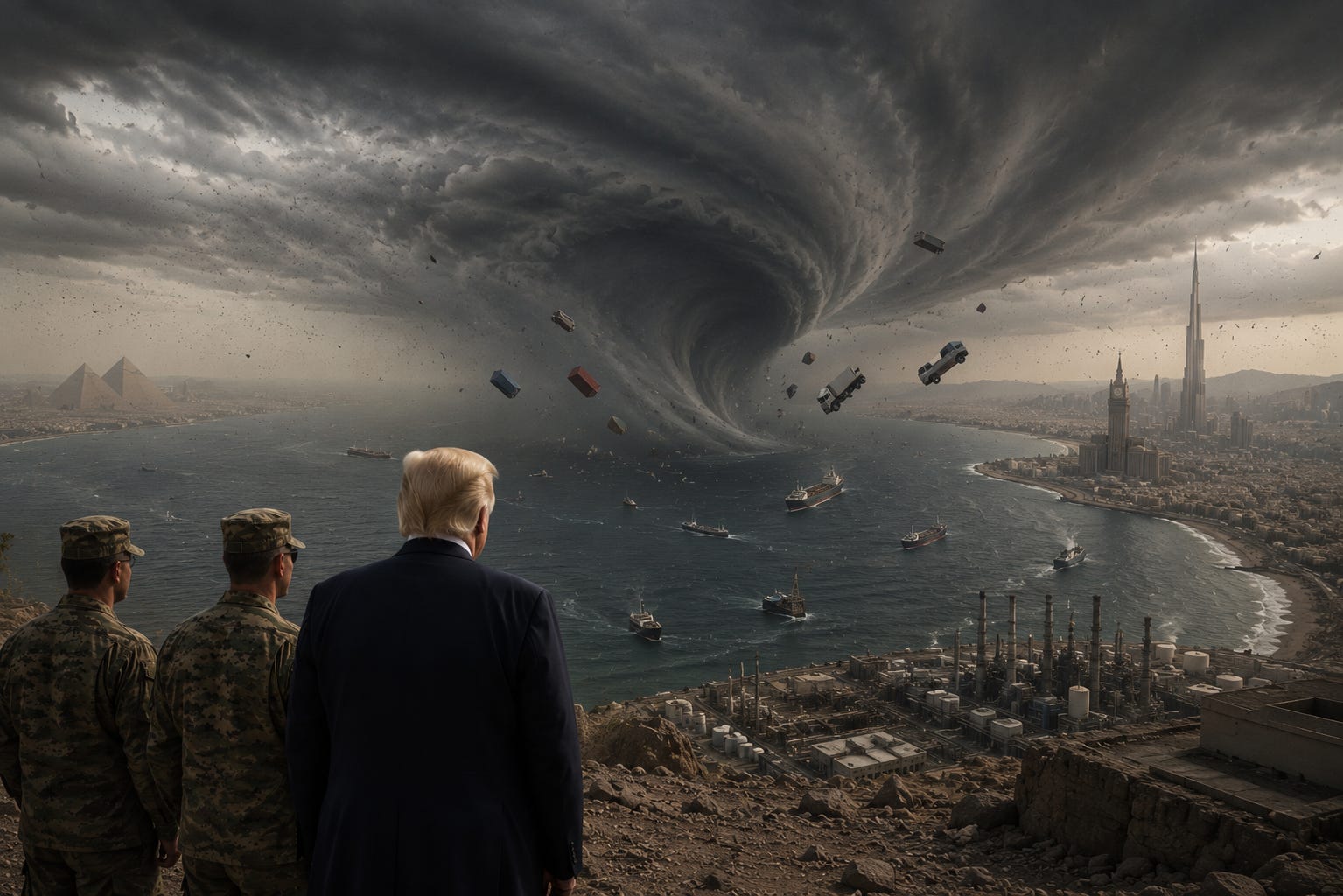
Hormuz diplomacy has stalled and the Red Sea became more exposed. Saudi Arabia moved towards a maritime coalition and appears to be mobilising troops. Egypt’s Damietta port came under attack putting the vulnerability of the Suez into the frame. Ukraine struck Iran-linked supply routes in the Caspian Sea exposing a link that not everyone had considered.
A war Washington chose is now touching shipping, oil, alliances, diplomacy and the Russia-Ukraine conflict - we are five months down this road and offramps are looking scarcer and scarcer.

The week began with a pause that looked less like control than a recognition of limits. President Donald Trump halted US strikes around Iran’s southern coast and the Strait of Hormuz after Admiral Brad Cooper advised that two weeks of bombing had reached the limit of its effectiveness. General Dan Caine also warned that shortages of air defence interceptors could add risk to protecting US forces and allies.

That is a striking position for a war presented as a demonstration of strength. The US can still hit targets, intercept missiles and expand operations with Saudi Arabia. Yet the week showed Washington reacting to Iranian and Iran-linked moves rather than actually being able to steer events towards any sort of a settlement.
By the time that the week was run, the US was again launching a series of attacks but, given the prior comments from Admiral Cooper, one has to wonder what they were actually shooting at.
Trump kept saying Iran wanted a peace deal but the record was missile attacks, renewed US strikes, Saudi exposure, Iraqi anger and unresolved diplomacy over Hormuz.

Chokepoints have been central to this war for months but this week they showed their importance widening. Hormuz remained the core point of Iranian leverage. Iran and Oman discussed reopening shipping through the strait but Iran rejected Oman’s proposal to divide control evenly and demanded control of the inbound lane.

The more significant change was that the Red Sea and Suez complex became more real as a second zone of exposure. Saudi Arabia had avoided some Hormuz disruption by moving more than half its oil overland to Yanbu on the Red Sea. That workaround now looks less secure. Houthi threats and attacks pushed Riyadh towards a multinational Red Sea shipping coalition, while an attack on Egypt’s Port of Damietta exposed Suez vulnerability.
The war does not need to close every oil supply route to alter behaviour. It only needs to make alternatives less reliable and potentially too expensive.

The most revealing link came far from the Gulf. Ukraine’s strike in the Caspian Sea targeted vessels and facilities connected to military cargo shipments involving Iran and Russia. Iran said one sailor was killed on an Iranian commercial vessel, summoned Ukraine’s chargé d’affaires and warned that Kyiv’s actions could not go unanswered.

That episode connected two wars that many readers might still treat as separate. The Caspian is Iran’s most direct route to Russia and is less exposed to US or allied interdiction than Iran’s southern ports. For Ukraine, striking that route disrupts Moscow’s links with Tehran and frames Iran’s drone support for Russia as part of the same battlefield.
The Iran war is intersecting with the supply routes and military relationships that sustain Russia’s war in Ukraine.

The Iran war is spreading into a global environment already short of spare capacity. Europe’s wildfires forced mass evacuations, destroyed homes and exposed gaps in aerial firefighting capability. In France, the Gironde fire burned roughly 420 square kilometres and forced more than 220,000 people to evacuate. Record-low Danube levels forced Hungary and Romania to cut nuclear output because cooling systems were disrupted.

Economic policy also showed caution rather than resilience. China signalled faster public spending but avoided major stimulus. The Federal Reserve held rates despite inflation risks linked to the Iran war, tariffs and AI-linked demand. Cuba announced reforms opening parts of its state-run economy as sanctions and a six-month oil blockade deepened strain.
These developments were not all caused by the Iran war but they formed the setting into which Washington’s conflict is now moving: strained energy systems, fragile logistics and governments with limited room for error.

The week’s larger lesson is that ownership of a conflict is not the same as control over its consequences. The old adage that wars are won not by the side that can inflict the most pain but by the side that can absorb the most pain looks relevant yet again.
The Iran war remains Washington’s war in the sense that the United States chose to prosecute it, escalated it and continues to define its stated objectives (even if these objectives have been a moveable feast). The reality is that events around it are increasingly being shaped by retaliation, route leverage, allied exposure and adjacent conflicts not by the side that chose the war and pulled the trigger.
The creep became highly visible. Hormuz did not settle. The Red Sea became more exposed. Suez entered the risk map. The Caspian linked Iran to Ukraine.
Five months in, peace looked no closer.
Just now I read this