


Diplomacy remained active this week but resolution remained elusive. Across several of the world’s most consequential conflicts, negotiations continued, ceasefires formally held and political leaders spoke of progress. Yet military operations persisted, underlying disputes remained unresolved and uncertainty continued to shape decision-making far beyond the immediate conflict zones.
For governments, businesses, private citizens and investors alike, the challenge is increasingly not how to respond to sudden crises, but how to operate in a world where instability becomes a semi-permanent state of affairs. This week offered several examples of that shift. From the Middle East to Europe and East Asia, states continued to adapt to a landscape defined less by decisive breakthroughs than by prolonged competition, strategic hedging and the management of risk.

The clearest illustration came from the Middle East. Negotiations between the United States and Iran continued throughout the week, even as both sides accused each other of ceasefire violations and military activity persisted around the Strait of Hormuz. Similar patterns were visible in Gaza and southern Lebanon, where ceasefires increasingly appear less as pathways to settlement than as mechanisms for preventing wider escalation while deeper disagreements remain unresolved.

For much of the post-Cold War period, ceasefires were often viewed as stepping stones towards political settlements. This week suggested a different model. Across several conflicts, negotiations continued alongside ongoing military activity, creating a situation in which diplomacy and confrontation increasingly coexist rather than replace one another.
Nowhere was the contradiction clearer than in the US-Iran talks. Negotiations continued, draft agreements circulated and officials spoke of progress. At the same time, military activity persisted, disputes over Hormuz and uranium remained unresolved and both sides continued to accuse each other of violating the ceasefire. The process remained active, but the core disagreements showed little sign of narrowing.

Similar dynamics were visible in Gaza and Lebanon. Formal ceasefire arrangements remained in place, yet military operations, territorial disputes and political disagreements continued. Rather than signalling an end to conflict, these arrangements increasingly resemble frameworks designed to contain escalation while larger disputes remain unresolved. The result is a geopolitical environment in which negotiations persist, violence continues and uncertainty becomes a structural feature rather than a temporary condition.

For decades, much of the international security architecture rested on a simple assumption: the United States would remain the central provider of military power across multiple regions simultaneously. This week offered several reminders that allies are increasingly preparing for a more uncertain version of that arrangement.
Reports suggesting reductions in some US commitments to Nato coincided with fresh debate about weapons stockpiles depleted by the Iran conflict. Neither development implies an American retreat from global leadership- yet. Together, however, they reinforce growing questions about how military resources are prioritised in an era of multiple overlapping security challenges.

Many allies appear to be adjusting accordingly. Britain and Poland moved to deepen defence cooperation, European governments continued discussions around burden-sharing and integration, while Japan and the Philippines strengthened security ties in East Asia. Canada, meanwhile, continued to emphasise the need for greater economic and strategic independence while maintaining close cooperation with Washington.
The common thread is not a collapse of existing alliances. Rather, it is a gradual redistribution of responsibility within them. As security challenges become more numerous and geographically dispersed, governments are placing greater emphasis on regional partnerships and self-reliance alongside traditional alliance structures.

The week’s technology stories shared a common theme: governments increasingly view advanced technology not simply as an economic sector but as a strategic asset tied directly to national power.
China’s reported restrictions on overseas travel for senior artificial intelligence specialists illustrated this shift clearly. Highly skilled researchers and engineers are increasingly being treated as strategic resources, reflecting the growing importance attached to technological competitiveness. Similar thinking underpinned Huawei’s claims of semiconductor advances that could reduce dependence on foreign technologies and export-controlled equipment.
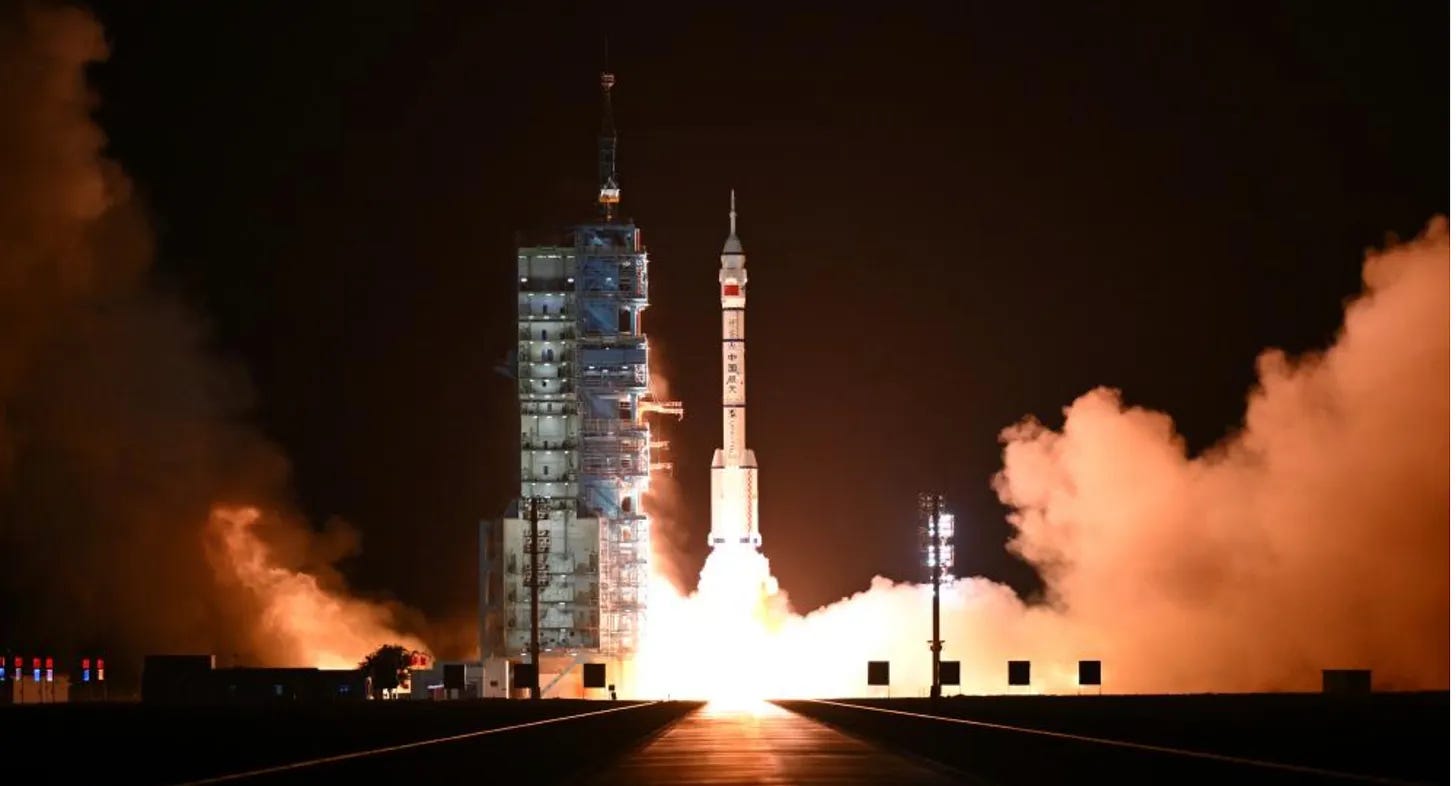
China’s continued investment in its space programme reinforces the same pattern. Space capabilities, semiconductor manufacturing and artificial intelligence are often discussed separately, yet governments increasingly view them as interconnected components of national capability.
The trend extends beyond China. Japan and the Philippines moved to deepen defence cooperation and explore new mechanisms for sharing information and military technology. Together, these developments suggest that technology policy is becoming inseparable from security policy. The competition is no longer solely about innovation. It is increasingly about control, access and strategic advantage.

Many of the week’s most important stories involved risks that have been discussed for years but are now becoming harder to treat as future challenges.
Climate provided one example. New projections pointed towards continued warming over the coming years, while parts of Europe experienced record-breaking May temperatures. Discussions that once focused primarily on future climate scenarios increasingly revolve around present-day adaptation and resilience.

Public health showed a similar pattern. Ebola cases continued to rise in eastern Democratic Republic of Congo, with health authorities warning that the outbreak was outpacing response efforts. Elsewhere, Australia’s legal action over PFAS contamination highlighted the growing financial and political consequences of environmental issues that have accumulated over decades.
The same theme appeared in international institutions. Funding pressures facing peacekeeping missions, disputes involving the United Nations and broader questions around institutional legitimacy all reflected systems struggling to manage increasingly complex demands. The common thread was not sudden deterioration, but the gradual emergence of long-term challenges into immediate policy problems.

Taken individually, many of this week’s developments appeared incremental. Negotiations continued. Alliances evolved. Technology programmes advanced. Climate and public health warnings accumulated. None represented a single transformative moment.
Taken together, however, they point towards a world becoming more accustomed to managing persistent pressures rather than resolving them. Ceasefires continue without settlements. Security responsibilities are being redistributed. Technological rivalry deepens while strategic interdependence remains unavoidable. Long-term risks increasingly demand immediate responses.
Whether these trends represent a temporary phase or a more durable feature of international affairs remains uncertain. What appears clearer is that many governments are already adapting to a world in which instability is less often an interruption and more often part of the operating environment.
After perpetually reading posts like these two, it's challenging or rather, seemingly hopeless waste of time, or maybe just verbal rope-a-dope to stay informed, about whatever is being said…?