


This week did not bring a decisive shift. It showed instead how much diplomatic and political effort is now being spent managing conflicts that remain fundamentally unresolved.
In the Middle East, talks moved forward, but the main disputes over inspections, shipping, Lebanon and regional security did not.
In Europe, governments continued adjusting to a security burden they already know is growing. Whilst in Ukraine, pressure on Russian infrastructure and air defences reinforced the sense that Kyiv is trying to do more than simply hold the line.
Across Western politics, formal authority remained in place, but looked harder to exercise with confidence.

The main arc of the week was diplomatic movement without meaningful resolution. The United States issued a 60-day waiver allowing the production, delivery and sale of Iranian oil after talks in Switzerland were described as productive. The framework signed on 17 June also remained in place.
Yet nearly every subsequent development showed that the core disagreements had not narrowed. Washington said Iran had committed to free transit through the Strait of Hormuz and to IAEA inspections. Iranian officials said there had been no new nuclear commitments and continued to resist the idea that access to damaged sites had been settled.
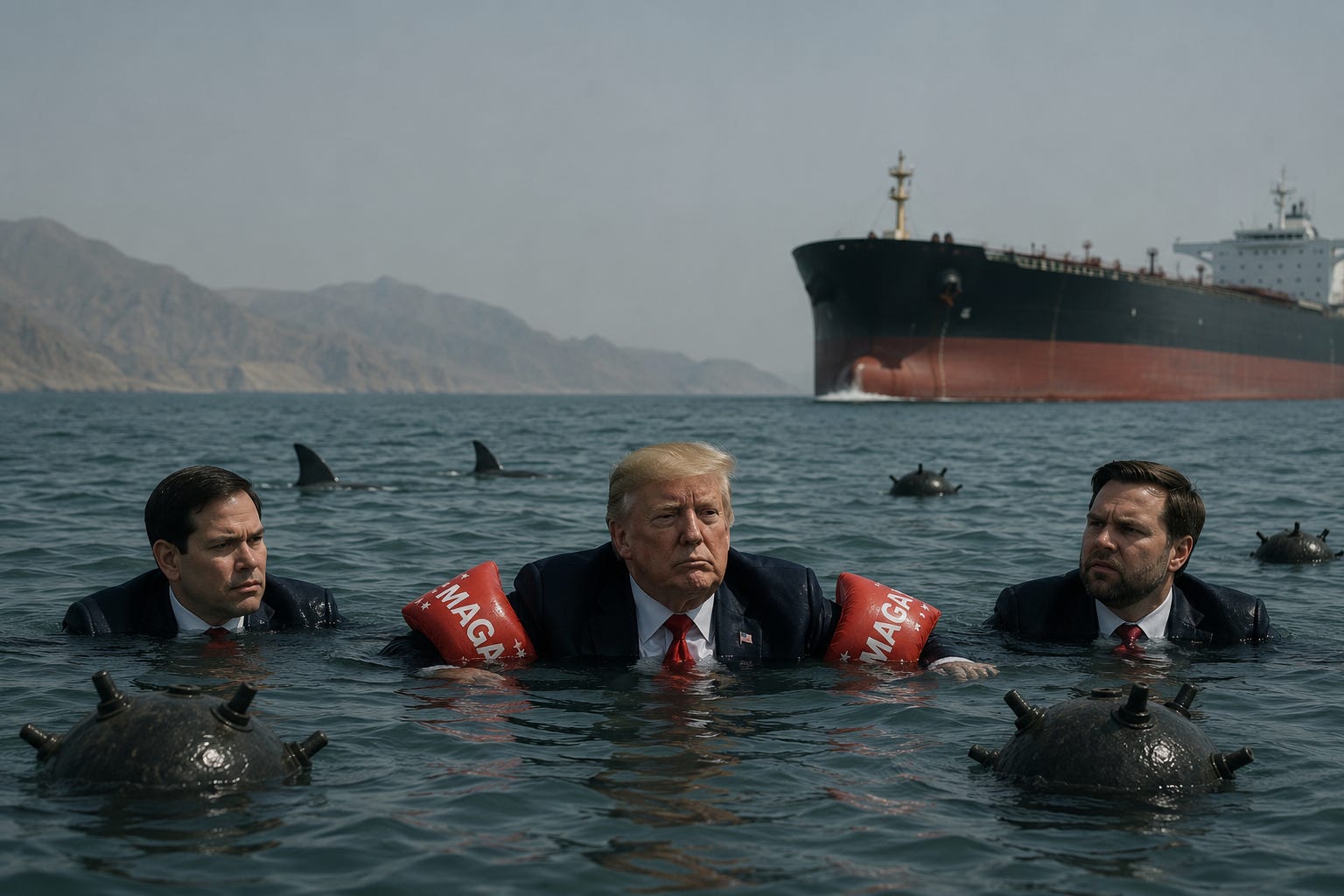
That gap became harder to ignore as the week went on. The United Nations began evacuating sailors stranded in Hormuz, Gulf states were reassured that any lasting arrangement would have to address missiles, drones and proxy groups, and the language around free and unrestricted navigation remained firm. Yet the attack on a cargo ship on the new route through the strait damaged the sense that even limited stabilisation was taking hold. Israel’s insistence that its troops would not withdraw from southern Lebanon left another central dispute unresolved.
The week produced flurries of diplomatic activity, but little real progress. The region still looks caught between ceasefire management and unfinished war.

The European story this week was not a new strategic awakening. It was the continuation of an adjustment that remains incomplete. In Berlin, the leaders of Germany, France, Italy, the UK and Poland pledged to strengthen NATO’s European pillar, increase defence cooperation and push support for Ukraine higher up the agenda. That fits an existing pattern. Europe is trying to carry more of the security burden because the need has become harder to postpone.

What remains unresolved is how coherent that adjustment really is. Italy pushed back after remarks suggesting US planes had taken off from bases in Italy to support the Iran war, reopening questions about national authorisation and political consent. In the Czech Republic, a dispute over who would attend the NATO summit exposed another layer of division over defence spending and representation.
Europe is therefore still moving in the same direction, but under familiar constraints. It wants a stronger role within NATO, greater defence coordination and a clearer capacity to support Ukraine. It still lacks a settled formula for doing so without friction between domestic politics, alliance dependence and strategic ambition.
The most interesting military arc of the week was not simply that Ukraine acted more boldly. It was that both sides behaved in ways suggesting Ukrainian pressure may be producing effects Russia cannot ignore. Kyiv widened strikes against fuel infrastructure, missile electronics production and communications facilities, while signalling that even its ceasefire offer may not remain fixed indefinitely.
This does not amount to victory, and it does not overturn the war’s fundamentals. It does suggest, however, that Ukraine is acting less like a country waiting for relief and more like one testing whether continued pressure can alter Russian calculations.

Russia’s response gives that interpretation more weight. Civilian fuel sales were halted in Crimea after Ukrainian attacks on fuel supplies. Russian officials also accused the United States of failing to follow through on prior understandings reached between Donald Trump and Vladimir Putin. Volodymyr Zelenskyy, meanwhile, said Russia was moving more air defences towards Moscow, Valdai and the Kerch Bridge, implying that valuable systems were being pulled back to defend the core.
The significance is not that Ukraine is suddenly winning in any conventional sense. It is that the war is imposing visible defensive and political costs further inside Russia, and Moscow is behaving as though those costs are becoming harder to absorb.

A fourth pattern ran through several countries at once. Governments and institutions still hold formal authority, but exercising it looks increasingly difficult, costly and contested. In Britain, Keir Starmer’s decision to quit as Labour leader while remaining prime minister until a successor is chosen reopened questions about fiscal credibility and market confidence.
In the United States, a Pew survey pointed to sharply negative global views of Donald Trump and declining confidence in America as a reliable partner. Congress, meanwhile, approved a war powers resolution directing Trump to halt military action against Iran, even if the administration dismissed it as symbolic.

The wider point is not that political systems are ceasing to function. It is that authority is becoming more conditional and more fragile. Courts, legislatures, markets and public opinion are all exerting pressure, but not necessarily resolving the disputes underneath. That leaves leaders with formal room to act, yet less capacity to impose a stable line at home or abroad. In practical terms, that makes policy harder to sustain and diplomacy harder to anchor.

This was, then, a week of visible activity but limited settlement. Negotiations continued, alliances adjusted, military pressure shifted and political systems kept functioning, but none of those developments removed the deeper sources of uncertainty underneath them. The important changes were not dramatic breakthroughs. They were further signs that several major contests remain open, and that more governments are having to operate inside that ambiguity rather than above it.