


This week’s roundup looks at how conflict, trade routes and state capacity became intertwined across diverse regions across the globe, from the Gulf and Ukraine to Venezuela, France and Central Africa.
Although escalating conflict was a key theme, this was not only a week of war. It was a week in which conflict, disaster, disease, heat, trade and political control all moved through the systems that allow states to function. The US-Iran war supplied the most visible shock, but it was not the only test. Ukraine’s command reset, Venezuela’s earthquake damage, France’s heat deaths & wildfires, Congo’s Ebola outbreak, and new assertions of political, trade and technology control all pointed to a wider question: how well institutions cope when events move faster than their underlying systems architecture were designed for?
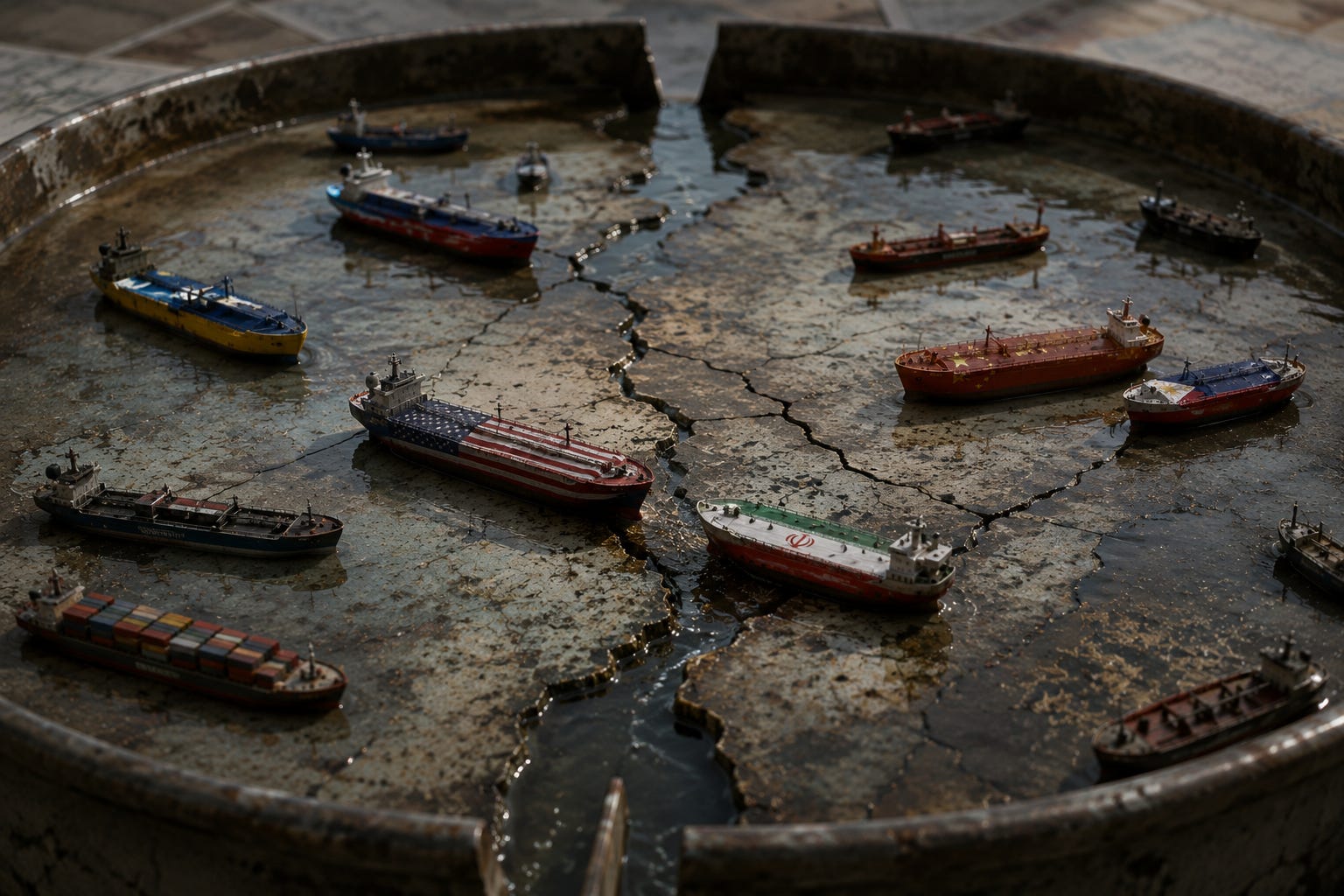
The result was a week in which infrastructure mattered as much as ideology. Shipping lanes, energy markets, air defences, public health systems, disaster response, trade law and digital platforms became the places where events found traction and by doing so acquired wider significance.

The US-Iran war dominated the week because it reached well beyond the exchange of mere military strikes. The United States carried out successive nights of attacks on Iranian military, maritime and logistics targets, while Iran attacked commercial vessels and launched drones and missiles across the region each side claiming its actions to be in response to the other. Jordan, Kuwait and Bahrain all reported interceptions or related attacks, showing how quickly the conflict was spreading through both allied airspace and transport systems.

The centre of gravity was maritime. The Strait of Hormuz remained disrupted, crude oil moved through several price thresholds during the week, Donald Trump seemingly unable to find an appropriate offramp looks tempted to double down and said he was considering a larger attack on Iran. At the same time, the Houthis opened a Red Sea front by striking Saudi-linked tankers and threatening traffic through Bab al-Mandeb.
That gave the conflict a wider channel of transmission: energy flows, insurance costs, tanker routes and global growth expectations. The World Bank warning that a prolonged war could cut global growth to 1.3% in 2026 showed how quickly a regional war can become a macroeconomic event.

Ukraine’s week was defined by the interaction between the battlefield and the structures of command. Russia launched missiles, drones and guided bombs across Ukrainian cities, exposing Kyiv’s continuing shortage of Patriot air-defence systems. Ukraine, meanwhile, continued to strike deeper into Russian logistics, energy and shipping infrastructure, including targets hundreds of miles from the front.

Inside Ukraine, the war produced both a political and a military reset. Protests followed the dismissal of former defence minister Mykhailo Fedorov, whose dispute with Commander-in-Chief Oleksandr Syrskyi centred on technology, drone warfare and military reform. Zelenskyy then removed Syrskyi and appointed Mykhailo Drapatiy to lead the armed forces.
The significance was both practical and symbolic. Ukraine is trying to change how its army fights while still facing Russian assaults, manpower shortages and air attacks. Drapatiy’s task is to accelerate the use of drones and unmanned vehicles, loosen rigid decision-making and rebuild ties between army command and the defence ministry. Reform, in this case, is not separate from the war effort; it has become integral to it.

The week’s wars seemed to repeatedly converge at sea. Hormuz carried the risk of Gulf energy disruption; Bab al-Mandeb became central after Houthi attacks on Saudi-linked shipping; the Red Sea saw tankers change course; the Black Sea, a Russian missile strike on a corn ship near Odesa killed crew members and a Ukrainian maritime pilot and Ukraine also struck Russian vessels in the Black Sea and Sea of Azov.

These were not peripheral incidents. They showed how commercial shipping lanes can become extensions of war strategy. Oil, grain and shipping are not simply background economic flows, this week they became targets, bargaining tools and indicators of wider risk.
ASEAN’s call for safe, continuous passage through Hormuz made the connection explicit. Southeast Asian governments linked the war to energy security, food security, supply chains and agricultural production. That widened the map of the conflict from the Gulf itself to the states dependent on the routes that pass through it.

Beyond the wars, several stories showed how physical shocks expose weaknesses in public systems. It was revealed that Venezuela’s June earthquakes killed more than 5,000 people and injured nearly 17,000. The World Bank later estimated $19.6bn in direct physical damage and warned that reconstruction could cost close to $50bn once debris removal and stronger rebuilding were included.

In France, the consequences of heat and fire were visible in different ways. Health authorities recorded 5,764 excess deaths during the June heatwave, the highest heatwave-related excess mortality since 2003. Days later, more than 20,000 residents and holidaymakers fled wildfires in southwest France as firefighters battled a fast-moving blaze near the Atlantic coast.
Europe’s drought assessment added a structural layer, finding that heat is increasingly driving drought conditions rather than low rainfall alone.
In the Democratic Republic of Congo, Ebola deaths passed 1,000 in the fastest outbreak on record to reach that toll.
Each case was different, but all tested the capacity to respond, protect and rebuild.

Several governments used law, trade rules, party structures or technology policy to shape political and economic space and advantage.
In Nicaragua, Daniel Ortega said there would be no further elections, replacing managed competition with an explicit move away from electoral politics.
In Hungary, President Tamás Sulyok signed a constitutional amendment ending his own mandate after a dispute with the new government.
Turkey’s opposition also fractured after Ozgur Ozel announced plans for a breakaway party following his removal as head of the Republican People’s Party.

In France, parliament approved a staged ban on social media access for children under 15, with age verification expected from platforms.
Economic and technological control also featured.
Trump imposed new tariffs of 10% to 12.5% on 60 trading partners, while China presented open-source artificial intelligence as a soft diplomatic tool for developing countries.
These developments were not identical, but they shared a common method: using institutions, markets and rules to alter the space in which others operate.

The Iran war supplied the week’s most visible shock, but the broader pattern was more distributed. Ukraine’s command reset showed a state trying to adapt its military while the war continued. Venezuela’s reconstruction bill, France’s excess deaths and wildfires, Europe’s drought conditions and Congo’s Ebola outbreak showed public systems dealing with physical shocks. Nicaragua, Hungary, Turkey, France, the United States and China each showed governments using law, trade or technology to reshape political and economic space.
The week seemed to have some weight beyond the headline dominance of the Iran War because its events travelled through the systems beneath the headlines. Tankers changed course, air defences were tested, public health systems faced disease, reconstruction costs mounted, and governments rewrote rules. That is where the wider landscape is now being shaped.