


The disruption around the Strait of Hormuz continued to ripple through global politics and markets this week, but the more important shift was subtler. Governments increasingly behaved as though instability in global energy flows may not be temporary, but a condition that now needs to be managed over time.
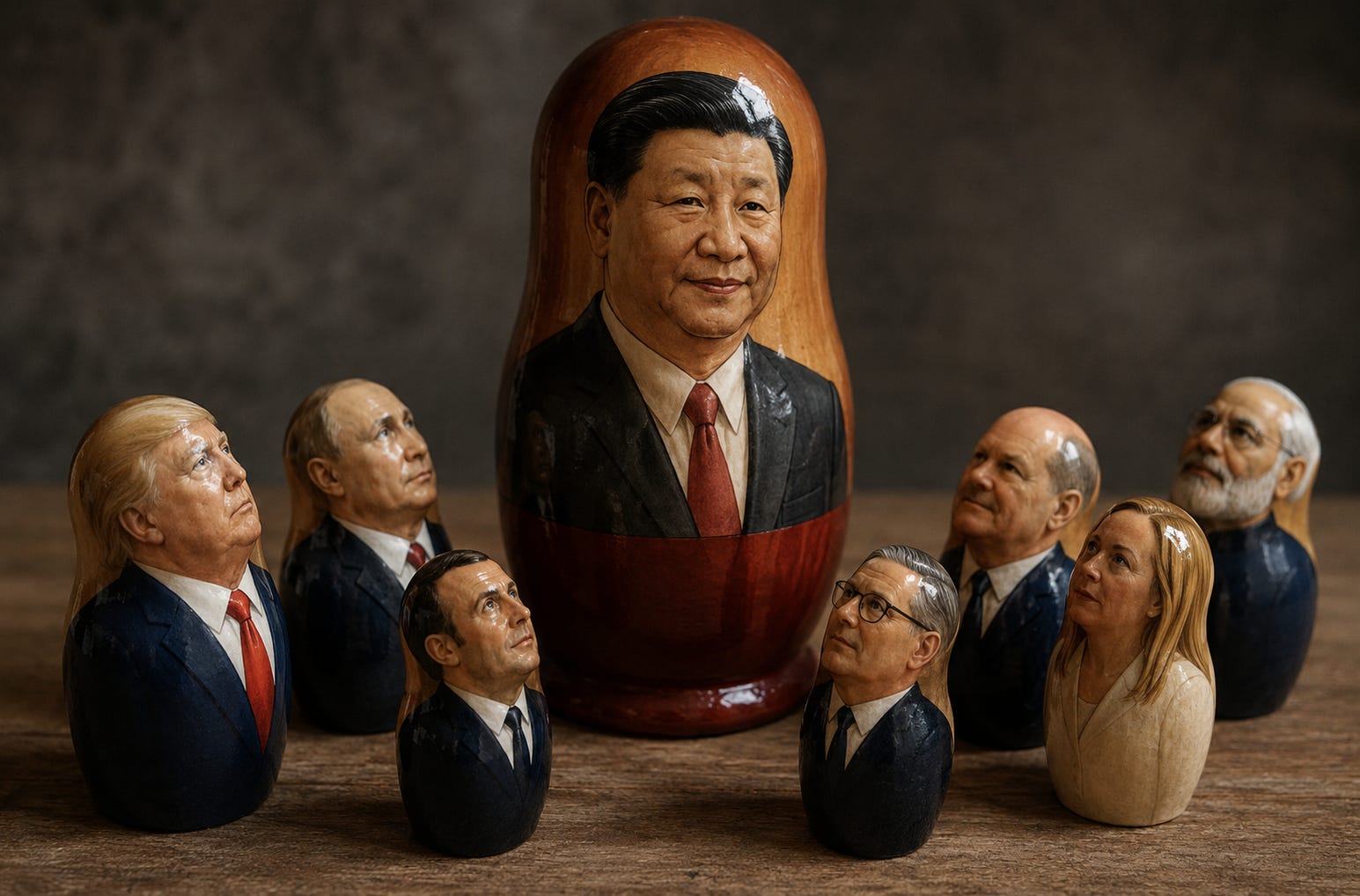
China continues to weather the storm better than many other nations, their previous buildup of strategic reserves looks more and more prescient and world leaders continue to beat a path to their door.

The most important development this week was not a dramatic military escalation in the Middle East, but the gradual normalisation of disruption itself.
Shipping through the Strait of Hormuz remained heavily constrained as negotiations between Washington and Tehran continued without resolution. Some tanker traffic resumed under Iranian oversight, but volumes stayed well below pre-war levels. At the same time, Iran explored new permit and fee systems for vessels crossing the waterway, reinforcing the sense that the crisis is evolving from an acute shock into a more chronic strategic pressure point.

This appears to be a meaningful change. Earlier phases of the conflict were dominated by fears of sudden escalation and immediate supply collapse. This week, attention shifted towards endurance: how long energy inventories can hold, how governments adapt to prolonged disruption, and how economic policy changes once instability appears persistent rather than temporary.
The language used by officials increasingly reflected this transition. International Energy Agency chief Fatih Birol warned that commercial oil inventories were falling “very fast”, while G7 finance ministers repeatedly emphasised the need to reopen Hormuz. Yet markets no longer reacted with the same intensity seen during the first weeks of the war. Instead, governments began quietly adjusting policy around the assumption that disruption may continue.

The clearest evidence of this adjustment came in energy and sanctions policy.
Washington extended a sanctions waiver allowing purchases of Russian seaborne oil despite earlier resistance from within the Trump administration. Britain meanwhile introduced temporary carve-outs permitting imports of Russian-origin jet fuel and diesel refined in third countries. Neither government framed the decisions as strategic reversals. Both presented them as limited responses to exceptional market conditions.
But taken together, the moves illustrated something broader: energy security is increasingly forcing governments into positions that would previously have carried far greater political cost.

The same pattern appeared in Europe’s growing focus on fertiliser security. Brussels began examining stockpiles, emergency procurement systems and ways to expand domestic production as officials warned that disruption to Gulf shipping threatened agricultural supply chains as much as fuel markets. G7 finance ministers similarly struggled to maintain unity over sanctions, trade imbalances and energy coordination as volatility spread through multiple sectors simultaneously.
What emerged this week was not panic, but accommodation. Governments increasingly appeared willing to soften previously rigid positions in order to stabilise supply, contain inflation and reduce exposure to prolonged disruption.

The pressure created by the Hormuz disruption is also beginning to reshape geopolitical relationships beyond the Middle East itself.
Vladimir Putin’s visit to Beijing, hot on the heels of Donald Trump and his entourage the previous week, highlighted Russia’s growing dependence on China as sanctions, war losses and economic strain continue to weaken Moscow’s position. Russian officials openly promoted their country as a more reliable long-term energy supplier to China amid instability in the Gulf, hoping prolonged disruption could revive stalled pipeline projects and deepen Chinese reliance on Russian exports.
At the same time, reports that Chinese facilities covertly trained Russian military personnel later deployed in Ukraine reinforced the sense that practical cooperation between the two countries continues to deepen despite Beijing’s public emphasis on neutrality.

The United States meanwhile sent mixed signals about its own strategic commitments. Washington signalled it could reduce the military capabilities available to NATO during future crises while virtually simultaneously announcing additional troops for Poland. The administration also paused a major Taiwan arms sale in order to conserve munitions linked to the Iran conflict, even as officials argued for an expanded American footprint in Greenland.
Individually, none of these decisions represented a decisive strategic shift. Collectively, they suggested governments are increasingly prioritising resources, supply resilience and strategic flexibility in a world where multiple theatres of pressure now overlap.

Away from the central energy story, several other developments this week illustrated how difficult it has become for governments and institutions to contain secondary risks.
Lebanon’s ceasefire remained fragile despite repeated extensions and continuing Israeli strikes. Baltic governments faced renewed concern over drone incursions and electronic interference linked to the war in Ukraine. In Gaza, diplomats warned that temporary fragmentation risks becoming structurally permanent as negotiations over governance and reconstruction stalled.
Meanwhile the Ebola outbreak in Congo and Uganda exposed the difficulty of managing public health emergencies in regions already weakened by conflict, displacement and fragile infrastructure. The World Health Organization warned that the absence of a vaccine for the Bundibugyo strain could complicate containment efforts for months.
None of these crises alone dominated the international agenda this week. But together they reinforced a broader impression of institutions operating under sustained pressure while struggling to restore stable equilibrium.

The defining characteristic of the week was therefore not escalation, but adjustment.

Governments increasingly behaved as though disruption around the Strait of Hormuz may need to be managed over time rather than quickly resolved. That shift is beginning to influence sanctions policy, alliance management, industrial planning and diplomatic positioning well beyond the Gulf itself.
The international system has not entered a new phase suddenly or dramatically. But the longer the disruption persists, the more policies initially presented as temporary responses risk becoming embedded features of a more constrained and fragmented environment.
Thank you