


The historic Shenzhen trilateral summit seemed to overshadow APEC yet produced few concrete results, while conflicts continued, economic vulnerabilities became more apparent and international institutions faced renewed challenges.
The first meeting between Donald Trump, Xi Jinping and Vladimir Putin was the diplomatic centrepiece of the week. Bringing together the leaders of three of the world’s most powerful countries was significant in itself but the Shenzhen summit produced little substantive progress on the conflicts dominating international affairs.
The contrast with events elsewhere was striking. Fighting intensified in Ukraine and across the Middle East, even as diplomatic efforts continued. The economic consequences of prolonged instability became more apparent, while developments in artificial intelligence highlighted both its extraordinary commercial potential, continued investor appetite and its growing strategic vulnerabilities for the markets and the world economy as a whole.
Meanwhile, international institutions faced their own challenges, from the UN’s inability to agree on a new secretary-general to disagreements over international justice and accountability.
The week offered a reminder that diplomatic influence, economic power and the ability to achieve lasting agreements are not necessarily the same thing.

The Shenzhen summit brought together Trump, Xi and Putin for their first trilateral meeting. Their joint declaration called for UN reform, increased oil supplies, reduced nuclear risks and respect for the immunity of state officials.
Conspicuously absent were any substantive commitments on Ukraine and Iran, the two conflicts dominating international security and energy markets.
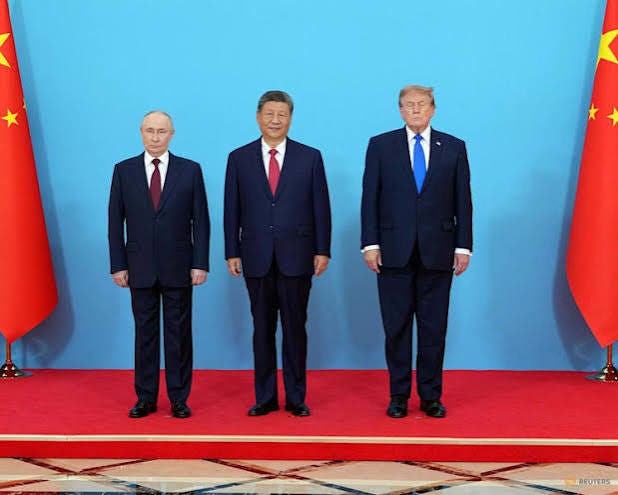
For Xi, hosting both APEC and the leaders’ summit reinforced China’s diplomatic standing. For Putin, participation at the top table demonstrated Russia’s continued position among the major powers. Trump secured an unprecedented meeting but with no apparent commitments to help end either war it feels like he came away virtually empty handed.
The concerns of countries outside the three way discussions were equally revealing. European leaders remained determined to participate in negotiations affecting their own security, while Japan’s strained relationship with Beijing and Southeast Asian doubts about American reliability remained unresolved.
The summit demonstrated a shared willingness to discuss international stability but little agreement on the conflicts and relationships that most directly affect it. The three powers could only agree on broad principles without committing themselves to actually resolving the disputes in which they are involved.

The diplomatic discussions surrounding Ukraine now extend well beyond the question of just territory. NATO membership, security guarantees, foreign military deployments and Europe’s future security arrangements all now seem to form part of the negotiations, with significant disagreements remaining over each.
American proposals reportedly included exchanging Ukrainian territorial concessions for NATO membership, while US envoy Jared Kushner suggested Russia might accept NATO-style security guarantees. European governments secured participation in renewed discussions and proposed further financial support for Kyiv.

Yet Putin rejected a ceasefire, reiterated opposition to foreign troops in Ukraine and offered European leaders talks in Moscow without committing to their formal participation in any peace negotiations.
Meanwhile, Ukrainian strikes damaged the Kerch Bridge, a key symbol for Russia and it’s attempts to legitimise the annexation of Crimea, and further disrupted Russian refining capacity, while Russian attacks on Ukrainian cities continued.
The wider the negotiations extend into Europe’s security arrangements, the harder it becomes to treat Ukraine as a settlement that Washington and Moscow can negotiate between themselves. Europe’s determination to participate reflects the direct consequences that any agreement would have for its own security.

Trump’s stated position to defer consideration of further major strikes against Iran until 2027 suggests a reduced American appetite for escalation. Events elsewhere point to a more complicated reality.
Iranian attacks on Bahrain and Kuwait, American strikes on Qeshm Island and continuing threats to shipping through Hormuz demonstrated that hostilities remain active and even escalating.
The Houthis’ advance along Yemen’s Red Sea coast and their attacks on Saudi infrastructure have added another dimension. With both Hormuz and Bab el-Mandeb affected by conflict, the disruption now clearly extends across two critical maritime routes.

The political costs in Washington are also becoming clearer. Pentagon expenditure has reached an estimated $48.3bn, while JD Vance’s criticism of the war’s electoral consequences has reportedly strained relations with Trump.
The distinction between postponing further military escalation and actually ending the conflict is increasingly important. Washington can delay decisions about additional strikes, but the blockade, regional attacks and economic disruption continue in the meantime. Congress again balked at restricting President Trump’s war with Iran but with Republican control of both houses about to end this adds a time factor into what he can and cannot do in the future.

Artificial intelligence remains an extraordinary source of economic growth. Nvidia’s quarterly revenue more than doubled to $115.8bn, while the IMF identified AI as a significant contributor to global economic expansion in 2026.
Yet the same developments demonstrating AI’s potential are also exposing it as a strategic vulnerability for the world.
Nvidia’s leadership crisis has raised questions about governance and financing arrangements at a company central to the industry. Washington’s Pax Silica initiative and restrictions on advanced chip access reflect the growing strategic importance of semiconductor supply chains, while China continues developing its own capabilities. Oversubscription to the jumbo sized Anthropic float shows investors’ continued appetite for the AI bandwagon.

Energy is becoming a constraint. The IEA expects datacentre electricity consumption to double by 2030, with associated emissions rising 70%. The scale and environmental consequences of expansion will depend heavily on national energy choices.
The IMF’s warning that global public debt is approaching 100% of GDP adds another consideration, as governments face higher borrowing costs alongside growing demands for infrastructure and investment.
AI’s economic potential is increasingly evident but so is its dependence on reliable energy, capital, secure supply chains and stable corporate leadership. The technology driving growth is also creating new strategic dependencies and risk in a fragile international environment.

Two developments this week illustrated contrasting approaches to international accountability.
The International Court of Justice ruled that Myanmar had committed genocide against the Rohingya, ordering reparations for atrocities committed in 2017. Yet the court has no direct enforcement mechanism.
Meanwhile, Trump, Xi and Putin endorsed respect for the immunity of state officials and criticised what they described as jurisdictional abuse by the International Criminal Court.

The two courts have different responsibilities. The ICJ rules on disputes between states, while the ICC prosecutes individuals. Nevertheless, the juxtaposition is significant: one international court issued a binding judgment on state responsibility, while three major powers emphasised limits on international criminal jurisdiction.
Elsewhere, the Security Council remained unable to agree on a successor to António Guterres, while negotiations over autonomous weapons and climate commitments encountered further disagreements.
International institutions continue to establish legal judgments, convene negotiations and propose common rules. Their effectiveness, however, remains closely dependent on the willingness of governments to accept and implement collective decisions.

The central feature of this week was the distinction between the concentration of international influence and the ability to achieve agreed outcomes.
The three leaders in Shenzhen could endorse broad principles but the wars in Ukraine and Iran continued on terms their declaration did little to address. AI’s economic opportunities were accompanied by growing dependencies on energy, finance and strategic supply chains. International institutions continued their work amid disagreements over authority and enforcement.
The deeper question is whether major powers are prepared to accept common obligations as well as exercise influence. Shenzhen demonstrated their willingness to meet and to discuss their shared importance. Their positions on international accountability and the continuing disagreements over major conflicts, suggest that accepting shared responsibility remains considerably more difficult.
📩 To follow these developments as they unfold, and receive ten concise global stories in your inbox each weekday, subscribe free to 10 Things Global News: 10things.news/subscribe