


Trump Struggles to Contain Israel Iran Escalation (Middle East)
Houthis Threaten Israeli Ships in Red Sea (Middle East)
EU Sanctions Iran Over Hormuz Traffic (Geopolitics)
France And Germany Scrap Joint Fighter Jet Plan (Europe)
China And North Korea Seek Closer Ties (Diplomacy)
NATO Shoots Down Drone Over Latvia (Europe)
Rare Earthquake Shakes Cuba, Mexico And Florida (North America)
US Adds Alibaba And BYD to Military List (USA)
Judge Blocks Trump Visa Fee (USA)
US Presses NATO on Huawei Removal (USA)
A succinct daily briefing delivered each weekday to help you stay on top of the stories shaping the world.

Israel and Iran signalled an end to attacks on Monday after trading long-range missile strikes that followed an Israeli strike on southern Beirut. Israeli Prime Minister Benjamin Netanyahu said the front was contained because Tehran had stopped attacking, while Iran’s armed forces said it had delivered a painful response and would halt its strikes.
President Donald Trump had urged restraint as he sought to protect talks with Tehran on extending the April ceasefire and formally ending the war. After first urging Netanyahu to stand down, Trump later pressed him to keep Israel’s response limited and then to end the attacks.
The exchange exposed a widening gap between Washington and Israel over Lebanon, Hezbollah and Iran. Israel wants freedom to keep using force, while Trump is trying to secure a deal that would reopen the Strait of Hormuz and ease pressure on oil markets and global consumers.
Sources: Washington Post, Wall Street Journal

The Houthis said they would stop Israeli ships operating in the Red Sea and treat enemy movements as military targets, threatening another pressure point in the Iran war. Yahya Saree, a Houthi military spokesman, said the partial naval blockade would take effect immediately and that the group had fired missiles at Israel.
The move came as Iran’s effective blockade of the Strait of Hormuz has already forced key Middle Eastern exporters to seek alternative routes. The Red Sea has become a key outlet for Saudi Arabia since the United States and Israel attacked Iran in late February.
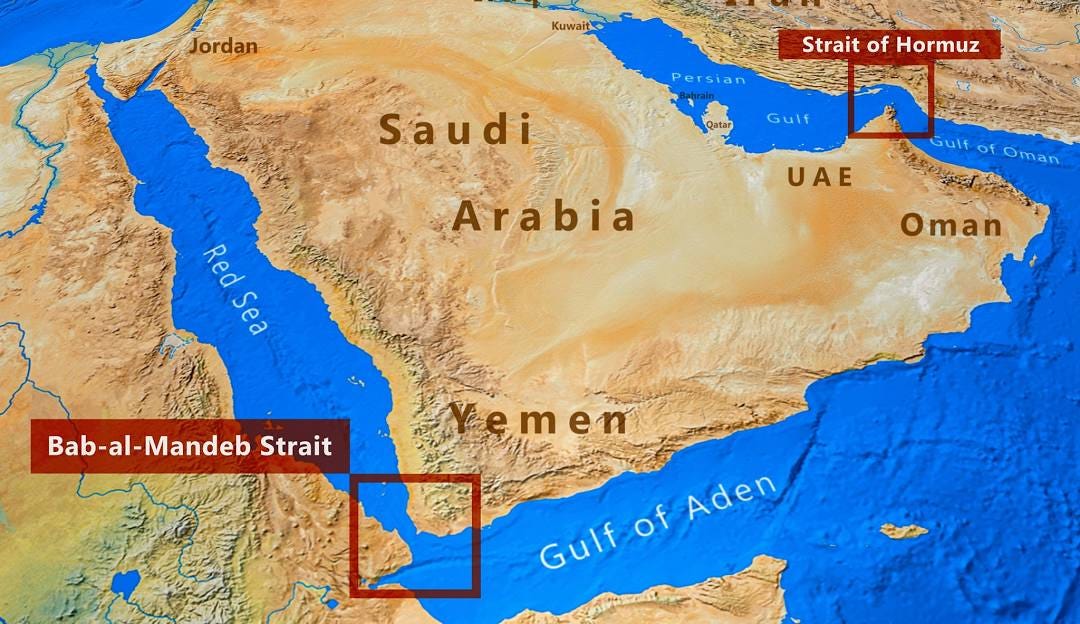
It was unclear what the Houthi threat would mean in practice, but cargo unable to pass Bab al-Mandab must sail around southern Africa. Analysts warned that even limited attacks could raise insurance costs, disrupt shipping and risk turning the waterway into a wider military confrontation.
Sources: Bloomberg, New York Times

The European Union imposed sanctions on two Iranian individuals and a unit of the Islamic Revolutionary Guard Corps Navy for threatening freedom of maritime traffic in the Strait of Hormuz, where around a fifth of the world’s oil flows. The move was the bloc’s first use of new powers to sanction Iran for restricting freedom of navigation.
The EU added the Hormozgan Provincial Command of the IRGC Navy to its sanctions list, alongside Mohammad Akbarzadeh and Hamid Hosseini. Kaja Kallas, the EU’s foreign policy chief, called Iran’s actions unacceptable and said the regime would be used again if necessary.
Iran’s Deputy Foreign Minister Kazem Gharibabadi dismissed the move as political and hypocritical. He said Iran would continue its strategy to maintain sovereignty over the strategic strait, which Tehran moved to close after US-Israeli strikes began on February 28.
Sources: Reuters, Eunews

France and Germany have agreed to abandon the fighter aircraft element of the Future Combat Air System after years of disputes between Dassault Aviation and Airbus over leadership, workshare and intellectual property rights.
The programme, launched in 2017 with Spain, was intended to replace existing combat aircraft and strengthen Europe’s defence capabilities as concerns grow over US security commitments and Russia’s war against Ukraine.
German Chancellor Friedrich Merz and French President Emmanuel Macron concluded that the companies could not be forced to cooperate. While the fighter jet project has been scrapped, Berlin and Paris will continue work on the Combat Cloud, a digital network linking aircraft, drones and weapons systems. The two countries will also meet in July to develop a roadmap focused on a smaller number of realistic defence projects. The collapse of one of Europe’s most ambitious defence ventures highlights the difficulty of turning higher military spending into coordinated industrial cooperation.
Sources: Wall Street Journal, Euronews

China’s President Xi Jinping and North Korean leader Kim Jong Un agreed in Pyongyang to expand cooperation in politics, the economy and culture, with both sides calling for closer strategic communication. It was Xi’s first visit in seven years to China’s only formal treaty ally.
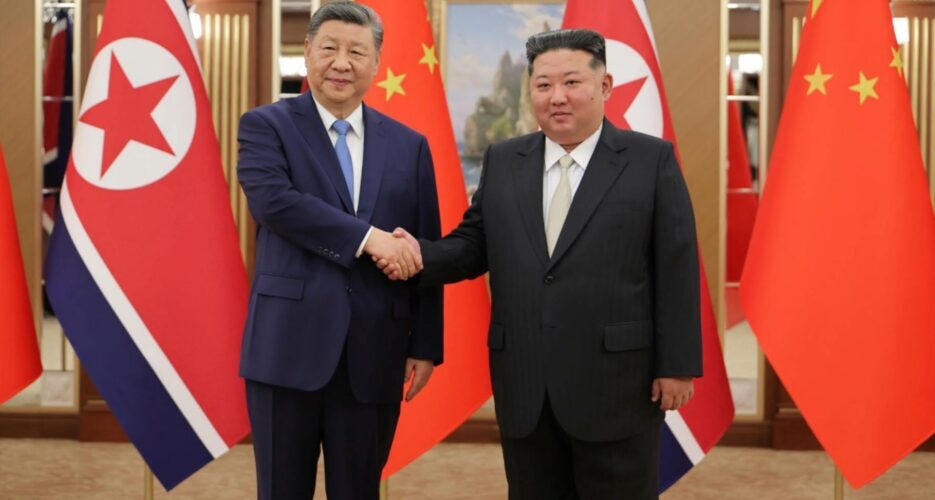
Kim said he fully supported the One China principle, while Xi pledged cooperation in trade, agriculture, science, tourism and health care. The visit came as analysts said Beijing was seeking to balance Russia’s growing influence over Pyongyang after Moscow signed a mutual defence pact with North Korea two years ago.
The summit underscored a shifting relationship between the neighbours. Chinese summaries stressed practical exchanges and regional peace, while North Korean messaging presented the partnership as one between equals, emphasising dignity, solidarity and resistance to US dominance.
Sources: Reuters, New York Times
Restacking this post will help it reach more readers interested in the world.

NATO fighters shot down a drone over Latvia on Monday after it entered the alliance member’s airspace from Russia as a result of Russian electronic warfare, according to the Latvian military. French aircraft destroyed the drone near Berzgale, about 30 kilometres from the Russian border. Latvian Defence Minister Raivis Melnis said no one was hurt and no property was damaged.
The incident came as fragments of a Ukrainian drone were found in Moldova after it entered from Ukraine, with officials there also blaming Moscow. Countries in the region have reported repeated drone incursions in recent months as Russia’s war on Ukraine spills into neighbouring states.
The French jet was part of NATO’s Baltic Air Policing mission, which has patrolled Latvia, Lithuania and Estonia since they joined the alliance in 2004. The latest interception adds to concerns over Europe’s eastern border and the widening effects of the war.
Sources: France 24, Al Jazeera

A magnitude 6.1 earthquake struck off Cuba’s northwest coast on Monday, shaking parts of Cuba, Mexico and Florida in an area not typically prone to quakes. The US Geological Survey measured the shallow quake at a depth of 26 kilometres, with its epicentre 104 kilometres west-northwest of Mantua, Cuba.
Authorities had not reported major damage, casualties or injuries, but concern rose in Cuba because decades of economic crisis have left buildings in severe disrepair and widespread blackouts made communications difficult. Emergency protocols were activated in Mexico’s Yucatan and Quintana Roo states.
William Barnhart, a geophysicist with the US Geological Survey, described the quake as extremely rare and the largest ever recorded in the Gulf of Mexico with modern instruments. No tsunami warning or watch was issued, and Barnhart said strong aftershocks might affect western Cuba but were unlikely to be felt in Florida.
Sources: South China Morning Post, Associated Press

The Pentagon has added Alibaba, BYD and Baidu to a list of Chinese military companies, preventing them from receiving US defence contracts. The list identifies companies the Pentagon considers linked to China’s military or contributing to its defence industrial base, including firms that appear to be civilian entities.
The updated list now includes 188 Chinese entities, up from roughly 130 last year. Inclusion does not immediately sanction a company or stop it doing business in the US, but it can cause reputational damage and lead to further restrictions.
The Chinese embassy accused Washington of overstretching national security and making discriminatory lists. Alibaba and Baidu said there was no basis for their inclusion, while lawmakers on the House Select Committee on the Chinese Communist Party called the list a warning to American businesses, government and the public.
Sources: Associated Press, BBC

US District Judge Leo Sorokin struck down President Donald Trump’s $100,000 fee on new H-1B visas, ruling that the administration lacked legal authority to impose what the court described as an unauthorised tax on employers. The fee had been announced in September 2025 and applied to certain new H-1B workers recruited from abroad.
Sorokin sided with 20 states that argued the policy exceeded executive authority, violated federal rulemaking law and would harm universities, hospitals, technology industries and public services that rely on highly skilled foreign workers. The programme covers speciality occupations requiring at least a bachelor’s degree.
The ruling contradicts an earlier federal court decision upholding the fee, creating a legal split. The administration said it expects the order to be reversed on appeal, while the decision for now removes a major obstacle for employers seeking foreign professionals.
Sources: NPR, Times of India

President Donald Trump’s administration has urged NATO allies to use defence-related spending to remove Huawei equipment from networks and critical infrastructure. US State Department China coordinator Joshua Young told officials in Brussels last month that the alliance’s spending benchmark could help fund replacement of Chinese components.
The proposal draws on NATO’s expanded spending framework, which includes 3.5 percent of gross domestic product for core defence needs and 1.5 percent for defence-related spending. A NATO official said the second category can be used to defend networks, including replacing vendors.

Germany and Spain are resisting European Commission plans for a bloc-wide ban on Chinese telecom suppliers. Officials in Berlin and Madrid want national control over vendor decisions and fear retaliation from Beijing. The dispute shows how cybersecurity, defence spending and China trade exposure are increasingly colliding inside the alliance.
Sources: Bloomberg, Eastern Herald
Restacking or sharing this publication means more people can read it. Commenting extends the conversation. Liking shows your appreciation.
On this day …
On this day in 1815, the Congress of Vienna formally concluded after months of negotiations among Europe’s major powers. Meeting in the aftermath of the Napoleonic Wars, diplomats sought to redraw borders, restore stability and prevent any single state from dominating the continent.
The settlement helped establish a balance-of-power system that, despite periodic crises, contributed to an unusually long period without a continent-wide European war. Many of the principles developed in Vienna influenced international diplomacy throughout the nineteenth century and helped shape modern ideas about collective security and multilateral negotiation.
Can durable international order be built through diplomacy alone, or does it ultimately depend on power as well?