


Houthi Airport Attacks Deepen Saudi Conflict (Conflict)
Hormuz Tanker Attacks Reach Wartime High (Middle East)
Israel Election Puts October 7 Accountability On Ballot (Middle East)
Russian Barrage Exposes Ukraine’s Air Defence Gap (Conflict)
Ukraine Counteroffensive Checks Russia In Donbas (Conflict)
France Halts Stun Grenades As Student Unrest Grows (France)
Nepal Flood Law Leaves Families In Limbo (Asia)
Space Weapons Spread As Deterrence Remains Unclear (Space)
Death Of Evicted Woman Deepens Spain Housing Crisis (Europe)
World’s Largest Penguin Colony Loses Its Crown (Climate)
A succinct daily briefing delivered each weekday to help you stay on top of the stories shaping the world.

Houthi claimed attacks on airports in Riyadh and Abha have killed three civilians and injured 36 others, as fighting between Saudi-backed forces and the Iran-aligned group escalates in Yemen. Two female residents, a Moroccan and an Algerian, were killed at Abha, while a Sudanese national died at King Khalid International Airport.
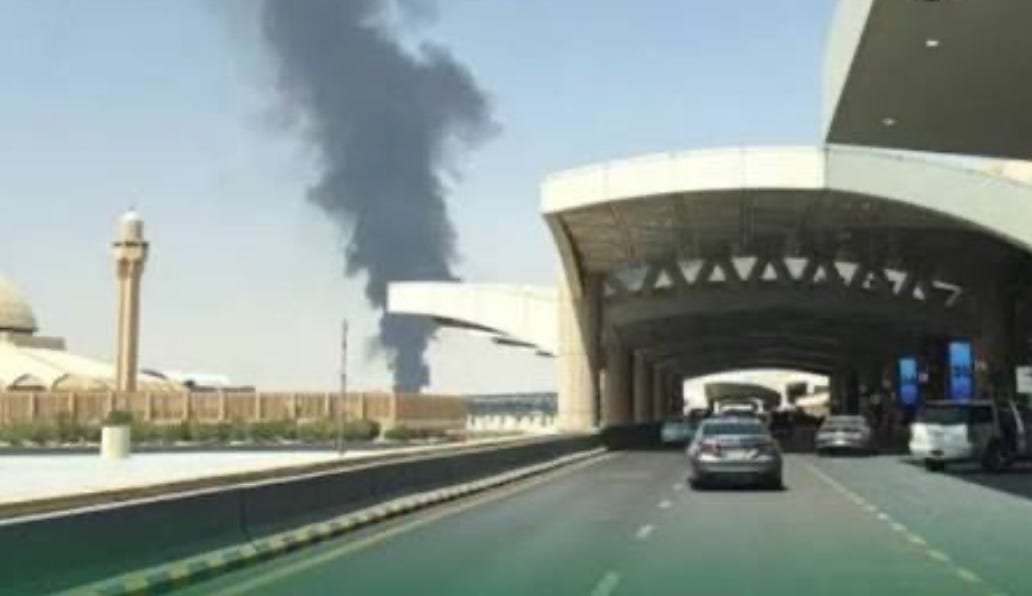
Saudi-led coalition spokesperson Major-General Turki al-Maliki said forces intercepted a ballistic missile north of Riyadh and destroyed a launch platform in Sanaa. New cage-like fences have been erected around Aramco fuel tanks and equipment near Riyadh airport after recent attacks on Saudi oil and military assets.
The escalation reaches beyond airport security. Houthi territorial gains around the Bab al-Mandeb Strait have supported a blockade of Saudi-linked shipping, while Saudi Arabia and allied Yemeni forces have launched a counter offensive to retake territory along Yemen’s western Red Sea coast. About 12 percent of global trade transits the strait.
Sources: Al Jazeera, Times of Israel

Attacks on tankers around the Strait of Hormuz reached their highest weekly level since the Iran war began, even as Middle East oil exports returned to around pre-war levels. Maritime security sources recorded at least 12 attacks on oil, LNG and LPG tankers between September 28 and October 5, while UN shipping agency data recorded nine incidents.
The increase comes as Gulf producers push exports higher. Gulf oil exporters exceeded pre-war levels for about half of September, while Kpler data showed the seven-day moving average of Middle East crude exports reached 18.3 million barrels per day on September 30, compared with about 18 million before the war.
The security risk may also be widening geographically. A tanker off Qatar’s north coast was struck by multiple projectiles on Wednesday, with casualties reported, in an attack described as unusual because vessels have more commonly been targeted in the Strait of Hormuz.
Sources: Reuters, Al Jazeera

Israel’s October 27 election is shaping up as a reckoning over Prime Minister Benjamin Netanyahu’s leadership three years after the Hamas-led October 7 attacks killed about 1,200 people and took 251 hostages. Some survivors and families are demanding accountability for the security failures, while others credit Netanyahu’s wartime leadership.
Netanyahu has blamed security chiefs for the failures, refused to accept personal responsibility and has blocked an independent commission of inquiry. His electoral challengers Gadi Eisenkot and Naftali Bennett have promised to establish an inquiry on their first day in office.
The political outcome remains uncertain. Most polls show Eisenkot’s party leading Likud, but neither bloc appears likely to secure the 61 seats required for a Knesset majority. Netanyahu argues his leadership delivered an effective battlefield response across Gaza, Syria, Lebanon and Iran, while critics say the failure to investigate October 7 remains unresolved three years later.
Sources: Washington Post, Axios

Russian missile and drone attacks across Kyiv and a dozen other Ukrainian regions killed at least 25 civilians, including five children, and wounded around 100 overnight, despite Ukrainian intelligence warning a day earlier that Moscow was preparing a massive strike.
Nineteen people, including the five children, were killed when a missile struck an apartment building in Pryluky. Ukrainian President Volodymyr Zelenskyy said three of the children were one year old and another was eight. Russia said its overnight attack targeted facilities involved in producing and storing missiles and drones.
The assault exposed continuing weaknesses in Ukraine’s air defences. Ukraine cannot stop Russian ballistic weapons without ammunition for US-made Patriot systems, while Patriot missiles are in short supply because of the Iran war. Kyiv is also racing to develop interceptors capable of catching Russia’s newer jet-powered drones as the two countries continue their long-range aerial war.
Sources: Associated Press, BBC

Ukraine’s monthslong Operation Vivaldi counteroffensive in the northern Donbas has reclaimed territory and disrupted Russian efforts to encircle the remaining Ukrainian-held cities, challenging President Vladimir Putin’s repeated claim that the region’s fall is inevitable.
Russia continues intense assaults in the southern Donbas, but Ukrainian forces have reorganised their defences and prevented further advances towards encircling major cities. More broadly, Russian territorial gains across Ukraine have slowed sharply in 2026. September was Russia’s worst month for net territorial gains since June 2023, according to Finland-based Black Bird Group.
Western battlefield trackers differ on precise figures but broadly agree Russia has gained only slightly more territory than it has lost this year. Ukraine’s progress remains limited: months of preparation were required to reclaim a small fraction of occupied territory, while Russia continues sending hundreds of troops into daily assaults in one of the front’s most contested sectors.
Sources: New York Times, Kyiv Post
Please Restack this post so it reaches more people

France has suspended the use of stun grenades during nationwide student protests after a 15-year-old boy lost his hand during a clash with police in Lens. Interior Minister Laurent Nuñez said there was a strong possibility a grenade caused the injury and ordered the suspension while the incident is investigated.
The protests, now in their third week, continued on Wednesday with more than 500 schools fully or partially closed. Students are demanding better learning conditions, including more teachers and improved buildings, while rights groups, unions and opposition politicians have accused police of disproportionate force.
Prime Minister Sébastien Lecornu said the government would review student demands and present proposals at the end of October. The dispute is unfolding six months before an election to replace President Emmanuel Macron, with 72% of French people considering the students’ demands legitimate but 55% saying the protests should stop.
Sources: Reuters, BBC

More than 5,000 people remain missing after Nepal ended non-essential search and rescue operations after the August 26 floods, leaving many families unable to obtain death certificates or compensation. Nepalese law generally presumes a missing person dead only after 12 years, while existing exceptions do not cover disasters like the flood.
Families need death certificates to access funeral and bereavement payments, transfer property and inheritance. More than 1,400 bodies have been recovered but identification is slow, with Nepal having little experience processing DNA at scale.
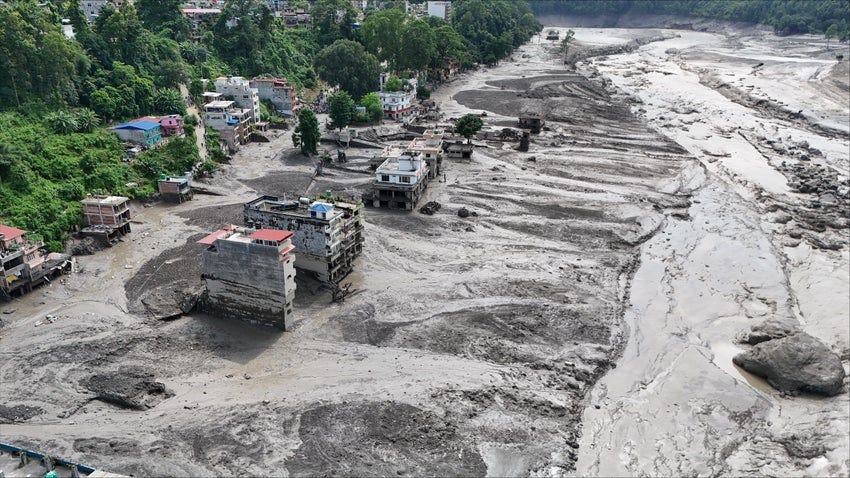
The government says it is seeking a solution and is prepared to amend the law if required. The legal problem comes alongside a reconstruction bill estimated at up to USD 4.8 billion with 7,570 private buildings were damaged or destroyed. Prime Minister Balen Shah has said rebuilding will require more than 10% of Nepal’s gross domestic product and is seeking grant-based international support rather than new loans.
Sources: Times of India, BBC

The United States has confirmed it has deployed weapons in space, joining a wider field of nations developing counterspace capabilities. Systems under development across 13 countries include satellites able to approach or disable spacecraft, anti-satellite missiles, electronic jamming, lasers, high-power microwaves and cyber operations. Russia and China have also demonstrated satellite manoeuvres with potential military applications.
But disclosure does not necessarily create deterrence. Air Force Secretary Troy Meink revealed that the US has fielded on-orbit space control weapons without specifying their type, effects or what actions might trigger their use. Analysis of the disclosure argues that deterrence requires adversaries to understand, in general terms, both what crosses a line and that retaliation will follow.
The challenge is compounded by the legal framework. The 1967 Outer Space Treaty prohibits weapons of mass destruction in orbit but not conventional weapons, while dual-use technologies make agreement on broader restrictions difficult.
Sources: PBS, CSIS

The death of María del Carmen Abascal, an 87-year-old woman whose eviction from her Madrid home triggered nationwide protests, has intensified Spain’s housing crisis weeks before an early election. Abascal had lived in the apartment for more than 70 years before police and social workers removed her by stretcher on September 23.
Thousands marched towards parliament after her death, while trade unions announced a nationwide general strike over housing for November 11. Prime Minister Pedro Sánchez called an early election for November 29 after parliament rejected emergency measures aimed at curbing evictions and rent pressures.
Housing costs have become a broader source of anger. Average rents have almost doubled over the past decade, while the government says 26% of Spanish renters spend an average 40% of their income on rent and utilities. Abascal had become a symbol for renters struggling with affordability.
Sources: The Independent, NBC News

More than half a million chinstrap penguins have disappeared from Zavodovski Island since 2011, stripping the remote Antarctic outcrop of its title as the world’s largest penguin colony. Researchers found occupied chinstrap nests fell 63% between 2011 and 2025, an annual population decline of around 7%.

Scientists ruled out the island’s 2016 volcanic eruption, competition for nesting space and regional krill fisheries as causes. They concluded the most plausible explanation is human-driven climate change heating the ocean and disrupting krill, the penguins’ key food source. As warming pushes krill south, chinstraps cannot follow because the water becomes too icy for them.
The decline contrasts with Zavodovski’s macaroni penguins, whose population increased before stabilising. Researchers say chinstraps’ limited range, specialised diet and rapid declines elsewhere in Antarctica could eventually push the species from least concern into the endangered category.
Sources: CNN, The Guardian
Restacking or sharing this publication means more people can read it. Commenting extends the conversation. Liking shows your appreciation.
On this day …
On 8 October 1912, Montenegro declared war on the Ottoman Empire, beginning the First Balkan War. Serbia, Bulgaria and Greece soon joined the conflict as the Balkan League sought to seize remaining Ottoman territories in Europe. Within months, Ottoman forces had suffered major defeats and lost most of their European possessions.
Victory did not bring stability. Disputes among the Balkan states over the division of conquered territory soon produced another war, while Serbia’s growing strength intensified its confrontation with Austria-Hungary. Less than two years later, the assassination of Archduke Franz Ferdinand in Sarajevo would trigger the First World War.
The Balkan Wars showed how the collapse of one regional order can create dangerous competition over what replaces it.