


Hormuz Clashes Test Fragile US-Iran Ceasefire (Conflict)
Saudis Block Trump’s Hormuz Escort Plan (Middle East)
UN Draft On Hormuz Faces China-Russia Veto Risk (Geopolitics)
China Sees US Strain Before Trump-Xi Summit (Geopolitics)
US Intel Says Iran Can Outlast Hormuz Blockade (US)
India’s Military Turns To Green Energy Amid Oil Shock (Energy)
Court Rules Against Trump’s New Global Tariffs (Trade)
Trump Sets July Deadline For EU Trade Deal (Trade)
WHO Says Cruise Virus Is Not The Start of A Pandemic (Health)
US Sanctions Cuba As UN Warns Of Fuel Crisis (Geopolitics)
A succinct daily briefing delivered each weekday to help you stay on top of the stories shaping the world.

US and Iranian forces exchanged attacks around the Strait of Hormuz on Thursday in the most serious test yet of the month-old ceasefire between the two countries. Iran accused the US of targeting ships and carrying out strikes on coastal areas including Qeshm Island, Bandar Khamir and Sirik, while Washington said it acted in response to Iranian attacks involving missiles, drones and small boats against US Navy destroyers.

Donald Trump insisted the ceasefire remained in place and said negotiations with Tehran were continuing despite the flare-up. Both sides claimed military success and warned they would respond to further aggression, while Iran later said conditions around the strait had returned to normal.
The renewed tensions come as Tehran considers a US proposal aimed at ending the conflict while leaving major disputes, including Iran’s nuclear programme, unresolved.
Sources: BBC, South China Morning Post

A reported Saudi refusal to allow US aircraft to use its bases and airspace helped push Donald Trump to shelve Project Freedom, a planned operation to escort oil tankers through the Strait of Hormuz. A Saudi source close to the government denied the report, saying the US still had regular access to Saudi bases and airspace.
The dispute exposed concern in Riyadh that the mission lacked clear terms of engagement and could trigger a naval confrontation with Iran, effectively ending the partial ceasefire in force since 7 April. Saudi Arabia wants a permanent end to the conflict on almost any terms, while the United Arab Emirates has taken a more assertive line after being hit by Iranian attacks.
Trump said the operation was paused because progress had been made towards a deal, but the reversal reduced his options for breaking the blockade.
Sources: Times of Israel, The Guardian

The US urged countries to back a UN resolution demanding that Iran halt attacks and mining in the Strait of Hormuz, but diplomats said China and Russia were likely to veto the draft. The text, written by the US and Bahrain with Gulf support, calls on Iran to stop attacks, disclose mine locations and avoid impeding clearance operations.
US Ambassador to the UN Mike Waltz said states opposing the measure would set a dangerous precedent, while Permanent Representative of Iran to the UN Amir Saeid Iravani called it deeply flawed, one-sided and politically motivated. Diplomats said Russia wanted the draft withdrawn or rewritten, while China objected to bias and its use of Chapter VII powers.
The draft also condemns alleged ceasefire violations. The dispute comes as Washington and Tehran edge towards a temporary agreement to stop the fighting while leaving major issues unresolved, including the Strait, Iran’s nuclear programme and sanctions.
Sources: Reuters, Anadolu Agency
Chinese analysts say the Iran war has depleted American firepower and weakened Washington’s ability to deter China in a conflict over Taiwan, threatening Donald Trump’s leverage before next week’s summit with Xi Jinping. Internal estimates and congressional officials say the US has used around half its long-range stealth cruise missiles and about 10 times its annual Tomahawk purchases since the war began in late February.
Beijing wants to stabilise ties, extend the trade truce and reduce US support for Taiwan. Chinese commentary has presented the war as exposing limits in US military supply chains, while American officials reject claims that Middle East operations have weakened deterrence in Asia.
The war may also help China argue to US allies that Washington is a less reliable security guarantor, while Gulf states reassess their reliance on US protection.
Sources: New York Times, Chatham House

A confidential intelligence assessment says Iran can survive the US naval blockade for at least three to four months before facing more severe economic hardship, challenging Donald Trump’s public optimism about ending the war. The analysis also says Tehran retains significant ballistic missile capabilities after weeks of US and Israeli bombardment.
Iran is said to retain about 75 percent of its prewar mobile launchers and about 70 percent of its prewar missile stockpiles. Officials said Tehran has reopened underground storage facilities, repaired some damaged missiles and assembled some new missiles. It is also storing oil on tankers, reducing flows in oil fields and may seek overland routes through Central Asia.
US officials still say the blockade is inflicting major damage, but the assessment suggests Iran may have more time, weapons and economic resilience than public messaging implies.
Sources: Washington Post, Jerusalem Post
Restacking this post will help it reach more readers interested in the world.

India’s military is exploring alternative energy sources after supply disruption from the Iran war drove up oil and gas prices, exposing vulnerabilities for Asian countries dependent on imported fuel. Local reports say the army plans to acquire biogas stoves, explore green fuels for vehicles and administrative work, and use solar and wind power for military installations.
The shift is intended to reduce reliance on conventional fuels without replacing them in combat operations. Analysts said clean energy can support bases, cookhouses, surveillance systems and remote posts, but remains supplementary because costs, technology limits and intermittent supply restrict its use for heavy military platforms.
The pressure extends beyond India. The Middle East accounts for 60 percent of Asean’s oil imports, while analysts warned that even a peace deal would take weeks to restore meaningful Strait of Hormuz shipping volumes and rebuild insurance confidence.
Sources: South China Morning Post, MSN News

A federal trade court ruled against Donald Trump’s newest 10 percent global tariff, finding that the temporary duty was not justified under the 1970s law cited by the administration. A split three-judge panel ruled 2-1 that Trump had exceeded the tariff powers Congress allowed under the law, calling the levies invalid and unauthorised.

The decision applies directly to the state of Washington and two businesses that sued, with defendants ordered to implement the ruling within five days and refunds due to the importers involved. The administration is expected to appeal first to the Federal Circuit and potentially to the Supreme Court.
The ruling adds another legal setback to Trump’s tariff strategy after the Supreme Court struck down broader global tariffs in February. Separate investigations into forced labour and overcapacity could still lead to fresh tariffs.
Sources: Associated Press, Le Monde

Donald Trump has given the European Union until 4 July to ratify its trade deal with the US or face much higher tariffs. After speaking with Ursula von der Leyen, Trump said the deadline would fall on the country’s 250th birthday, while von der Leyen said the bloc had made good progress and remained committed to implementation.
The deal, struck last July, would set tariffs on most European goods at 15 percent and also requires endorsement by the 27 EU member states. Progress stalled after talks between EU lawmakers and governments ended without agreement, although negotiators are due to meet again on 19 May.
The threat comes as Trump’s broader tariff strategy faces legal pressure, after a US trade court ruled his latest 10 percent global tariffs were not justified under US trade law.
Sources: The Guardian, BBC

The World Health Organization said a hantavirus outbreak on the MV Hondius cruise ship was not the start of a pandemic, as authorities traced passengers who had disembarked before the virus was detected. WHO spokesperson Maria Van Kerkhove said the situation was not Covid because hantavirus spreads through close, intimate contact.
Five of eight suspected cases have been confirmed, and three people have died, including a Dutch woman who had the virus. The wider public health risk remains low, though WHO Director General Tedros Adhanom Ghebreyesus said more cases may appear because the incubation period can last up to six weeks.
The ship is expected to reach Tenerife on 10 May after leaving Cape Verde. Passengers are isolating in cabins, while countries including Britain, Ireland, Singapore, the US and Argentina are tracing, testing or preparing care for people linked to the voyage.
Sources: RTE, BBC

The United States has imposed new sanctions on Cuba as UN experts warned that Washington’s fuel pressure campaign amounted to “energy starvation”. The measures target GAESA, a military-controlled conglomerate with ties to nearly all parts of Cuba’s economy, along with Ania Guillermina Lastres Morera and Moa Nickel SA.
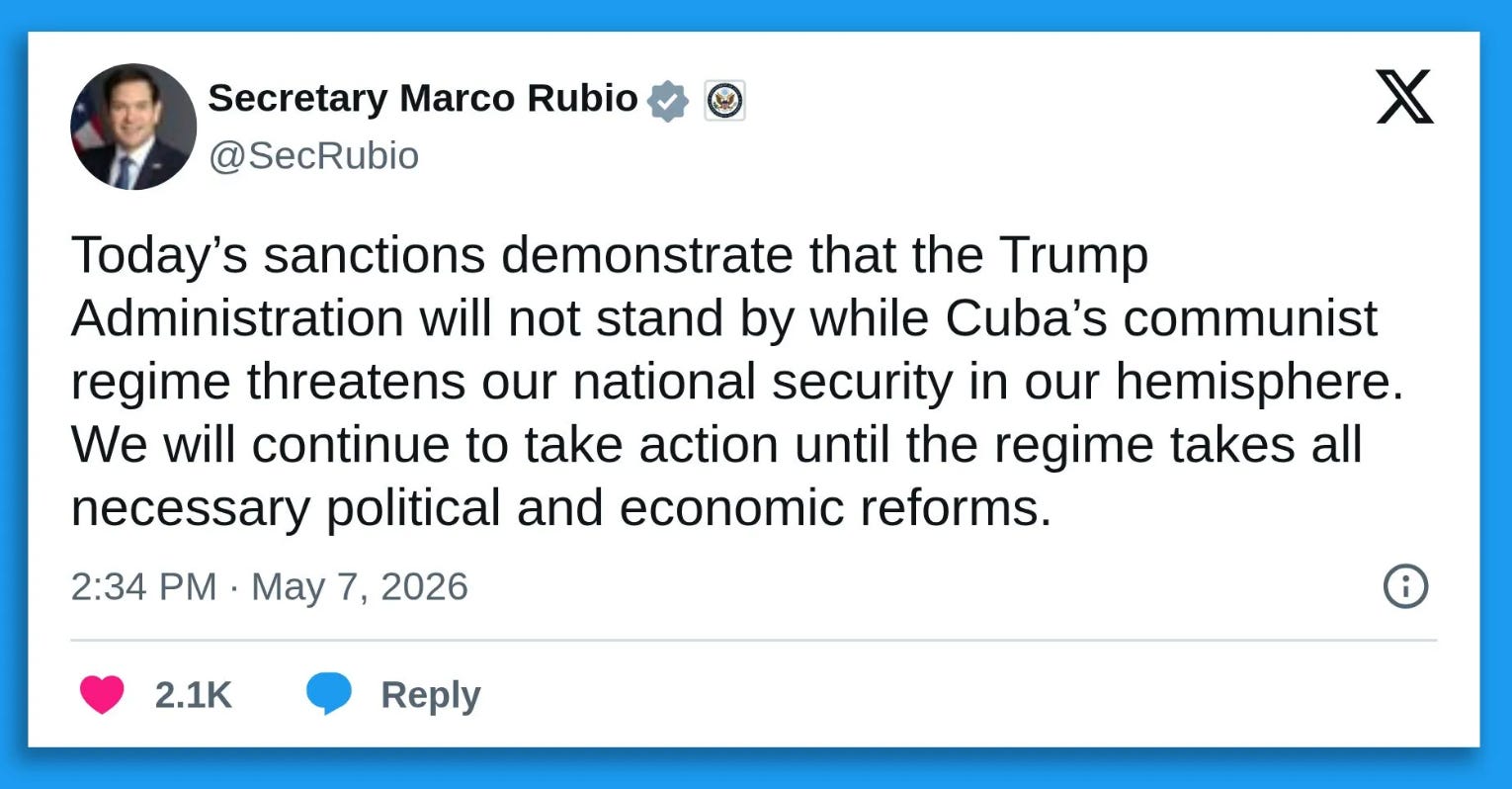
US Secretary of State Marco Rubio said the sanctions showed the Trump administration would not stand by while Cuba’s communist regime threatened US national security, and said more action would continue until political and economic reforms were taken. Cuba did not immediately respond to the latest measures, but earlier condemned similar sanctions as unilateral coercive measures and collective punishment.
The pressure follows Washington’s effort to halt Venezuelan oil deliveries to Cuba and an executive order creating a path to sanction countries delivering fuel to the island. UN experts said fuel shortages were disrupting essential services and human rights.
Sources: Al Jazeera, Axios
Restacking or sharing this publication means more people can read it. Commenting extends the conversation. Liking shows your appreciation.
On this day ….
On this day in 1945 Allied governments marked Victory in Europe Day following the unconditional surrender of Germany and the end of major combat operations across Europe in the World War II.
The conclusion of the war on the continent reshaped borders, accelerated the collapse of remaining fascist regimes, and set the stage for the political division of Europe during the Cold War.
It also marked the beginning of reconstruction efforts that later contributed to the creation of new European institutions and alliances.
Did VE Day represent the end of one conflict, or the beginning of the geopolitical order that shaped Europe for the next half century?
Rubio will be president of Cuba - Trump said