


Iran-Israel Fire Threatens Fragile Ceasefire (Conflict)
War Fatigue Deepens Across Divided Iran (Middle East)
Philippines Quake Triggers Regional Alerts (Asia)
Peru Faces Weeks Of Election Uncertainty (Politics)
Hegseth D-Day Speech Draws Normandy Backlash (Europe)
US Ocean Monitoring Cuts Alarm Scientists (Environment)
Xi Visit Tests China North Korea Ties (Asia)
Europe Sets Terms For Ukraine Talks (Geopolitics)
Drone Strike Hits Chornobyl Fuel Site (Conflict)
Pashinyan Claims Mandate In Armenia Vote (Politics)
A succinct daily briefing delivered each weekday to help you stay on top of the stories shaping the world.

Iran and Israel exchanged fire for the first time since an April ceasefire, raising the risk that months of contained hostilities could return to open conflict. Israel said it struck military targets in western and central Iran after Tehran fired missiles towards Israel. Israeli officials said the incoming missiles were intercepted.
The confrontation followed Israeli strikes on suspected Hezbollah positions in Beirut’s southern suburbs, which Lebanon’s health ministry said killed two people and injured 20. President Donald Trump said he was “not happy” about the Beirut strikes and warned that Iran’s missile fire was “certainly not going to help negotiations” aimed at ending the war.
Talks remain focused on a wider peace deal, sanctions relief, frozen Iranian assets, highly enriched uranium and reopening the Strait of Hormuz. The latest exchange now puts those negotiations under renewed strain.
Sources: Washington Post, Wall Street Journal

Months of war, economic disruption and uncertain peace talks are deepening disillusionment across Iran, affecting both supporters and opponents of the government. Interviews conducted in several Iranian cities described growing despair, with many people focused less on political change and more on day-to-day survival amid inflation, shortages and damaged infrastructure.
The conflict has coincided with the effective closure of the Strait of Hormuz, rising prices and disruptions to industry. A factory manager said production had been shut down because of a lack of raw materials, while a doctor described medicine shortages and rationing. Iran’s official statistics centre reported sharp annual increases in the prices of cooking oil, eggs, rice and milk.
Many Iranians interviewed said they increasingly view negotiations as the best route to stability. Yet talks remain stalled over issues including Iran’s nuclear programme, frozen funds and control of the Strait of Hormuz.
Sources: New York Times, Times of Israel

A 7.8-magnitude earthquake struck off Mindanao in the southern Philippines on Monday, collapsing buildings and triggering tsunami warnings across Asia. The quake hit shortly before 7:40am local time, followed by more than an hour of aftershocks, according to the Philippine seismology authority.
Footage showed a three-storey building housing a Jollibee restaurant collapsing in General Santos City, while other images showed smashed windows and caved-in roofs. The number of potential casualties had not been confirmed, though one agency warned there was a reasonable chance of some fatalities.
President Ferdinand Marcos said emergency agencies had been activated and urged people in affected provinces to move to higher ground. Authorities warned of possible tsunami waves up to 3 metres in the Philippines, with alerts also issued in Japan, Malaysia, Indonesia and other coastal areas.
Sources: Al Jazeera, New York Times

Peru’s presidential run-off remained too close to call late on Sunday, with preliminary results and a quick count pointing in different directions. An early official tally put Keiko Fujimori narrowly ahead of Roberto Sánchez, while a sample-based count projected Sánchez slightly in front, within the margin of error.
A binding result is not expected until next month, after electoral judges adjudicate the result and legal challenges are settled. Electoral officials said a final audited count would take about a month, raising the possibility of an extended period of political uncertainty.
The winner, due to be inaugurated on July 28, will become Peru’s ninth president in a decade. They will inherit a divided Congress, years of political volatility, a punishing crime wave and a major copper-producing economy where neither leading party holds an outright majority in both chambers.
Sources: FT, New York Times

US Defence Secretary Pete Hegseth used an 82nd anniversary speech at the American military cemetery in Colleville-sur-Mer to link D-Day remembrance with immigration, saying European beaches were being stormed by a different “invasion” of boats and men.
Historians, rights campaigners and some Normandy residents condemned the remarks, saying they misused the memory of Allied soldiers who died in France. The English historian Simon Schama called the comments a “special kind of loathsomeness”, while the human rights lawyer Daniel Seidemann described them as an obscene desecration of those who fell.
Hegseth did not attend the main international ceremony in Langrune-sur-Mer, where some residents said he was not welcome. The dispute turned a commemoration of the Allied landings into a wider argument over memory, migration and America’s relationship with Europe.
Sources: France 24, The Guardian
Restacking this post will help it reach more readers interested in the world.

US climate monitoring cuts are set to remove more than 900 deep-sea instruments from sites near the Atlantic and Pacific coasts and the Irminger Sea, alarming scientists on World Oceans Day. The devices are part of the Ocean Observatories Initiative, a federally funded system that began operating in 2016 and was expected to collect data for 25 years.
Researchers use the data to study how oceans absorb greenhouse gases, how marine heatwaves affect fisheries and how currents influence weather. The National Science Foundation said the programme was not being cancelled entirely, describing the move as a reduction aligned with changing scientific priorities.

Scientists warned the loss could weaken forecasts and risk detection. Research found that removing US observations alone would increase errors in annual ocean heating rates, while experts said deep-ocean observations are irreplaceable because satellites cannot see below the surface.
Sources: RFI, CNN

Chinese President Xi Jinping arrived in North Korea on Monday for a two-day visit and his first trip there in seven years, as Beijing seeks to revitalise ties with Pyongyang. North Korean leader Kim Jong-un and first lady Ri Sol Ju greeted Xi and his wife Peng Liyuan at the airport.
The visit comes before the 65th anniversary of China and North Korea’s friendship and mutual assistance treaty, China’s only defence agreement with another country. Relations have cooled since pandemic-era border closures disrupted trade and North Korea drew closer to Russia.
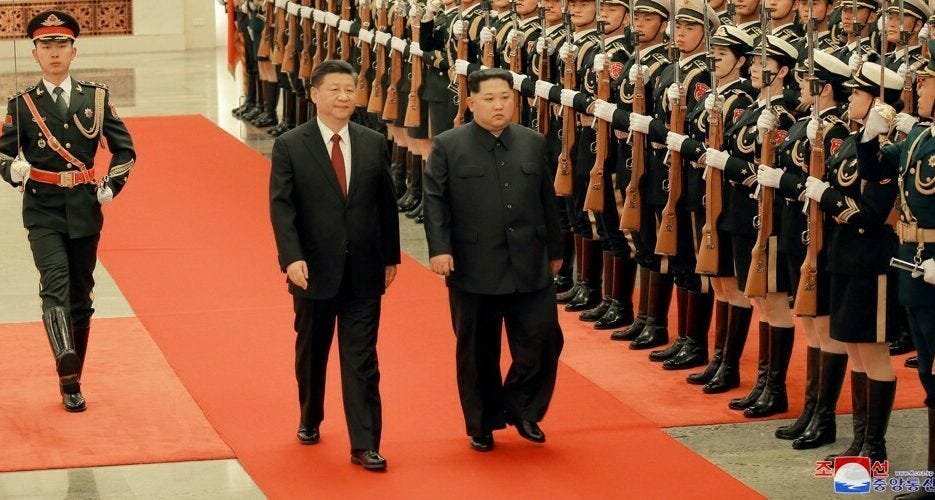
Kim has recently inspected a munitions company and a new nuclear material plant, while Pyongyang has pledged to expand its nuclear forces. The summit gives Xi a chance to reassert China’s role as North Korea’s key economic and diplomatic partner while managing instability on the Korean Peninsula.
Sources: CNN, The Guardian

European leaders backed Ukrainian President Volodymyr Zelenskiy’s proposal for direct talks with Russian President Vladimir Putin, saying any process should include active US and European participation. British Prime Minister Keir Starmer, German Chancellor Friedrich Merz and French President Emmanuel Macron met Zelenskiy in London after Kyiv had recently faced some of the biggest Russian air raids since the start of the 2022 war.
The leaders set out conditions for a “just and lasting peace”, starting with an immediate and complete ceasefire. They said the current line of contact should be the starting point for talks, Ukraine should receive legally binding security guarantees and Russian assets should remain immobilised until Moscow compensates Kyiv.
Putin rejected Zelenskiy’s offer as insincere and said he saw no point in meeting, while Europe sought a stronger role in any negotiations.
Sources: Reuters, BBC

A Russian Shahed drone substantially damaged a building used to store spent nuclear fuel near the disused Chornobyl nuclear power plant, in an attack Ukrainian President Volodymyr Zelenskyy called deliberate and “extremely vile”. The reception building was empty of containers at the time.
A fire covering about 40 square metres broke out after Sunday’s strike and was extinguished. No personnel were injured, and Ukraine’s state nuclear operator said radiation levels remained within normal limits. The International Atomic Energy Agency said the strike caused significant damage and that its experts were preparing to inspect the site.

The facility is located about 9 miles from the Chornobyl plant, scene of the world’s worst nuclear accident in 1986. The strike came amid intensified long-range aerial attacks, with Kyiv and Moscow also trading accusations over attacks near the Zaporizhzhia nuclear plant.
Sources: Al Jazeera, The Guardian

Armenian Prime Minister Nikol Pashinyan declared a “historic victory” in Monday’s parliamentary election count after early results showed his Civil Contract party leading. With just over one-fifth of polling sites counted, Civil Contract had about 54% of the vote, ahead of the pro-Russian Strong Armenia alliance.
The election was Armenia’s first general vote since its 2023 military defeat by Azerbaijan and was viewed as a test of Pashinyan’s push to deepen ties with the West and secure peace with Azerbaijan. Turnout was strong at nearly 59% of eligible voters.
A strong result would give Pashinyan a mandate to conclude negotiations with Azerbaijan and normalise relations with Turkey, a key ally of Azerbaijan. He said Armenia would continue rapprochement with the West while also developing relations with Russia.
Sources: Reuters, Euronews
Restacking or sharing this publication means more people can read it. Commenting extends the conversation. Liking shows your appreciation.
On this day …
On this day in 1949, George Orwell’s Nineteen Eighty-Four was published in the United Kingdom. Written in the aftermath of the Second World War and at the dawn of the Cold War, the novel imagined a society defined by surveillance, censorship and the manipulation of truth.
Terms such as “Big Brother” and “thoughtcrime” entered the political vocabulary and remain part of public debate more than seven decades later.
While Orwell was writing fiction, many of the questions he raised about information, technology and state power continue to shape discussions about privacy, artificial intelligence and government authority today.
How should societies balance security, technology and individual freedom in the digital age?