


Iran Uses Khamenei Funeral To Project Continuity (Middle East)
Sara Duterte Trial Opens Amid Marcos Feud (Asia)
Deadly Kyiv Strikes Ahead Of NATO Summit (Conflict)
NATO Summit Tests Alliance Under Trump Pressure (Geopolitics)
Australia And Fiji Sign New Pacific Defence Pact (Australasia)
OPEC+ Output Rise Meets Recovering Gulf Flows (Markets)
Patriot Front March Sparks Free Speech Test (US)
Venezuela Enters Recovery Phase After Quake (South America)
Houthi Escalation Hits Front Line And Red Sea (Conflict)
Review Ordered After Alleged Case of Cannibalism (Australia)
A succinct daily briefing delivered each weekday to help you stay on top of the stories shaping the world.

Throughout Tehran, Iran’s slain supreme leader Ayatollah Ali Khamenei’s funeral has become a carefully staged display of continuity at a time of transition and uncertainty. The ceremonies began with three days of mourning in Tehran before a procession through cities in both Iran and Iraq, while banners, portraits and organised demonstrations promoted a narrative of unity among supporters of the Islamic Republic. Iranian authorities have emphasised Khamenei’s “martyrdom” in official messaging and promoted grief for his death as a national duty.
The symbolism is also political. At the Grand Mosalla, where tens of thousands arrived dressed almost entirely in black, a giant red flag reading “O avengers of Hussein” linked Khamenei’s killing to Karbala and framed retaliation against the United States and Israel as a religious obligation.
The broader effort appears designed to project strength and continuity as Iran moves through a period of transition under Supreme Leader Mojtaba Khamenei.
Sources: New York Times, Al Jazeera

The Philippine Senate will open the impeachment trial of Vice President Sara Duterte on Monday in a politically volatile event set against her bitter feud with President Ferdinand Marcos Jr.
More than 6,000 police officers, including anti-riot squads, were deployed to secure the Senate, where pro- and anti-Duterte demonstrators were expected to converge. Duterte or her lawyers can appear at the start of the trial, which will run for 92 days.
If convicted of charges including alleged unexplained wealth and publicly threatening to have Marcos assassinated, Duterte may be permanently disqualified from holding public office. A conviction would be a lethal blow to her announced plan to seek the presidency in mid-2028.
Last month, the House of Representatives voted overwhelmingly to impeach her over alleged unexplained wealth, misuse of confidential state funds and a public threat to have the president, his wife and a former House speaker assassinated.
Sources: Associated Press, NBC News
Russia launched ballistic missiles and drones at Kyiv on Monday, killing at least seven people and wounding at least two dozen others, in its second major attack on the city in less than a week. Explosions rocked the capital early on the eve of a NATO summit in Ankara, Turkey, where the alliance’s response to the war in Ukraine is set to dominate the meeting.
President Volodymyr Zelensky of Ukraine, who is expected to attend the summit, had warned that Russia was preparing “a new massive strike” against the capital. Mayor Vitali Klitschko said emergency services were responding to multiple fires and at least one damaged apartment building where people were trapped. On Thursday, Russia pounded Kyiv in a nearly 12-hour assault that killed 31 people and wounded more than 100 others.
Sources: New York Times, The Guardian
NATO leaders meet in Ankara this week with Secretary-General Mark Rutte facing a harder problem than defence spending alone. President Donald Trump has shifted his demands from burden-sharing towards “loyalty”, saying he remained disappointed that some allies refused to join the Iran war and that he might have skipped the summit entirely were it not being hosted by Turkish President Recep Tayyip Erdogan.
That leaves the alliance trying to project unity while confronting deeper questions about capability, cohesion and American commitment. Last month, the Pentagon surprised allies by announcing it was scaling back the troops, warships, aircraft and drones it would provide if one of them came under attack, while Trump has sent conflicting messages about future U.S. troop levels in Europe.
Ankara is now shaping up as a test of whether NATO can manage a more transactional Washington while adapting to a more dangerous security environment.
Sources: PBS, Times of India
Australia and Fiji signed two treaties in Suva on Monday, including the Ocean of Peace Alliance, a mutual defence treaty that commits each country to come to the other’s aid. The deal elevates Fiji to one of Australia’s few treaty allies and deepens Canberra’s Pacific strategy as it seeks to reinforce its position as the region’s security partner of choice.
The agreement says Australia and Fiji will act to meet the common danger if either country is attacked and will consult over any security-related development that threatens sovereignty, peace or stability.
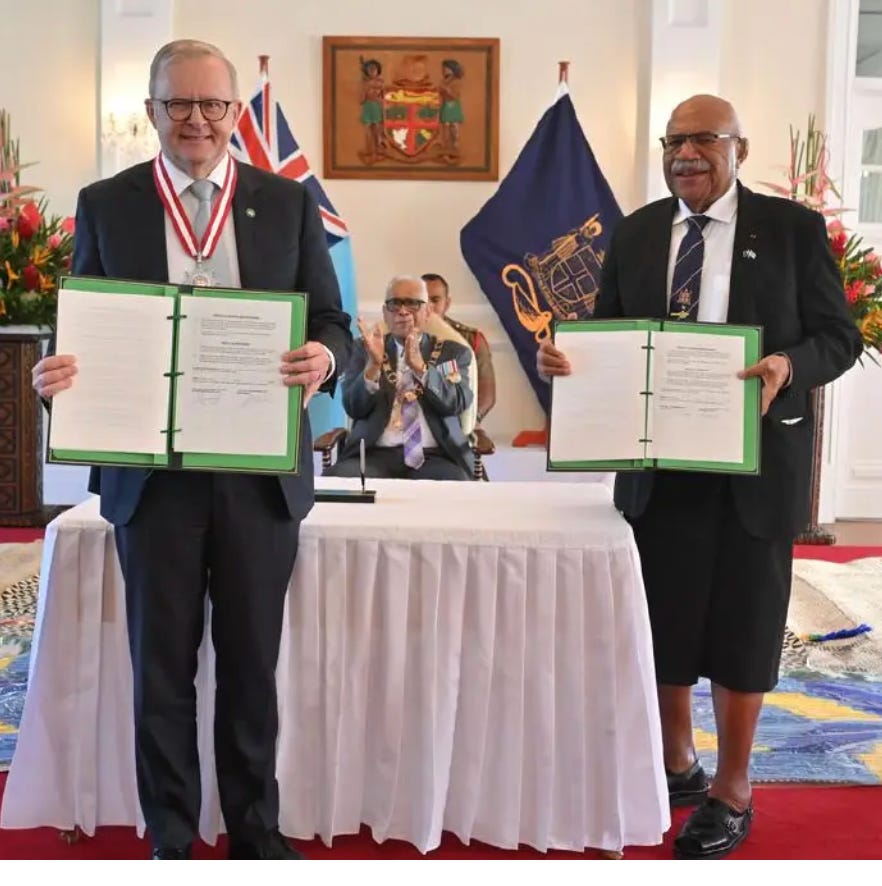
The broader package also includes the Vuvale Union, which Australian Prime Minister Anthony Albanese said would transform the relationship and underpin regional prosperity and security. The signing comes as Australia continues to respond to China’s growing influence across the Pacific after Beijing’s 2022 security pact with Solomon Islands.
Sources: South China Morning Post, The Guardian, Australian Foreign Minister
Restacking this post will help it reach more readers interested in the world.

Oil prices edged lower on Monday after OPEC+ agreed to raise output targets by 188,000 barrels a day from August, adding to expectations of more supply as Gulf exports recover. Brent crude fell 34 cents to $71.78 a barrel, while U.S. West Texas Intermediate crude was down 20 cents to $68.49.
The quota increase follows similar rises for June and July, but much of the added supply has so far remained theoretical because the war blocked the Strait of Hormuz and stopped Persian Gulf members from ramping up exports and output.
Since an interim peace pact between Tehran and Washington, Saudi Arabia and the UAE have restored oil exports to near pre-war levels, while Russia’s crude exports have climbed to record highs even as Ukrainian drone strikes hit its refineries. That combination is adding to the prospect of more supply eventually reaching the market.
Sources: Reuters, Bloomberg

Hundreds of masked members of the white nationalist Patriot Front movement marched through parts of Washington on Saturday as Americans marked the nation’s 250th birthday, carrying Confederate flags or U.S. flags and shouting “Reclaim America”. The group moved through areas around Union Station and Capitol Hill before leaving the city before 11:00 am, according to Washington’s Metropolitan Police Department.

The march was followed by a carefully framed response from Interior Secretary Doug Burgum, who said the demonstration was an example of “messy” democracy and that free speech was one of the foundational principles of the United States.
Burgum said what the group stood for was nothing he could possibly agree with, but stopped short of a broader denunciation. The episode placed an extremist march and the administration’s constitutional framing side by side on a symbolic national day.
Sources: Le Monde, Al Jazeera

Venezuela has entered a new stage in its response to the June 24 twin earthquake, shifting from the search for survivors to clearing rubble and recovering bodies after nearly all international rescue teams departed. Coordination of operations was transferred on Friday from the United Nations to Venezuela’s Civil Protection, while the official toll stood at 2,954 dead and more than 16,500 injured.
In La Guaira, the hardest-hit area, dozens of machines arrived to speed up debris removal and body recovery, work now carried out mainly by Venezuelan volunteers, firefighters, civil defence and residents.
The scale of destruction remains severe. On July 1, the government said 1.25 million tons of debris had been generated in Caraballeda alone, where 856 buildings were damaged and 190 collapsed. Casualty figures remain provisional and could rise as debris removal advances.
Sources: Mercopress, PBS

Yemen’s Houthi rebels killed 16 government troops in western Hodeidah governorate in what officials described as the fiercest clashes in years, as fighting also coincided with a reported attack on a cargo ship off the Red Sea coast near Hodeidah. Medical sources said hospitals received 16 dead and 22 wounded from pro-government forces.
The officer with government-aligned forces said the Houthis briefly seized positions after launching the attack late on Friday before a counterattack retook the sites by dawn on Saturday. He said Houthi fighters used snipers, drones and mortars. Front lines have remained largely frozen since a United Nations-brokered truce in 2022.
Separately, the United Kingdom Maritime Trade Operations centre said a bulk carrier 30 nautical miles southwest of Hodeidah came under attack by unknown armed assailants, though the ship and crew were reported safe.
Sources: CBS News, Al Jazeera

In the Australian state of New South Wales police are investigating whether cannibalism was involved in the death of a four-year-old boy on the Central Coast after the child’s mother was charged with domestic violence murder. Police found the boy’s body at a unit in Wyong on Saturday after the 32-year-old woman walked into Wyong police station, triggering a welfare check. She was refused bail and the matter is due to return to court in September.
The case has also triggered an independent review into the family’s previous contact with the Department of Communities and Justice. Families and Communities Minister Kate Washington said the department had “received and responded to a number of reports” relating to the family, the last one 18 months ago. The review, to be led by former Children’s Court president Peter Johnstone, will examine whether more could have been done to protect the child.
Sources: ABC, The Guardian
Restacking or sharing this publication means more people can read it. Commenting extends the conversation. Liking shows your appreciation.
On this day …
On this day in 1942, Anne Frank and her family went into hiding in a secret annex in Amsterdam to escape Nazi persecution during the Second World War.
For more than two years, the Frank family lived concealed above Otto Frank’s business premises, relying on a small group of trusted helpers while the Holocaust intensified across occupied Europe. Anne documented her thoughts, fears and hopes in a diary that was preserved after the war by Miep Gies and later published by her father, Otto Frank, the family’s only surviving member. It has since become one of the world’s most widely read personal accounts of the Holocaust.
Anne Frank’s story reminds us that history is experienced by individuals as much as nations. How can personal testimony continue to shape our understanding of humanity’s darkest chapters?