


Europe Confronts a New Phase in Russian Hybrid Threats (Geopolitics)
Kyiv Gunfight Exposes Rift Between Ukraine’s Spy Agencies (Europe)
Trump Threatens More Strikes as Hormuz Conflict Deepens (Conflict)
Israel Seeks US Backing for Gaza Emigration Plan (Middle East)
Putin Pledges Support to Iran Against US Sanctions (Geopolitics)
Dutch Central Bank Moves Gold to London Amid Unrest (Europe)
Ceuta Migrant Crisis Fuels Protests Across Spain (Europe)
OpenAI Faces 30 New Lawsuits Over Tumbler Ridge Shooting (Legal)
AI Boom Tests Tech Firms Climate Pledges (Climate)
UN Says World Will Breach 1.5C Climate Limit (Climate)
A succinct daily briefing delivered each weekday to help you stay on top of the stories shaping the world.

Germany has formally blamed the Kremlin for a recent attempted drone attack on Leipzig airport prompting fresh sanctions, tighter entry controls on Russian nationals and a rise in its threat level from “general” to “high”. German Interior Minister Alexander Dobrindt said Germany was not at war but was the target of daily hybrid attacks.
NATO Secretary-General Mark Rutte said evidence pointing to Russia was clear and pledged stronger deterrence against malign actions. European Commission President Ursula von der Leyen promised a clear response while European capitals voiced solidarity with Germany.
The attribution comes after suspected Russian hybrid attacks in Europe but marks the first time Moscow has been blamed so directly. Separately, US Ambassador to NATO Matthew Whitaker urged members to prepare for emerging Russian threats. CIA Director John Ratcliffe recently visited Moscow to warn Russia against attacking NATO countries.
Sources: Euronews, The Hill

A shootout in central Kyiv between units linked to Ukraine’s SBU domestic security service and HUR military intelligence has exposed a deepening rivalry between two agencies central to clandestine operations against Russia. Three HUR-linked soldiers were wounded after armed exchanges late Tuesday and early Wednesday.
The confrontation followed the SBU’s detention of a Russian national fighting for Ukraine under HUR supervision and an attempted search of an apartment used by HUR-backed fighters. The SBU said armed individuals obstructed an investigation and attacked its agents, prompting its special forces to return fire.
Ukrainian President Volodymyr Zelensky demanded that both agencies inform the public about what happened. His chief of staff, Kyrylo Budanov, said investigators had opened a probe, while people familiar with the agencies said competition for influence and resources has intensified following leadership changes.
Sources: Wall Street Journal, Moscow Times

US President Donald Trump has threatened further strikes on Iran after the latest exchange of fire killed at least 18 people, including four people at a wedding party and wounded 108. The US struck areas along Iran’s southern coast near the Strait of Hormuz, Iran retaliated against US bases across the Middle East.
The renewed fighting comes as control of Hormuz remains contested. Iran says two tankers struck mines while attempting an unauthorised transit, while Saudi Arabia says an Iranian attack on the tanker Sidr killed two Filipino sailors. Tehran has expanded a blacklist of ships that it says failed to comply with its rules.
Trump insists Washington has strong control of the strait, but only a handful of vessels now pass through each day compared with about 130 before the war. Brent crude has climbed to about $95, more than 30 per cent above its level at the start of the conflict.
Sources: BBC, Al Jazeera

Israel’s Defence Minister Israel Katz says plans to facilitate the mass emigration of Palestinians from Gaza remain under discussion and were frozen, rather than abandoned, by US President Donald Trump. Katz said Israel was organised to move people “by sea, by air, by every way possible” if other countries agreed to receive them.
Katz said US backing was crucial because countries willing to accept Palestinians wanted American support. He argued there was no real solution for Gaza without migration and said the issue continued to be discussed.
The remarks came as Israeli Prime Minister Benjamin Netanyahu visited an army post inside Gaza and said Israel had no plans to withdraw from the territory it currently holds. Netanyahu said Israel controlled 60 per cent of the Strip and would remain until Hamas was disarmed and Gaza demilitarised. Trump initially proposed relocating Gaza’s roughly 2.3 million residents in February 2025.
Sources: The Guardian, Times of Israel

Russian President Vladimir Putin pledged continued assistance to Iran during talks with Iranian President Masoud Pezeshkian in Bishkek, as both leaders presented closer cooperation as a way to resist US sanctions. Putin said Russia was supplying essential goods and standing in solidarity with Iran during the current conflict.
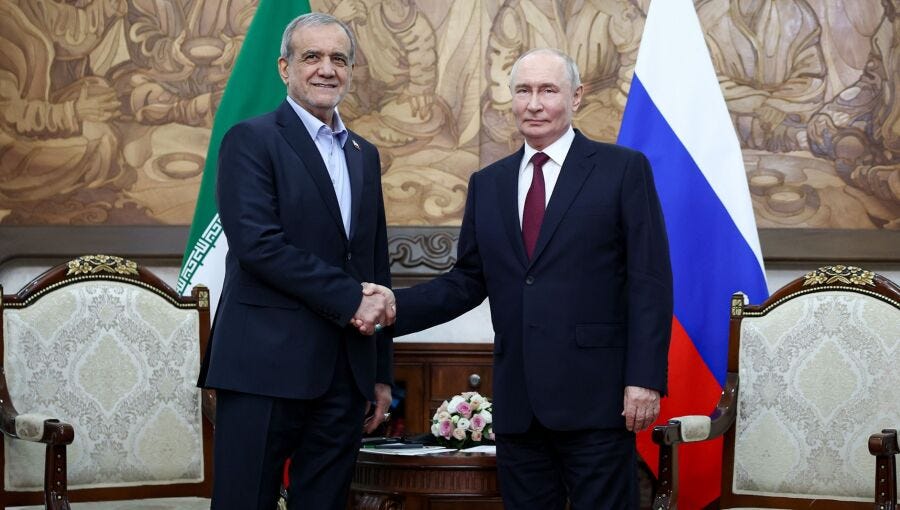
Pezeshkian said Moscow and Tehran could counter US “unilateralism” and find ways to circumvent sanctions through multilateral frameworks including the Shanghai Cooperation Organization.
Their meeting followed Washington’s announcement of a new economic campaign against Iran called Operation Economic Outcast.
The Bishkek summit also produced a joint statement condemning military strikes on Iran and opposing unilateral coercive measures that could harm the global economy. Russia and Iran have deepened military cooperation, with Iran providing drone technology to Russia and Moscow supplying targeting assistance for Iranian retaliatory strikes in the Middle East.
Sources: Jerusalem Post, Washington Post
Restacking this post will help it reach more readers interested in the world.

The Dutch central bank has moved 86 tonnes of gold reserves from the US and Canada to London, citing increasing geopolitical unrest and the need to improve access in a crisis. Governor Olaf Sleijpen said the relocation strengthened the reserves’ tradability, resilience and preparedness.
The transfer, carried out between March and August, shifted London’s share of Dutch gold reserves from 18.1 per cent to 32.1 per cent, making it the largest location. New York and Ottawa each now hold 18.5 per cent, while 30.8 per cent remains in the Netherlands. The total reserve stands at 612.4 tonnes.

The bank sold about 59 tonnes in New York and bought the equivalent in London, while more than 27 tonnes was physically moved through the Netherlands. DNB said London’s gold market allows reserves to be deployed more quickly in a crisis.
Sources: The Guardian, Bloomberg

Thousands of people protested in Ceuta and cities across Spain over the handling of a migration crisis that began when at least 72,000 people crossed from Morocco in July. More than 10,000 migrants, including unaccompanied minors, remain in makeshift camps or on streets and beaches in Ceuta, according to local authorities.
The demonstrations have become politically divisive. The opposition dominated federation of municipalities called the protests, while Spain’s government accused the right of exploiting the crisis. Left-wing groups and unions organised counter-gatherings condemning attacks on migrants.
Negotiations between Ceuta and the central government are deadlocked. Madrid has expanded temporary accommodation capacity to more than 3,400 places and deployed over 1,600 police but local groups say the measures remain insufficient. A citizens’ initiative seeking orderly returns, stronger security and respect for human rights has gathered nearly 65,000 signatures.
Sources: Reuters, Al Jazeera

OpenAI is facing 30 new lawsuits in US federal court in California over the February mass shooting in Tumbler Ridge, British Columbia, which left eight victims dead. The new complaints were filed on Wednesday by students, educators and other survivors and join seven earlier cases filed by families of victims.
The lawsuits allege OpenAI knew about violent scenarios described by the 18 year old shooter in interactions with ChatGPT but failed to alert law enforcement. OpenAI has previously acknowledged banning Jesse Van Rootselaar’s account in June 2025, saying the activity did not meet the higher threshold required for a police referral.
OpenAI Chief Strategy Officer Jason Kwon said the company is continuing to engage with the legal process.
British Columbia has also said it plans legal action against OpenAI.
Sources: CBC, Al Jazeera

Technology companies are increasing climate commitments but rapidly rising energy demand linked to artificial intelligence is outpacing emissions reductions, according to the Greening Digital Companies 2026 report. The study, covering 200 major technology companies, found leading AI and cloud providers increased individual emissions between 2020 and 2024 as energy needs and infrastructure expanded.

The companies reported 301 million tonnes of operational emissions in 2024, equal to 0.8 per cent of global energy-related emissions, while consuming close to 500 TWh of electricity. The 10 largest consumers used 269 TWh, more than the whole of Australia.
Only 25 companies said they sourced 100 per cent renewable electricity. Although 151 had near-term emissions targets only 85 were assessed as on track and just 81 had comprehensive plans to meet climate goals.
The report said AI can support efficiency but its environmental costs are rising alongside its expansion.
Sources: Japan Times, CNET

The world is certain to breach the Paris Agreement’s 1.5C warming threshold within the next few years, according to a new UN report that shifts the focus towards limiting the overshoot and eventually bringing temperatures back down. Average global temperatures have already risen about 1.4C above pre-industrial levels.
The report says returning temperatures to 1.5C this century would require peak warming to be limited to about 1.8C, alongside major emissions cuts and carbon dioxide removal on a vast scale. Current industrial capacity for carbon removal remains extremely limited and even under optimistic scenarios a single decade of warming could take about 50 years to reverse.
Current national policies and trends put the world on course for around 2.6C of warming by 2100. The report says carbon removal must supplement, rather than replace, sustained reductions in greenhouse gas emissions.
Sources: RFI, New York Times
Restacking or sharing this publication means more people can read it. Commenting extends the conversation. Liking shows your appreciation.
On this day …
On this day in 1783, representatives of Britain and the United States signed the Treaty of Paris, formally ending the American Revolutionary War. Britain recognised the independence of its former thirteen colonies and accepted boundaries that gave the new United States territory stretching west to the Mississippi River.
The treaty transformed the political map of North America and confirmed that a rebellion against one of Europe’s major powers had successfully created a sovereign republic.
Yet many questions left by independence including relations with Indigenous peoples, slavery and control of the continent would shape American politics and expansion for generations.
Winning independence settles one question about a new country while creating many others.