


Trump Approval Near Low As Midterms Approach (Politics)
US Midterm Election Spending Set To Reach Record $12bn (Politics)
Russian Strike Kills 26 Ahead Of Ukraine Peace Talks (Conflict)
False Nuclear Alerts Hit Ukraine And Russia After Hacks (Conflict)
US Seeks More NATO Funding For Ukraine Weapons (Europe)
Iran War Talks Continue Without Breakthrough (Diplomacy)
French School Blockades Resume As National Strike Looms (Europe)
Cyberattacks Disrupt Supermarket Freezers Across Europe (Europe)
Russia Amplifies Poland’s Constitutional Crisis (Geopolitics)
UK Warns Of AI-Powered Infrastructure Attacks By 2028 (Technology)
A succinct daily briefing delivered each weekday to help you stay on top of the stories shaping the world.

US President Donald Trump’s approval rating stood at 32 per cent ahead of Tuesday’s congressional midterm elections, just above his recent record low of 31 per cent. A nationwide poll showed voters favouring Democrats over Republicans by 46 to 38 per cent, although that eight-point advantage had narrowed from 11 points a week earlier.
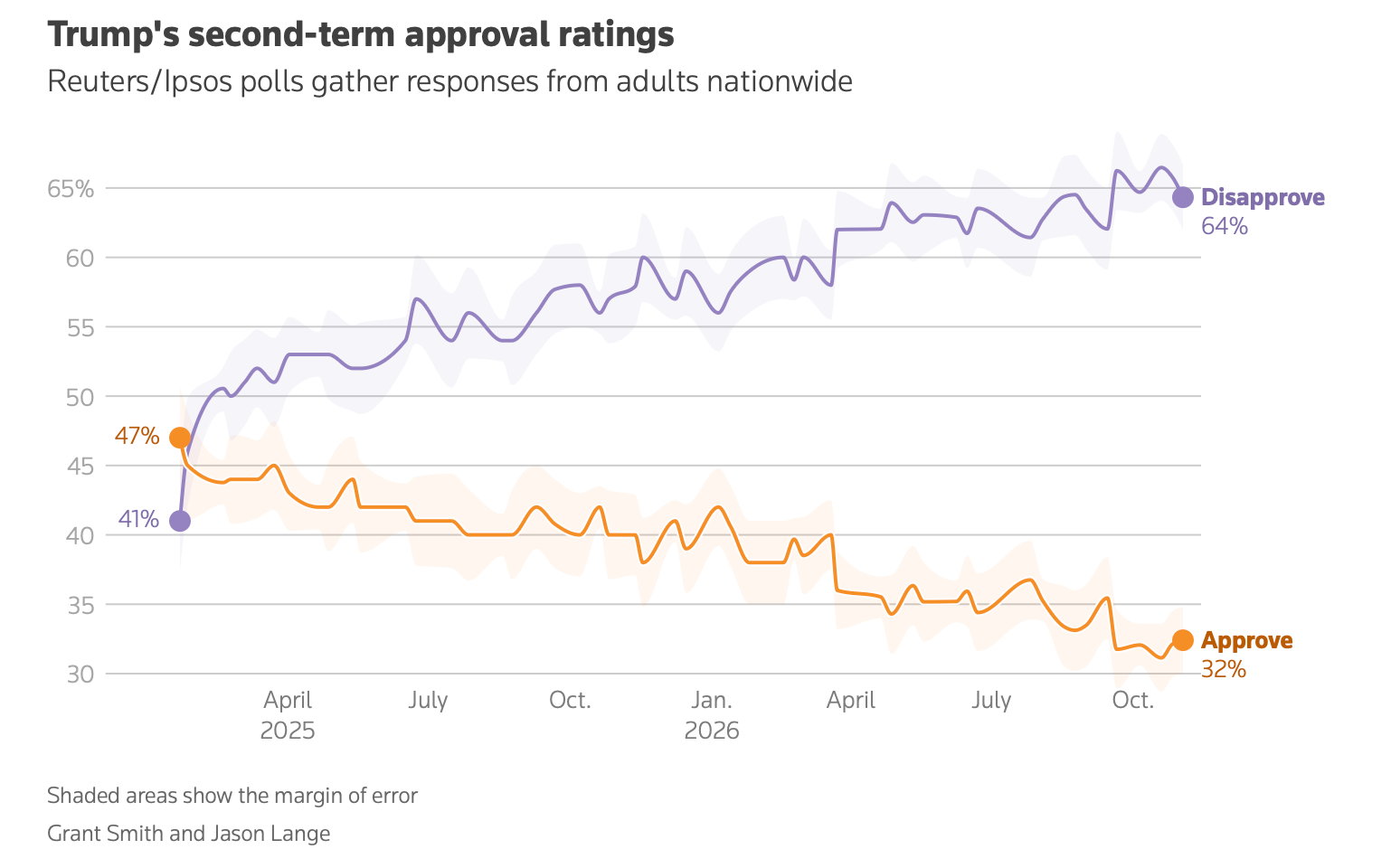
Rising living costs dominated voter concerns, with 78 per cent identifying them as a major electoral issue. Democrats led Republicans by 43 to 32 per cent on handling those costs. Among independent registered voters, half viewed their congressional vote as opposition to Trump, compared with 13 per cent who saw it as support.
Separate Senate polling showed Democratic candidates ahead in Kansas, Maine, Michigan, Ohio and Texas, with Alaska and Iowa effectively tied. Republicans are defending majorities in both chambers, while analysts cautioned that previous polling has underestimated conservative turnout.
Sources: South China Morning Post, The Independent

Spending on Tuesday’s US midterm elections is projected to reach $11.9 billion, making the campaign the most expensive on record. The independent campaign finance organisation OpenSecrets estimates the total will be approximately 30% higher than in 2022. Federal filings showed more than $9.5 billion spent by mid-October.
Political action committees and Super PACs accounted for approximately $5.5 billion, with the latter permitted to accept unlimited donations. Billionaire Elon Musk was the largest individual contributor, donating nearly $500 million to Republican aligned groups. The 40 biggest donors contributed $2.4 billion by mid-October.
The Texas Senate contest between Republican Ken Paxton and Democrat James Talarico has attracted particularly heavy spending. Advertising dominates campaign expenditure, with tracking firm AdImpact reporting $11.15 billion in election advertising by late October. Most advertising spending has concentrated on competitive Senate races, particularly in Ohio, Texas and Michigan.
Sources: BBC, Spectrum News

Russian airstrikes on a humanitarian aid centre & shelter in southern Ukraine killed at least 26 people on Monday, according to Ukrainian officials. The attack struck a school in Komyshuvakha, Zaporizhzhia region, where residents gathered weekly to collect aid. Two rescue workers and four police officers were among those killed, while 27 people remained missing.
Ukrainian President Volodymyr Zelenskyy said Russian forces struck as residents arrived, then bombed the shelter. He accused Moscow of rejecting de-escalation, contrasting the attack with last week’s humanitarian evacuation from Russian-occupied Oleshky, enabled by a temporary ceasefire.
Hours later, US special envoy Steve Witkoff announced that Russian and Ukrainian delegations would meet in Abu Dhabi on 10-11 November. Discussions will cover security arrangements, de-escalation, humanitarian measures and ending the war. The talks follow months without a diplomatic breakthrough, while Zelenskyy warned of further Russian attacks on Ukraine’s energy and logistics networks.
Sources: Al Jazeera, The Guardian

Emergency alert applications in Ukraine and Russia were compromised on Sunday night, sending false warnings of nuclear threats and other attacks. Ukraine’s widely used air raid app issued its highest warning level nationwide, alongside alerts about radiation, chemical attacks and street fighting. Ukrainian authorities temporarily disabled the application and directed residents towards other official information channels.
A group of Russian hackers claimed responsibility, saying they accessed the Ukrainian system through a malicious file downloaded by an administrator. Ukrainian air force spokesman Yuriy Ihnat said the breach had not affected military operations.
Hours later, Russia’s emergencies ministry reported a massive cyberattack on its own application, which issued false warnings about incoming nuclear warheads. Russian authorities said the country’s wider warning network remained unaffected. It was unclear whether the two incidents were connected or who was responsible for the Russian breach, highlighting vulnerabilities in public emergency communications during the war.
Sources: Washington Post, BBC

The United States is preparing to ask NATO allies for additional funding to supply Ukraine with American weapons, despite continuing tensions between US President Donald Trump and Ukrainian President Volodymyr Zelenskyy. The request could come this month and would expand NATO’s Prioritized Ukraine Requirements List (PURL), under which allies finance US weapons deliveries to Kyiv.
Officials familiar with the discussions said approximately $2 billion remained unpaid for previously approved weapons packages. Washington has continued shipments before receiving allied funding, potentially increasing the shortfall if further deliveries proceed. The programme includes air defence equipment and other military supplies.
The initiative continues despite Trump’s criticism of Zelenskyy and a reported US threat last month to suspend deliveries following Ukrainian attacks on Russian energy infrastructure. That threat was not implemented. Separately, Washington approved a $2.1 billion Patriot missile sale funded by Canada, Germany, Norway and the European Union.
Sources: Jerusalem Post, Bloomberg

Iran and the United States remain in indirect contact over ending their war after talks with Qatari mediators produced revised proposals but no breakthrough. Iranian Foreign Minister Abbas Araqchi said consultations were intensive, while US President Donald Trump said an agreement could happen. Vice-President JD Vance also reported progress.
Iran says its seven step proposal could now be implemented within two days. It calls for Washington to lift its blockade on Iranian ports, Tehran to reopen the Strait of Hormuz, relief from oil sanctions and further negotiations. Iran insists its conditions must be verified before nuclear talks resume. Trump rejected the original proposal in September.
The diplomatic exchanges coincide with fears of military action after Tuesday’s US midterm elections. Iranian media reported explosions on Qeshm island following a report of limited US strikes, which American officials had not confirmed. China and Russia urged diplomacy, while a Qatari LNG tanker was struck on Friday.
Sources: Reuters, France 24

Dozens of French high schools were blockaded on Monday as students resumed protests over teacher shortages, deteriorating buildings and overcrowded classrooms. The education ministry reported 41 schools affected, while student unions claimed 150. Police intervened at some entrances and made arrests as pupils returned from a two-week holiday.

The demonstrations, which began in September, have expanded into wider protests over living costs, inequality and wages. Trade unions are planning nationwide strikes on Thursday involving teachers, rail workers and private-sector employees. Government proposals to limit some class sizes and reform university admissions have failed to satisfy student leaders.
Education Minister Édouard Geffray warned that missed lessons were jeopardising final examinations, with some pupils having lost several weeks of teaching. France’s mounting public debt limits additional spending, while Prime Minister Sébastien Lecornu has promised further talks with student unions next week.
Sources: The Guardian, RFI

Supermarkets in seven European countries reported suspected cyberattacks on Monday that altered refrigeration temperatures, forcing retailers to remove food from sale and discard spoiled products. Stores in Belgium, Luxembourg, Sweden, Ireland, the Netherlands, Finland and Estonia were affected. Some freezers reportedly reached 50 degrees Celsius.
The incidents appear similar to October’s attacks on approximately 700 French supermarkets. A Belgian refrigeration company said affected units had been switched into defrost mode. The latest disruptions involved equipment made by Danish manufacturer Danfoss, whose older refrigeration controllers have remained exposed online despite earlier attacks.

Cybersecurity researchers said nearly 5,000 potentially vulnerable systems were accessible last week, falling to approximately 1,000 after Monday’s incidents. Some older equipment requires physical modification or replacement rather than software updates. No group has claimed responsibility, and the full extent of the attacks remains unclear. The incidents highlight vulnerabilities in internet-connected equipment used to manage food storage.
Sources: Japan Times, BBC

Poland’s constitutional crisis has drawn intervention from Russia, which is amplifying accusations that Prime Minister Donald Tusk’s pro-European government has staged a coup. The allegations followed Friday’s suspension of Constitutional Tribunal chief justice Bogdan Święczkowski and the deployment of riot police around the court. Former Russian president Dmitri Medvedev described the dispute as a constitutional coup.
The confrontation centres on judicial appointments. President Karol Nawrocki, an ally of the former Law and Justice government, has refused to swear in judges approved by parliament. Newly appointed judges entered the tribunal on Friday and suspended its leadership, prompting Nawrocki to abandon an overseas trip and return to Warsaw.
Tusk says his government is restoring judicial independence, while opponents accuse it of unlawfully seizing the court. The dispute comes as Moscow seeks to undermine European support for Ukraine. Poland remains a strong supporter of Kyiv, and parliamentary elections are due next year.
Sources: New York Times, CNN

Britain’s National Cyber Security Centre has warned that an AI-powered ransomware attack on critical national infrastructure is highly likely by 2028. Its annual report says artificial intelligence will allow hostile actors to identify and exploit existing vulnerabilities on a previously unimaginable scale, rather than necessarily inventing new attack methods.
NCSC chief executive Richard Horne said decades of underinvestment in technology had left British organisations and supply chains exposed. He identified China as the most sophisticated and sustained cyber challenge facing Britain, while warning of Russian attempts to penetrate military networks and Iranian operations targeting the UK.
The warning follows cyberattacks on European supermarket refrigeration systems, illustrating the vulnerability of equipment controlling physical operations. British authorities estimate malicious cyber activity costs organisations almost $20 billion annually. Horne urged businesses to update ageing systems, warning that failures could disrupt food supplies, electricity and commercial operations.
Sources: Reuters, Associated Press
Restacking or sharing this publication means more people can read it. Commenting extends the conversation. Liking shows your appreciation.
On this day …
On this day in 1839, British and Chinese naval forces clashed near Chuenpi in the Pearl River delta in Souther China, marking the beginning of the First Opium War. The conflict followed China’s efforts to suppress the illegal opium trade, which British merchants had used to offset Britain’s substantial trade deficit with China.

Britain’s superior naval technology ultimately forced the Qing dynasty to accept the Treaty of Nanking in 1842. China ceded Hong Kong, opened five treaty ports and granted significant commercial concessions. The defeat marked the beginning of what China subsequently called its “Century of Humiliation”, a period of foreign intervention that continues to influence Chinese political thinking.
This legacy of nineteenth century imperialism remains extremely visible in modern geopolitics and is something that is well remembered by the current Chinese leadership.