


US Strikes Iran Again As Hormuz Tensions Escalate (Conflict)
NATO Sees No Imminent Attack Despite Rising Tensions (Europe)
US Plans Weekly Iran Sanctions As Resistance Holds (Markets)
Russian Strike Exposes Failings Near Kyiv (Conflict)
Niger Mutiny Exposes Strain Inside Military Rule (Africa)
Nepal Flood Toll Deepens As Recovery Crisis Grows (Asia)
Iceland Rejects Restarting EU Membership Talks (Europe)
Israeli Settler Attack Exposes Enforcement Gap (Middle East)
Haiti Hostage Release Exposes Wider Security Crisis (Carribean)
Putin Meets Xi As Russia’s Dependence On China Grows (Geopolitics)
A succinct daily briefing delivered each weekday to help you stay on top of the stories shaping the world.

US forces struck two Iranian launchers on Larak Island after the Islamic Revolutionary Guard Corps was observed preparing to launch rockets carrying sea mines into the Strait of Hormuz. The attack was the first known US strike on Iran since late July when President Donald Trump paused a renewed military campaign.
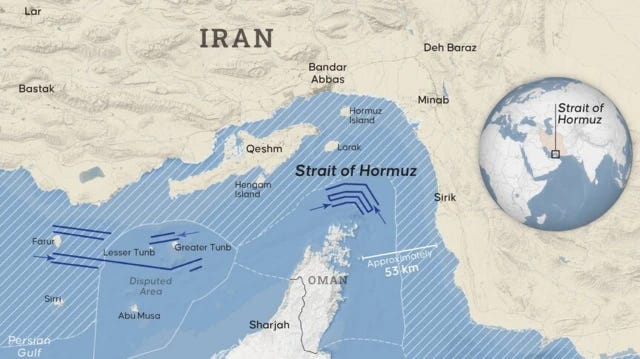
Iran said the strike killed two people and injured two others, they then launched ballistic missiles at US military targets in Jordan. Jordan’s army said it intercepted eight missiles while an IRGC spokesman warned that the US would face economic and military consequences.
Larak sits directly on the Strait of Hormuz, where Iran is making tanker traffic pass the island for checks and reportedly charging vessels $2 million to cross.
Before the war, about 20% of the world’s oil and liquefied natural gas travelled through the waterway. The war has now crossed its six-month mark.
Sources: BBC, The Guardian

NATO sees no imminent threat of attack despite Russia stepping up hybrid acts in Europe and attacks on Ukraine an alliance official said. The assessment came as Polish Prime Minister Donald Tusk warned that a Russian provocation against a NATO member could not be ruled out.
CIA Director John Ratcliffe raised the possibility of a Russian operation against a NATO member during a brief meeting with Russian intelligence counterparts, according to two sources. Russia has consistently denied involvement in sabotage planning or attacks in Europe.
Separately, Russian Foreign Minister Sergei Lavrov said NATO military activity in the Arctic poses direct threats to Russia’s security and increases the risk of incidents that could trigger armed confrontation.
NATO launched its Arctic Sentry mission in February to bolster its presence in the far north, while Norway expanded a recently created military brigade headquartered in the Arctic this month.
Sources: Reuters, France 24

US Treasury Secretary Scott Bessent said Washington is likely to unveil new secondary sanctions on Iran every week initially targeting banks and potentially cutting institutions off from the dollar-based financial system. He plans to urge G20 finance ministers and central bank governors to sever economic ties with Tehran or face sanctions under Operation Economic Outcast.
The campaign has so far drawn limited compliance. China, which buys 90% of Iran’s oil, warned Washington rather than backing down, while Iranian bank branches remained open in the UAE and commercial flights continued between Iran and several trading partners.
Bessent said he disagreed that sanctions would fail without targeting Chinese companies, arguing that the US blockade had already curbed most Chinese purchases of Iranian oil.
Analysts cited in the sources said effective sanctions would need to hit China but warned that doing so could provoke retaliation and major global economic fallout.
Sources: Bloomberg, Reuters

A Russian drone strike on a munitions warehouse near Kyiv killed at least 37 people and triggered explosions and a fire that spread into nearby homes. At least 50 residential buildings were damaged, nearly 400 people were being evacuated, and dozens were injured.
Ukrainian President Volodymyr Zelenskyy announced a criminal investigation, condemning the storage of explosives beside residential buildings as “terrible negligence”.
Prosecutors said they would examine whether the warehouse had the required permits and whether explosive materials were stored legally.
The attack has revived scrutiny after a July strike on an ammunition depot in Vyshneve killed 22 people and caused fires in surrounding homes. Ukrainian Prime Minister Serhii Koretskyi said repeating the same mistakes in the fifth year of Russia’s full-scale invasion amounted to criminal negligence and that those responsible should be punished.
Sources: Al Jazeera, NPR

Niger’s army regained control of a key military airbase in Niamey after mutinous soldiers attacked the site and the presidency, underscoring growing strains inside the armed forces. State media said hundreds of disaffected soldiers were involved while the Presidential Guard rallied to military ruler Abdourahamane Tiani’s defence.
Russia said its African Corps helped repel the attempted coup, while Algeria also sent fighter jets, a transport aircraft and a refuelling tanker. The airbase hosts Nigerien aircraft and drones, an Alliance of Sahel States counter-terrorism unit, and Russian and Italian forces.
The unrest adds an internal challenge to Niger’s long-running jihadist insurgency. Analysts and security sources say frustration is mounting within frontline units after repeated battlefield losses, while Tiani’s government has deepened ties with Russia and moved away from Western partners since taking power in a 2023 coup.
Sources: Straits Times, BBC

The death toll from floods and mudslides across Nepal and Tibet has risen above 800, with more than 3,000 people, including more than 260 foreigners, still missing as search operations entered a fifth day. Morgues across Nepal are overflowing, mass burials have begun in Bharatpur, and authorities have requested more than 1,000 freezer units to store bodies safely.
In Chitwan, more than 250 bodies have washed up along riverbanks, but only nine have been identified. Officials are using photographs, DNA samples and personal features to help families identify victims. Many of the worst-hit areas remain accessible only by army helicopter.
Rescue teams are also searching flooded hydropower projects, where hundreds of workers remain unaccounted for. Nearly 20,000 security personnel have been deployed, including around 8,500 army personnel, while India has sent relief flights, tunnel-rescue specialists and forensic teams to assist Nepal.
Sources: Times of India, The Guardian

Icelandic voters rejected reopening negotiations to join the European Union, with 52.8% voting no and 47.2% voting yes. The referendum revived a debate suspended more than a decade ago, balancing concerns about geopolitical stability against preserving national control over Iceland’s fisheries.

Prime Minister Kristrún Frostadóttir said she would respect the result and that the government would not pursue the issue unless something significant changed within the next 24 months. Reykjavik was the only area where a majority backed restarting talks.
Opposition centred on fears that EU fisheries rules would weaken Iceland’s control of its waters, while supporters argued membership could bring greater economic and geopolitical stability. Iceland already participates in the EU single market and Schengen area, but full membership would require reopening negotiations and a second referendum on any eventual agreement.
Sources: Associated Press, NPR

Dozens of Israeli settlers entered a Palestinian home in Qusra in the occupied West Bank while residents were inside throwing stones and trapping people in the building. The Israeli military said its forces found dozens of rioters barricaded inside the house and dispersed them, but no arrests had been announced by Sunday.
Prime Minister Benjamin Netanyahu condemned the violence, saying the attackers were breaking the law and harming Israel’s international standing. President Isaac Herzog called the incident reprehensible and demanded firm law-enforcement action.
The assault came amid escalating settler violence in the area. Israeli rights groups say few perpetrators are prosecuted, while US Ambassador Mike Huckabee has previously condemned attacks in Qusra as terrorism. The military has raised its readiness in the West Bank and said forces would remain deployed to prevent further disturbances.
Sources: CNN, New York Times

Haitian gangs have released six children and seven women taken during a mass kidnapping in Kenscoff, where at least 47 people were killed and more than 50 abducted. UNICEF said it worked with community leaders to secure the release, while it remained unclear how many women and children were still being held.
The attack has intensified international concern over Haiti’s security crisis. More than 2,600 people were displaced from Kenscoff, while nearly 1.5 million people are internally displaced nationwide.
At an emergency UN Security Council meeting, officials called for faster deployment and stronger support for the UN-backed Gang Suppression Force. The force is expected to strengthen its presence in Port-au-Prince, while Haitian police and armed forces reinforce Kenscoff. UN envoy Carlos Ruiz Massieu said the attack showed gangs’ continued capacity to terrorise communities and challenge state authority.
Sources: Associated Press, Al Jazeera

Russian President Vladimir Putin is set to meet Chinese President Xi Jinping in Kyrgyzstan as Moscow’s dependence on Beijing deepens during the war in Ukraine. Ukrainian strikes on Russia’s oil and gas industry have added economic strain, while China has gained cheaper Russian oil and greater access to a market vacated by Western competitors.
Analysts say the balance inside the relationship has shifted, with Putin increasingly forced to accept the role of junior partner as Russia relies more heavily on China. Beijing has also resisted Moscow’s proposed new gas pipeline unless pricing matches Russia’s subsidised domestic market.
The meeting will take place alongside a Shanghai Cooperation Organization summit attended by leaders including Iran’s Masoud Pezeshkian and India’s Narendra Modi. Putin and Xi have repeatedly used the group to promote a multipolar world and present a united front against Western influence.
Sources: Wall Street Journal, France 24
Restacking or sharing this publication means more people can read it. Commenting extends the conversation. Liking shows your appreciation.
On this day …
On this day in 1980, Poland’s communist government signed the Gdańsk Agreement with striking workers led by Lech Wałęsa. The settlement allowed the creation of independent trade unions, giving birth to Solidarity - the first independent trade union in a Soviet-bloc country.
Solidarity rapidly developed into a broader social movement challenging communist authority. The government imposed martial law in 1981 and suppressed the organisation, but it survived underground before returning to negotiations later in the decade. In 1989, Solidarity candidates dominated partially free elections, accelerating the end of communist rule in Poland and the wider transformation of Eastern Europe.
Can political systems survive once they concede that organised opposition has a legitimate voice?