


US Builds Forces As Hormuz Pressure Grows
Pakistan Offers Talks as Iran Warns on Ground Troops
Trump Weighs Seizing Iran Oil Hub
Netanyahu Expands Lebanon Operation
Ukraine Hits Key Russian Oil Port Again
US Eases Oil Embargo on Cuba
Palm Sunday Ban Sparks Holy Week Reversal
Pope Rebukes Leaders Who Invoke War
Paris Bomb Plot Spurs Terror Probe
Australia Ends Seven-Month Freeman Manhunt

Attacks linked to the Iran war entered a fifth week as Israel struck Tehran and Yemen-based Houthi militants launched ballistic missiles at Israel following US-Israeli strikes on Iranian nuclear facilities. The Houthis’ entry widened the conflict as strikes and interceptions spread across the region and more than a dozen US personnel were wounded in an Iranian strike on a Saudi base.
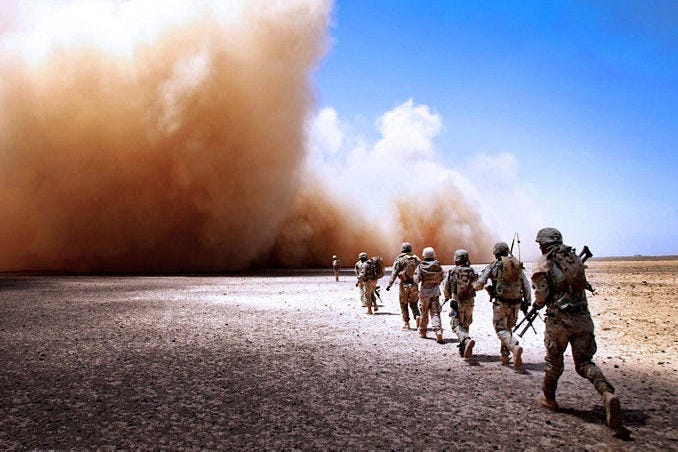
Around 3,500 additional US troops arrived in the Middle East, bringing the regional total to more than 50,000, roughly 10,000 above usual levels. Officials are weighing potential ground operations, including moves to open the Strait of Hormuz, where flows that normally carried about a fifth of seaborne global oil have slowed to a trickle.
Iran is drafting legislation to govern passage through Hormuz, including shipping security provisions and fees, underscoring the waterway’s role as its main source of leverage in a war that has killed more than 4,500 people.
Sources: Bloomberg, New York Times

Pakistan said it would soon host talks between the United States and Iran after diplomats from Turkey, Egypt and Saudi Arabia met in Islamabad, though there was no immediate word from Washington or Tehran and it remained unclear whether any discussions would be direct or indirect. Donald Trump said Washington was in discussions with Iran and doing “extremely well” in the negotiation.
The diplomatic opening was overshadowed by renewed threats from Tehran. Iran’s parliament speaker dismissed the Pakistan track as cover after thousands of US Marines arrived in the Middle East and said Iranian forces were waiting for American troops on the ground. Iran also threatened to attack the homes of US and Israeli commanders and political officials in the region.
The war has threatened supplies of oil, natural gas and fertilizer, shaken markets through Iran’s grip on the Strait of Hormuz, and killed more than 3,000 people.
Sources: Associated Press, CNN

Donald Trump said he could “take the oil in Iran” and seize Kharg Island, the export hub through which most of Iran’s oil is shipped, even as he said indirect talks with Tehran via Pakistani emissaries were progressing well.
He described taking the oil as his preference and said the United States had a lot of options, while also acknowledging that any move could mean remaining on the island for a while.
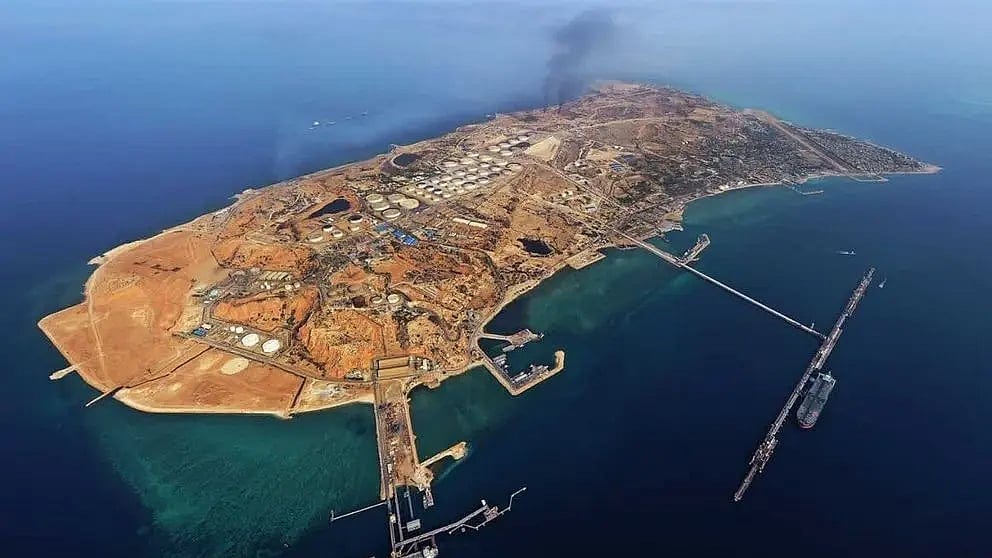
The remarks came as the United States sent thousands of troops to the Middle East and oil prices surged. Brent crude rose above $116 a barrel on Monday morning in Asia, while a possible ground operation was described as very risky. Kuwait said a power generation and water desalination plant was damaged in an attack on Sunday evening, killing one worker.
Sources: FT, CNBC

Benjamin Netanyahu said he had ordered the Israeli military to further expand operations in southern Lebanon, citing continued rocket fire by Hezbollah and saying the aim was to push anti-tank missile fire away from Israel’s border. Israel said last week it was enlarging a buffer zone up to the Litani River, though it was not immediately clear whether Netanyahu’s latest order referred to that area or to the seizure of additional territory.
His office declined to provide further details and said the matter had not yet been discussed by the security cabinet. Netanyahu said Hezbollah still had a residual capability to launch rockets and that Israel was determined to fundamentally change the situation in the north.
Israeli strikes and ground operations have killed more than 1,100 people in Lebanon, while the Israeli military has said four of its soldiers have been killed in fighting in southern Lebanon.
Sources: Daily Maverick, SBS

Russia’s Baltic port of Ust-Luga sustained fresh damage in a Ukrainian drone attack that sparked a blaze later brought under control, as Kyiv stepped up strikes on Russian oil export infrastructure. Regional authorities said air defences downed 36 drones overnight and emergency services were deployed with additional equipment, including two firefighting trains, to contain the fire.
The attack followed several strikes last week on Russia’s western energy corridor, when facilities at Ust-Luga and Primorsk came under fire, igniting storage tanks and forcing a suspension of oil and oil product loadings. Ust-Luga loadings have been halted since Wednesday after significant damage, while Primorsk has also been hit.
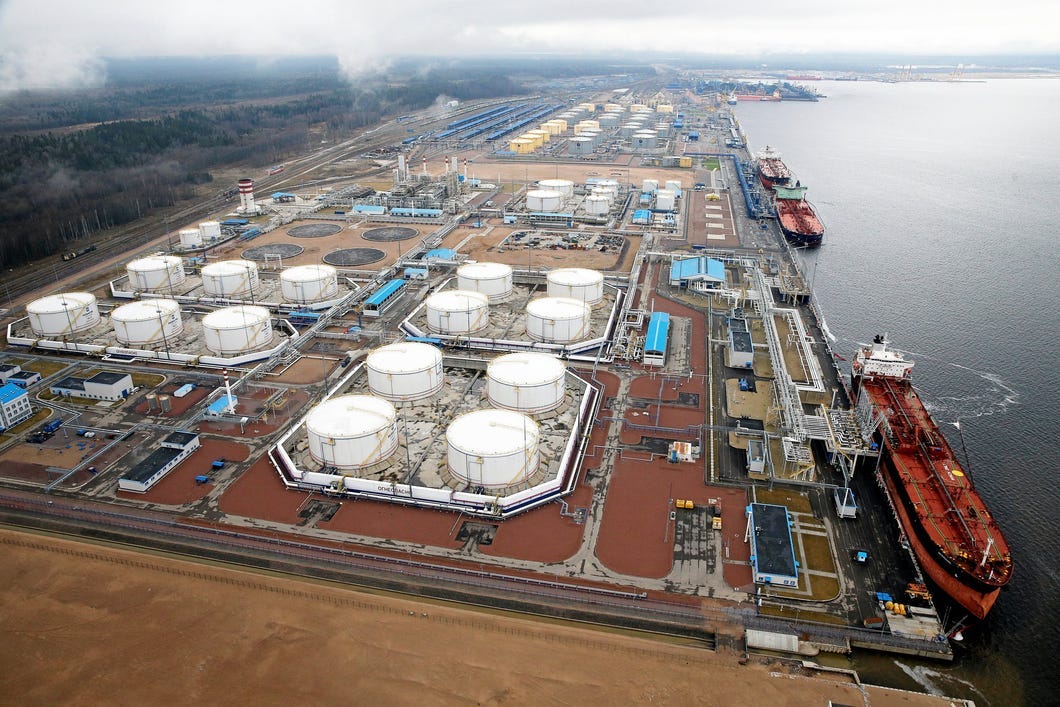
Just before the recent attacks, Primorsk and Ust-Luga handled about 45 per cent, or 1.72 million barrels a day, of Russia’s seaborne crude exports. The disruption threatens Russian oil export revenues at a time of higher oil prices.
Sources: Bloomberg, Reuters

Donald Trump signalled new flexibility on oil shipments to Cuba, saying he had no problem with a country sending oil to the island, whether Russia or not, as the sanctioned tanker Anatoly Kolodkin approached Matanzas carrying around 730,000 barrels of crude. The administration is planning to let the shipment dock, according to people familiar with the matter, easing pressure created by a near-total blockade on fuel deliveries.
The move offers relief to an energy crisis that has intensified under Trump’s embargo. Cuba has suffered widespread blackouts in recent weeks, while President Miguel Díaz-Canel said the country had received no oil imports for three months. Fuel rationing, soaring prices, reduced public transport and multiple power outages have hit the island’s fragile economy.
The shipment should be enough to power Cuba’s thermoelectric plants for about a week, or, according to one energy expert, could be converted into enough diesel to cover demand for about 12.5 days.
Sources: The Guardian, Japan Times

Israeli police prevented two senior Roman Catholic leaders from entering the Church of the Holy Sepulchre on Palm Sunday, citing safety concerns linked to the war with Iran and the difficulty of emergency access in Jerusalem’s Old City. Church officials said it was the first time in centuries that senior church leaders had been unable to celebrate Palm Sunday Mass at the site.
The decision drew condemnation from international leaders and prompted a rapid reversal. Giorgia Meloni called it an offense to the faithful, Emmanuel Macron said it added to a concerning sequence of violations of the status of the holy sites, and the US ambassador to Israel said the move was difficult to understand or justify.
Benjamin Netanyahu later said he had instructed authorities to give Cardinal Pierbattista Pizzaballa full and immediate access to the church and allow him to hold services as he wished.
Sources: New York Times, Reuters

Pope Leo XIV used his Palm Sunday Mass to reject claims that God justifies war, saying Jesus is the king of peace and that God does not listen to the prayers of those who wage war. Speaking before tens of thousands in St Peter’s Square, he said the conflict involving Iran, Israel and the United States was atrocious and added that many Christians in the Middle East could not fully observe the rites of Holy Week.
The unusually pointed remarks came days after the US defence secretary prayed for overwhelming violence against enemies who deserved no mercy, and as thousands of US troops arrived in the Middle East. The pope did not name any government or individual.
Leo has repeatedly called for a ceasefire and a ban on airstrikes. On Sunday he urged prayers for people wounded by war and called for concrete paths of reconciliation and peace.
Sources: The Guardian, NPR

French authorities arrested three people after a suspected foiled bomb attack outside Bank of America’s offices in Paris, with anti-terrorism prosecutors opening an investigation into attempted damage by fire or other dangerous means in connection with a terrorist undertaking. The incident happened at about 03:30 local time on Saturday in the city’s 8th arrondissement, near the Champs-Élysées.
An initial suspect was detained at the scene after placing a device close to the bank. Police said it contained flammable liquid and an ignition system, while another source described two bottles of flammable liquid, adhesive tape and 650 grams of explosive powder. Two more suspects were arrested on Sunday, and all three are under 18 according to a source close to the investigation.
Interior Minister Laurent Nuñez said the attempted attack could be linked to the US-Israel war on Iran, though he said it was for investigators to determine.
Sources: BBC, ABC News

Australian police say a man believed to be Dezi Freeman was shot dead after an hours-long standoff at a rural property in Victoria, potentially ending a seven-month manhunt for the fugitive accused of killing two police officers last August. Formal identification is still underway, but police said their families were informed first.
Police said the man emerged from a building wrapped in a blanket and armed with a gun, with an opportunity to surrender peacefully that he did not take. No officers were injured in the operation, which will be investigated as standard in police shootings.
Freeman had fled into dense bushland after the deaths of Detective Neal Thompson and Senior Constable Vadim De Waart at his property in Porepunkah. Police said further investigations would now focus on anyone who may have assisted him while he was on the run.
Sources: BBC, RTE
On this day …
On this day in 1867, the United States agreed to purchase Alaska from the Russian Empire for $7.2 million, adding nearly 600,000 square miles to its territory and ending Russia’s colonial presence in North America.
The agreement reflected both Russia’s concern about defending the region after the Crimean War and Washington’s growing interest in Pacific access and Arctic positioning.
Initially criticised as “Seward’s Folly”, the acquisition later proved strategically important for resources, trade routes and military geography.
What looked like a remote territorial bargain in 1867 would eventually shape Arctic strategy and North Pacific power balance for generations.