


Fragile Ceasefire Tested In Gulf And Lebanon (Middle East)
Pakistan Border Strikes Deepen Ceasefire Strain (Conflict)
Ukraine Drone Strikes Expose Russia Fuel Shortage Impact (Conflict)
Europe Heatwave Death Toll Rises As Systems Strain (Environment)
Venezuela Rescue Window Narrows As Toll Climbs (South America)
Uganda Media Shut Down By Army Chief (Africa)
Australia Doubles Social Media Ban Penalties (Technology)
Israel Strike Tests New Lebanon Security Deal (Middle East)
Vucic Resignation Plan Fails To End Serbia Protests (Europe)
China Tech Growth Scrambles Energy Planning (Technology)
A succinct daily briefing delivered each weekday to help you stay on top of the stories shaping the world.

Iran launched drone and missile attacks targeting Bahrain and Kuwait on Sunday following new U.S. airstrikes, while threatening a “complete halt” in negotiations if Washington continues its attacks.
Kuwait said air defences intercepted Iranian drones and two missiles with no reports of injuries or damage. Bahrain said a residential building near the international airport was damaged and no one was killed.
The exchanges added pressure to a preliminary peace deal already under strain from continued fighting in Lebanon and disagreements over how the Strait of Hormuz should reopen. Iranian Foreign Minister Abbas Araghchi said Tehran must govern the strait and warned that any separate arrangements would delay its reopening and increase tension.
U.S.-assisted commercial transits continued uninterrupted, with 89 such transits recorded, below the historical average of 138 vessels a day.
Sources: Associated Press, Wall Street Journal

Pakistan launched air strikes and a ground operation along the Afghan border, saying it killed 29 fighters after attacks by armed groups across the country and a Karachi assault that killed three soldiers. Information Minister Attaullah Tarar said three targets in Paktia, Paktika and Kunar were destroyed, and described the operation as targeting hideouts and safe havens of the Pakistan Taliban.
The strikes are likely to further strain tense relations between Islamabad and Kabul. They came less than three weeks after Pakistani air strikes on what it said were fighter group hideouts in Afghanistan and ended about a month of relative calm after what Islamabad had described as an open war.
Multiple rounds of internationally mediated peace talks have failed to secure a lasting ceasefire, even after China hosted both sides in April and Beijing said they had agreed not to escalate.
Sources: Al Jazeera, BBC

Ukraine kept up its heavy drone assault on Russia, setting fire to a major oil refinery in the south as President Vladimir Putin acknowledged for the first time that the country was facing a “certain deficit” of fuel. Ukrainian President Volodymyr Zelensky said two Russian oil refineries were hit, while local authorities said falling debris killed one person in Slavyansk and wounded another in a nearby village.
The campaign has caused widespread shortages, long lines at petrol stations and fuel rationing in many regions. Putin said Russia was going through a difficult period and would import more fuel, speed up repairs at oil facilities and quickly deal with shortages in Crimea.
As shortages spread, Irkutsk Governor Igor Kobzev said drivers would be allowed to buy no more than 50 litres of fuel per vehicle per day at state-run Rosneft stations in the province.
Sources: South China Morning Post, PBS
More than 1,300 excess deaths have been recorded in Europe since June 21 in connection with the record-breaking heatwave, the World Health Organization said, while French health officials reported around 1,000 more deaths than expected in France since Wednesday.
WHO chief Tedros Adhanom Ghebreyesus called heat stress a “silent killer” and warned that homes, workplaces and schools were not built for these temperatures.
In Paris, funeral directors said mortuaries quickly ran out of storage space as deaths surged during the heatwave’s peak. Public Health France said there were more than 1,200 deaths last Wednesday, more than 1,400 on Thursday and another 1,400 on Friday, against a pre-heatwave daily rate of around 900 to 1,000. It said 85% of the deaths registered so far over those three days involved people aged 65 and above, with deaths at home up by about 40%.
Sources: France 24, Associated Press

Rescue teams kept searching for survivors in Venezuela on Sunday as the death toll from twin earthquakes rose to 1,450 and experts warned that the critical 72-hour window for finding people alive had passed. National Assembly President Jorge Rodriguez said 3,150 people were injured and 774 buildings had collapsed, while Interim President Delcy Rodriguez said rescue efforts would not be suspended after more people were found alive.
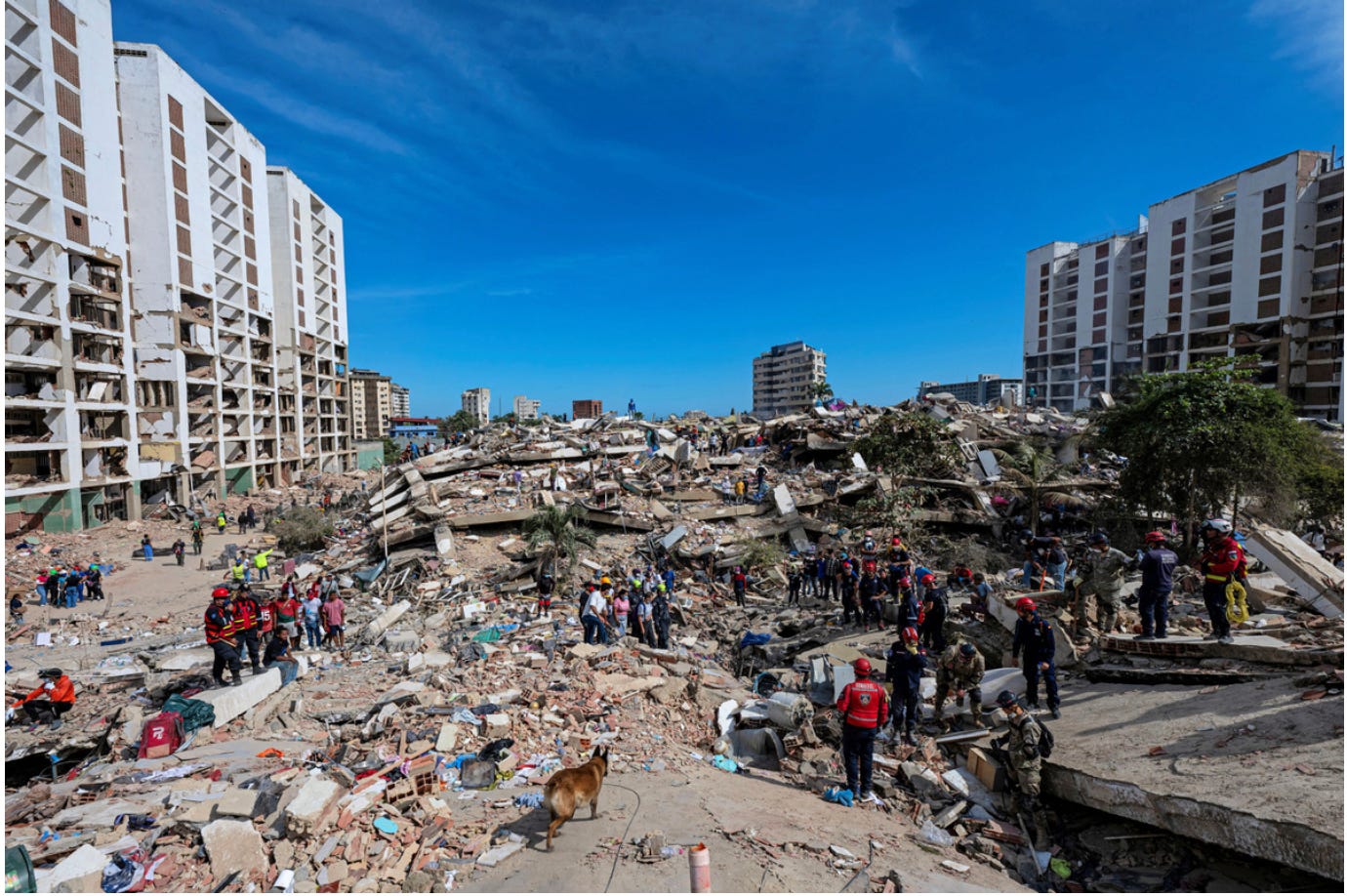
The disaster has left tens of thousands reported missing and intensified pressure on a country already mired in economic crisis. Foreign rescue teams continued operations in La Guaira, the hardest-hit state, where families and volunteers had earlier complained of scant heavy equipment and a limited official presence.
The government said school classes would be suspended for one more week and electricity supply in La Guaira had been restored to 75%.
Sources: Reuters, Euronews
Restacking this post will help it reach more readers interested in the world.

Uganda’s leading independent media group said it was under military siege after army chief Gen Muhoozi Kainerugaba ordered the closure of TV stations, newspapers and radio outlets under Nation Media Group. The Daily Monitor said armed soldiers were stationed outside its Kampala headquarters, while NTV Uganda and Spark TV were taken off air. Uganda’s National Broadcasters Association said at least six publishing and broadcasting outlets were closed.
In posts on X, Gen Kainerugaba said he did not believe in a free press, that both NTV and Daily Monitor would not reopen without his permission, and that all media in Uganda would follow the rules.
The shutdown came after President Yoweri Museveni was sworn in for a seventh term, amid speculation that he is grooming his son as successor. Opposition figure Bobi Wine said the move was aimed at silencing Uganda’s remaining independent voices.
Sources: BBC, Politico

Australia will double the maximum penalty for breaches of its social media minimum age law to A$99m, while giving the eSafety Commissioner stronger powers to compel platforms to provide evidence of what steps they have taken to comply. Children under 16 have been prevented from 10 key social media platforms since 10 December 2025, but the government said too many are still able to access and use the banned apps.
Prime Minister Anthony Albanese said big tech was not doing enough to comply with the law and that there were still too many children on social media.
Communications Minister Anika Wells said she was not satisfied that companies were doing everything they could and accused platforms of doing the bare minimum to get by. Investigations have been opened into the alleged non-compliance of Facebook, Instagram, Snapchat, TikTok and YouTube.
Sources: BBC, Al Jazeera

Two days after Lebanon and Israel agreed a U.S.-brokered security arrangement intended to ease hostilities along the border, Israel said it destroyed underground Hezbollah infrastructure in Majdal Zoun in southern Lebanon. A joint statement by Israeli Prime Minister Benjamin Netanyahu and Defense Minister Israel Katz said the attack targeted a 200-metre tunnel containing hundreds of weapons and launchers, and that the United States was informed ahead of the strike.
Hezbollah called the attacks a “flagrant” violation of the ceasefire to which it said it had adhered so far. Hezbollah leader Naim Qassem rejected the security agreement as a surrender to Israel and said the group would continue its armed resistance.
Benjamin Netanyahu said Israeli forces would remain in the security zone in southern Lebanon and continue to destroy terrorist infrastructure and remove threats from northern communities.
Sources: Reuters, France 24

Thousands of protesters rallied in central Serbia a day after President Aleksandar Vucic said he would step down within weeks and the country would hold early presidential and parliamentary elections. The announcement followed 18 months of student-led anti-government protests triggered by the collapse of a railway station canopy in Novi Sad in November 2024 that killed 16 people.
The protests continued on Sunday despite Vucic’s pledge to resign, underlining pressure that has become one of Serbia’s largest protest movements in history.
Vucic said he would help his ruling Serbian Progressive Party in the next election, while analysts said his resignation could pave the way for a return as prime minister. Although Serbia’s presidency is largely ceremonial, Vucic has wielded considerable influence over his party and the government.
Sources: DW, CNN

China’s energy planners said rapid growth in artificial intelligence, electric vehicles and other emerging sectors is making future power demand harder to predict. Ren Yuzhi, director-general of the planning department at the National Energy Administration, said demand over the past five years surpassed government expectations and that forecasting future energy demand, especially electricity, would be a key challenge in the next planning cycle through 2030.
China now expects average annual power demand growth of around 600 billion kilowatt-hours over the next five years, above the 570 billion kilowatt-hours recorded over the past five years. Ren Yuzhi said new demand from AI computing centres, electric vehicles and the shift from fossil fuels to electricity is prompting policymakers to reconsider where energy and industrial capacity are located, including whether more energy-intensive industries should move westward closer to renewable resources.
Sources: Bloomberg, Global Data
Restacking or sharing this publication means more people can read it. Commenting extends the conversation. Liking shows your appreciation.
On this day …
On this day in 2007, Apple’s first iPhone went on sale in the United States.
It combined a phone, music player and internet browser in a single touchscreen device, helping to reshape how people communicate, work, shop, navigate and consume information.
Its wider significance was not only technological but economic and social: it accelerated the smartphone era, changed the balance of power in the technology industry and helped place mobile platforms at the centre of modern life.
Nearly two decades later, the iPhone’s launch remains a reminder that some products do not just create markets - they reorganise daily behaviour.