


Five Men Held In UK Air Base Terror Investigation (UK)
More Than 30 Killed In South Africa Shooting Spree (Africa)
Houthis Accuse Saudi Arabia Over Deadly Taiz Strike (Conflict)
Reports Of Pre-Attack Warnings Put Netanyahu Under Scrutiny (Middle East)
Month Of Rain Floods Bangkok In One Weekend (Asia)
Trump Asked Xi If China Wanted To Buy US Weapons (US)
Trump Moves To Weaken US Fuel Economy Standards (US)
Gates Warns AI Could Cause A Billion Deaths (Technology)
EU Urges Energy Cuts As Winter Gas Costs Rise (Europe)
National Rally Secures Record French Senate Gains (Europe)
A succinct daily briefing delivered each weekday to help you stay on top of the stories shaping the world.

Five men arrested near RAF Fairford in Gloucestershire in the UK are being held on suspicion of preparing a terrorist act after police were alerted to three suspicious vehicles travelling towards the base early on Sunday. The UK-owned airfield is operated by the US and has been used by American bombers on missions against Iran.

Investigators are examining whether the incident has links to Iran or Russia but officials have not yet established any connection. Iran previously warned that bases used for attacks on its territory would be considered legitimate targets.
Police placed a 400-metre cordon around the vehicles while the army examined them, with more than 85 nearby homes evacuated. British Prime Minister Andy Burnham urged people not to speculate while investigators establish the facts. The five men remain in custody on suspicion of preparing a terrorist act and offences under the Explosives Act.
Sources: Associated Press, New York Times

Police are hunting gunmen after three separate shootings in South Africa left more than 30 people dead, adding to a recent series of violent attacks across the country. Seventeen people were killed and 15 wounded when eight gunmen opened fire at a tavern in Wedela, outside Johannesburg.
Ten more people were killed at an entertainment venue in Lwandle, near Cape Town, while four died in a separate shooting in Khayelitsha. No arrests have been made in the three attacks and police have not established definitive motives.
The killings follow the deaths of 11 people at a house near Durban last week. South Africa recorded an average of 58 murders a day between January and March. President Cyril Ramaphosa has deployed soldiers to support police against gang violence, having described organised crime in February as the most immediate threat to the country’s democracy, society and economic development.
Sources: France 24, CNN

Yemen’s Houthis have accused Saudi Arabia of striking a market in Taiz province, killing seven people and injuring 40, including children. Houthi military spokesman Yahya Saree said Saudi forces carried out two air raids and warned the attack would have “severe consequences”.
The Houthi account could not be independently verified. Yemen’s internationally recognised government said its own forces had targeted a Houthi military camp and vehicles at the same junction, while three government military sources said Houthi militants had recently established a camp near the market.
The competing accounts come amid renewed fighting after a fragile truce broke down months ago. The Houthis have seized Yemen’s Red Sea coast and imposed a blockade on Saudi energy exports, while at least 125,000 people have been displaced by renewed clashes. Yemen’s government has called for a general mobilisation.
Sources: Jerusalem Post, DW

Reports that Benjamin Netanyahu received warnings from Egypt and the United Arab Emirates before Hamas’s October 7, 2023 attack have renewed scrutiny of the Israeli prime minister ahead of next month’s election. Arab government officials said Egyptian intelligence chief Abbas Kamel called Netanyahu days before the assault after two earlier warnings.
The warnings did not specify the timing or scale of an attack. Netanyahu’s office has denied that he spoke with Kamel before October 7 and previously denied receiving a personal warning from UAE President Mohamed bin Zayed.
The issue has become a campaign focus. A September Israel Democracy Institute poll found 68% of Jewish Israelis considered October 7 a major factor in deciding their vote. Opposition candidate Gadi Eisenkot has accused Netanyahu of evading accountability, while Netanyahu says security chiefs failed to warn him. Mr Netanyahu has opposed an independent commission into the matter overseen by the Supreme Court.
Sources: Wall Street Journal, Times of Israel

Bangkok received nearly a month’s worth of rain over the weekend, flooding roads and homes and prompting Thailand’s government to close public offices on Monday and Tuesday. Nearly 300 millimetres fell over 48 hours, overwhelming drainage systems and leaving some residents stranded in their homes.
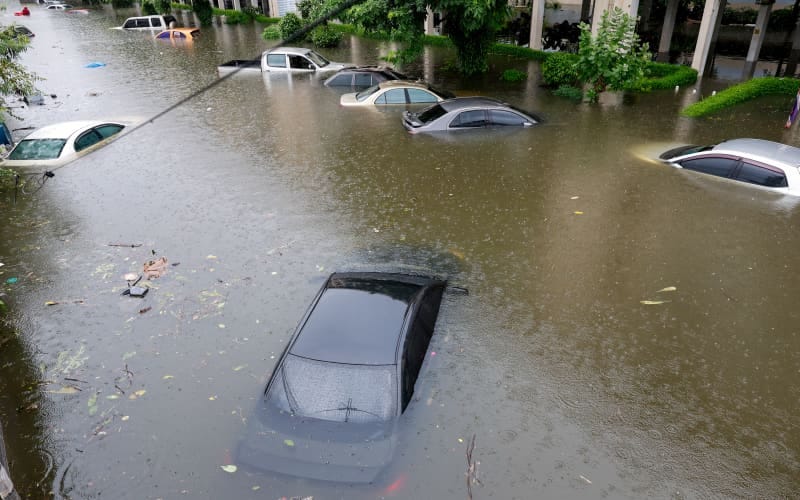
The disruption extended into the economy, with the Industry Ministry postponing a manufacturing production index until Wednesday. A preliminary estimate from the University of the Thai Chamber of Commerce put the national economic impact at 5 billion to 10 billion baht, or 0.025 to 0.05 percentage point of growth.
No deaths have been reported and the flooding is far less severe than the catastrophic inundation of 2011. Floodwater had receded in some areas by Sunday as rainfall eased, although further heavy rain and localised flooding were forecast for Bangkok and surrounding areas on Monday.
Sources: Bloomberg, Reuters
If you are enjoying 10 Things Global News then please re-stack it - it helps!

US Ambassador to China David Perdue says President Donald Trump asked Chinese President Xi Jinping whether China would like to buy American weapons, as Taiwan waits for approval of a proposed $14 billion US arms package. Perdue did not say when Trump made the comment.
The White House later said the US had no plans to sell weapons to China, while the State Department said US law prohibits such sales. Trump had previously described arms sales to Taiwan as a “very good negotiating chip” in dealings with Beijing and put the proposed package on hold after meeting Xi in May.
China opposes US arms sales to Taiwan and Xi urged Trump last week to oppose “Taiwan independence”. Taiwanese Deputy Foreign Minister Chen Ming-chi said China posed a severe military threat, while Perdue said there had been no change in Trump’s Taiwan policy, including on arms sales.
Sources: The Guardian, Times of India
The Trump administration plans to relax US fuel economy standards for new cars and light trucks, cutting the projected industry fleetwide average for 2031 to about 34.5 miles per gallon from 50.4 under Biden-era rules. President Donald Trump said the change would reduce vehicle costs and boost US auto production.
The move extends a broader rollback of policies supporting electric vehicles. Since taking office, Trump has relaxed tailpipe emissions rules, repealed fines for automakers missing federal mileage standards and ended consumer EV tax credits of up to $7,500.
The change comes as US petrol prices rise, with the national average at about $4.47 a gallon over the weekend. Environmental groups argue weaker standards will increase fuel costs and pollution, while the administration and automakers say the rules will improve access to affordable gasoline vehicles. The Sierra Club said it plans to challenge the move in court.
Sources: Associated Press, New York Times
Microsoft co-founder Bill Gates has warned that artificial intelligence is powerful enough to cause events killing a billion people if used by people with malicious intent and has urged Washington to impose federal safeguards and monitoring. He said emergency “kill switches” were insufficient without active tracking and records of model behaviour.

Gates said the more immediate threat was misuse by terrorists or rogue states for cyberattacks, disrupting bank accounts or shutting power grids, rather than autonomous machines. He argued that small groups using AI can now achieve capabilities previously available only to major countries.
The warning comes amid debate over US regulation. President Donald Trump has opposed federal intervention, while Gates said legislation would add some industry overhead without dramatically slowing development. He said regulating AI could prove harder than Cold War nuclear treaty negotiations and called for governments to insist on safeguards.
Sources: The Independent, FT

The European Commission has urged EU governments to reduce gas and electricity demand as low storage levels and constrained global supply push energy prices higher. European Energy Commissioner Dan Jørgensen asked ministers to consider measures for as long as necessary, while saying there was currently no immediate risk to security of supply.
EU gas storage is around 70% full, about 12 percentage points below the same point last year. The Dutch TTF gas benchmark is trading around €72 per MWh, up €40 since the US and Israel bombed Iran on 28 February.
Jørgensen said voluntary demand reductions used during the 2022 energy crisis had proved useful. He also encouraged countries to consider an 80% storage target rather than pushing aggressively towards 90%, arguing that flexibility could avoid panic buying as Europe competes for gas in tight global markets.
Sources: Politico Europe, Euronews

France’s National Rally and its allies have secured a record 14 seats in the 348-seat Senate, enough to form a parliamentary group in the upper chamber for the first time. RN presidential candidate Marine Le Pen called the result a “historic victory” after Sunday’s vote.
Nine RN senators were elected, joining three elected in 2023, while two more seats went to Eric Ciotti’s allied Union of the Right for the Republic. The result effectively quadruples the far-right’s representation, although the right, centre and Socialists remain the Senate’s three major forces.
The vote comes months before France’s presidential election, scheduled to begin in April, when President Emmanuel Macron steps down. RN was already the largest single party in the National Assembly after Macron called snap elections in 2024, although it fell well short of a majority.
Sources: The Guardian, France 24
Restacking or sharing this publication means more people can read it. Commenting extends the conversation. Liking shows your appreciation.
On this day …
On this day in 1928, Scottish bacteriologist Alexander Fleming returned to his laboratory at St Mary’s Hospital in London and noticed that mould growing in a contaminated culture dish had killed the surrounding bacteria. He identified the mould as belonging to the Penicillium genus and called the antibacterial substance it produced penicillin.
Fleming did not develop penicillin into a practical drug himself. That work came more than a decade later, when researchers including Howard Florey and Ernst Chain developed methods to produce and test it.
Mass production during the Second World War transformed medicine, making previously lethal bacterial infections treatable.
Few accidental observations have ultimately saved so many lives.