


DHS Review Contradicts Claim Pretti Brandished Gun
White House Moves To Soften Minneapolis Immigration Tactics
Zelensky Condemns Drone Strike On Ukrainian Train
Casualty Study Puts Ukraine War Near 2 Million
Iran Warns Of Instability As US Carrier Arrives
EU Set To Expand Iran Sanctions After Crackdown
Trump Shrugs Off Dollar Slide As Gold Hits Record
Trump Signals Tariff Deal Fix As Korea Scrambles
Starmer Heads To Beijing To Reset China Ties
Spain Opens Legal Path For Undocumented Migrants

A preliminary internal review found that Alex Pretti was shot by two federal officers after resisting arrest during an immigration enforcement operation in Minneapolis. The written notification, sent to Congress under standard procedure, made no reference to earlier claims by the homeland security secretary that Pretti had brandished a gun or intended to harm officers.
Video evidence reviewed by investigators showed Pretti holding a mobile phone, and that his firearm had already been removed before officers fired. A separate review of six recent encounters involving immigration agents found officials repeatedly portrayed U.S. citizens as aggressors before later evidence contradicted those accounts, fuelling doubts about investigative credibility.

The border agency said its report was factual and not a conclusion. The case is being investigated by a separate department unit, a decision criticised by former internal watchdog officials.
Sources: Reuters, New York Times

A senior Trump administration official tasked Tom Homan with leading immigration enforcement in Minneapolis met the city’s mayor and Minnesota’s governor on Tuesday as the White House sought to ease unrest after two U.S. citizens were shot dead by federal agents. Homan replaced Border Patrol commander Gregory Bovino, who was being demoted and removed after overseeing earlier crackdowns in Democratic-led cities.
The shift was part of a broader reset to soften aggressive deportation tactics as political pressure mounted over the killing of Alex Pretti and the earlier death of Renee Good. Some officials had accused Pretti of “domestic terrorism”, a claim contradicted by witness video showing he posed no threat.
Homan’s brief is to “recalibrate tactics” and improve cooperation with state and local authorities. Trump said his administration would “de-escalate a little bit”, and a senior official said public sweeps would be replaced by a more targeted approach.
Sources: Reuters, Axios

A Russian drone strike hit a passenger train in Ukraine’s north-eastern Kharkiv region on Tuesday, setting at least one carriage on fire and killing at least four people, according to local officials. President Volodymyr Zelensky condemned the attack as terrorism, saying there was no military justification for targeting civilians. He said the train was carrying more than 200 people and that four others were missing after the strike. Emergency services released images showing a badly damaged carriage still burning.
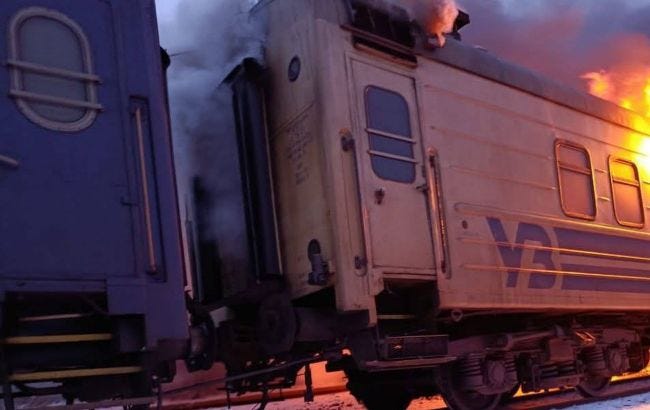
Kharkiv’s regional prosecutor’s office said one drone hit a carriage near the village of Yazykove, while two others exploded nearby. Separately, officials in Odesa said overnight attacks involving more than 50 drones killed three people and injured 25, collapsing several floors of a residential building and damaging energy infrastructure.
Talks aimed at ending the war were held last week but key territorial issues remain unresolved.
Sources: BBC, DW

A new study estimates that combined Russian and Ukrainian troop casualties are on track to reach 2 million by spring 2026. It puts Russian casualties at nearly 1.2 million and Ukrainian casualties at roughly 500,000 to 600,000, with combined casualties possibly as high as 1.8 million since February 2022.
The study says Russia has gained less than 1.5 percent of Ukrainian territory since the start of 2024 and is advancing remarkably slowly, at average rates between 15 and 70 metres per day in key offensives. It argues the war has become attrition warfare, characterised by high casualties, massive expenditures of matériel and limited movement of front lines.
It also says Russia’s war economy is under mounting strain, with manufacturing declining and economic growth slowing to 0.6 percent in 2025, alongside a lack of globally competitive technology firms.
Sources: New York Times, Center for Strategic International Studies

Iran’s president warned on Tuesday that US threats would bring “nothing other than instability” as a US naval strike group led by the aircraft carrier USS Abraham Lincoln took up position in Middle Eastern waters. He made the remarks in a call with Saudi Crown Prince Mohammed bin Salman, after Washington said it had dispatched the carrier “just in case” amid Tehran’s crackdown on protests.
The US also announced a multi-day readiness exercise to demonstrate the ability to deploy and sustain combat airpower across the region. President Donald Trump said the US had a “big armada next to Iran”, while adding that Iran “wants to make a deal” and “wants to talk”.
Saudi Arabia said it would not allow its airspace or territory to be used for military action against Iran. A rights group said it had confirmed 6,126 deaths and at least 41,880 arrests, with an internet blackout complicating tolls.
Sources: Le Monde, The Guardian

EU foreign ministers meeting in Brussels on Thursday are expected to approve sanctions on about 20 Iranian individuals and entities under the bloc’s human rights rules. The measures are expected to include export restrictions on components that Iran can use for the production of drones and missiles, and additional listings linked to support for Russia.
The EU is not expected to add the Islamic Revolutionary Guard Corps to its terrorist list because that would require unanimity and France opposes doing so for now. Italy’s foreign minister said he will call for listing the IRGC, leaving Paris as the one major holdout.
One European diplomat said France wants to keep communications open and is also worried listing the IRGC could harm efforts to bring back two French citizens now living at the embassy in Tehran after being released from prison last year.
Sources: Reuters, Iran International

President Donald Trump said he was not concerned by the dollar’s recent decline, telling reporters in Iowa: “No, I think it’s great.” He added: “Look at the value of the dollar. Look at the business we are doing. The dollar is, the dollar is doing great.”
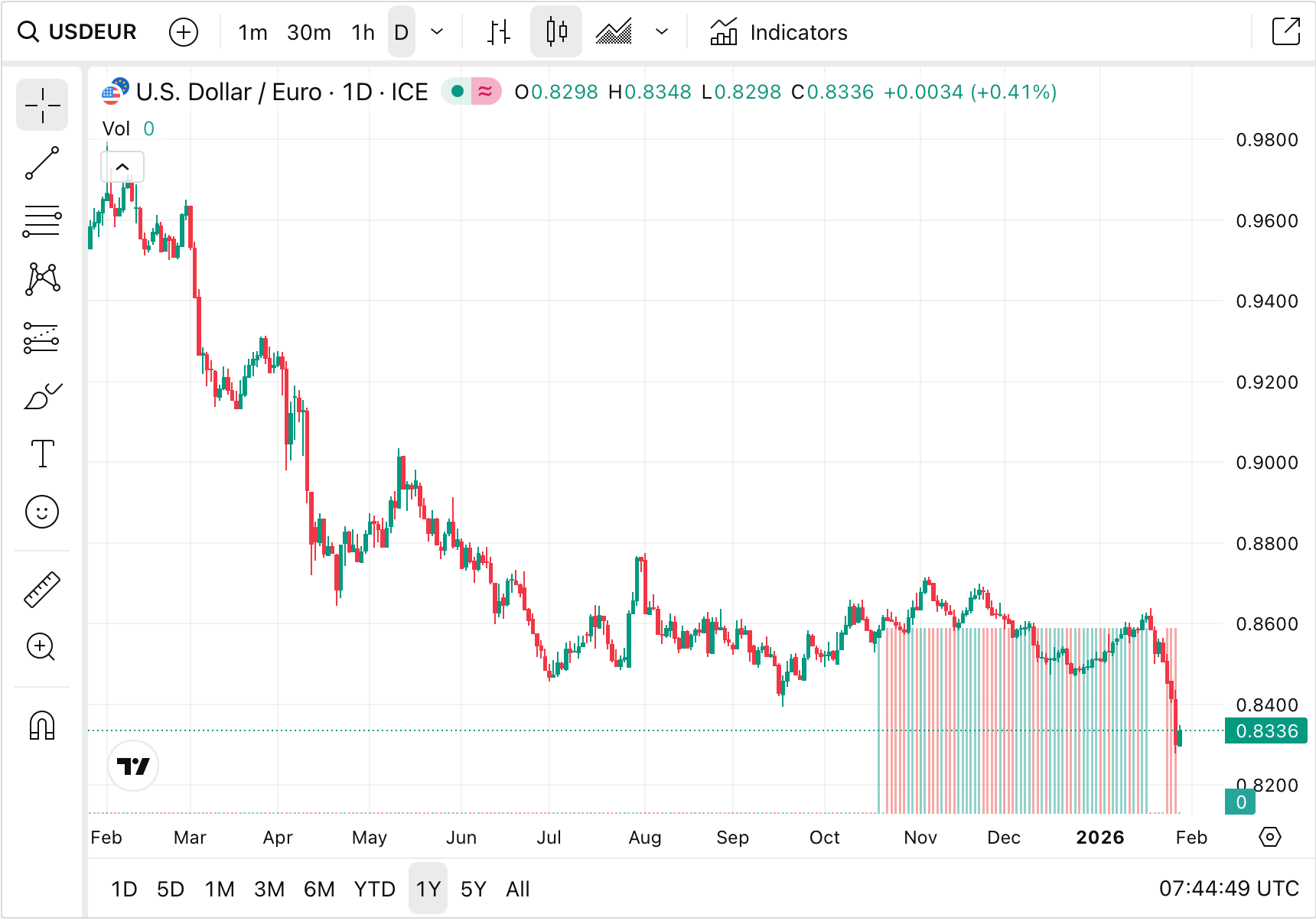
The dollar was down 1.3 per cent against a basket of other major currencies on Tuesday, leaving it trading at the lowest level in four years and off 2.6 per cent since the start of 2026. After Trump spoke, a dollar index extended losses to as much as 1.2 per cent before steadying somewhat in Asia trading Wednesday.
Gold broke through $5,200 per troy ounce, climbing 0.7 per cent on Wednesday in Asia to trade at $5,218 after a 3 per cent surge on Tuesday. The euro rallied 1.4 per cent to $1.204 and sterling jumped 1.2 per cent to $1.384, while the yen hit ¥152.3 against the dollar.
Sources: Bloomberg, FT

President Donald Trump said the US and South Korea “will work something out” after he announced on Monday that he would raise tariffs on South Korean imports to 25%, a move that rattled officials in Seoul.
His chief trade negotiator, Jamieson Greer, said the US had reduced its tariff rate on South Korean goods to 15% from 25% in exchange for Seoul’s pledge to invest $350 billion in the United States, allow more US cars into South Korea, and eliminate some non-tariff barriers. Greer said Seoul has not been able to get a bill through to do the investment, and said the US trade deficit with South Korea had reached $65 billion.
South Korea’s parliament is not expected to sit for plenary session until February, with five bills pending. Trade teams are expected to hold further discussions in Washington later this week, and the administration has not yet moved to implement the 25% rate.
Sources: Reuters, Bloomberg

Keir Starmer is travelling to Beijing, the first visit to China by a British prime minister since 2018, and is due to meet President Xi Jinping and the premier, Li Qiang, on Thursday. Around 60 British business and cultural leaders are also on the trip, including representatives from HSBC, GSK, Jaguar Land Rover and the National Theatre.
Downing Street says Starmer will maintain “guardrails” on national security while discussing economic ties, and will raise challenging issues where interests and values differ, including human rights abuses. Starmer argues a strategic and consistent relationship is firmly in the UK’s national interest, while critics point to concerns about espionage activity and the treatment of Jimmy Lai.
After visiting Beijing and Shanghai, Starmer will fly on to Tokyo to meet the new Japanese Prime Minister, Sanae Takaichi.
Sources: BBC, The Guardian

Spain’s government issued a decree giving hundreds of thousands of undocumented migrants a path out of legal limbo. The Socialist-led government said it was crucial for Spain, where migrant labour plays a key role in agriculture and tourism. It will let undocumented people living in Spain apply for temporary residency permits that allow people to work and last one year, renewable.
Under the decree, applicants must prove they arrived in Spain before December 2025 and have lived in the country for at least five months. People with criminal records will be excluded, and applications will be accepted only between April and June.
The move bucks a trend as other governments have cracked down on illegal immigration. Estimates suggest between half a million and a million undocumented migrants live in Spain, with the measure potentially benefiting about 500,000 people. Opposition parties criticised the move, and a far-right party promised to challenge the decree in court.
Sources: New York Times, Associated Press
On this day ….
On this day in 1986, the US space shuttle Challenger broke apart 73 seconds after launch, killing all seven crew members, including schoolteacher Christa McAuliffe.
The disaster halted the American shuttle programme for nearly three years and exposed deep organisational failures within NASA, including ignored engineering warnings about cold-weather risks.
Subsequent reforms reshaped safety oversight and decision-making in spaceflight. The accident also altered public perceptions of space exploration, shifting it from routine technology to high-risk national undertaking.
What does institutional accountability mean when technical ambition collides with political pressure?