


Netanyahu And Military Clash Over Iran Strike (Middle East)
UN Inquiry Accuses Israel Of Continuing Genocide (UN)
Mecca Alliance Seeks To Prevent Renewed Iran War (Middle East)
Hezbollah Rearms As Regional War Risks Grow (Conflict)
Machado Returns To A Venezuela Divided Over Elections (South America)
French Protests Spread Despite Education Concessions (Europe)
Trump Approval Edges Up As Republicans Trail (US)
China Tightens Party Discipline Ahead Of Xi Fourth Term (China)
Fukuda Death Leaves Gap In China Japan Diplomacy (Japan)
Anthropic IPO Exposes The Cost Of The AI Boom (Technology)
A succinct daily briefing delivered each weekday to help you stay on top of the stories shaping the world.

Israeli Prime Minister Benjamin Netanyahu reportedly sought to launch fresh military action against Iran ahead of today’s closely contested election, encountering resistance from military chief Lt General Eyal Zamir. According to Israeli officials, Zamir concluded there was no urgent military justification for an attack and feared a separate, unspecified operation could provoke Iranian retaliation.
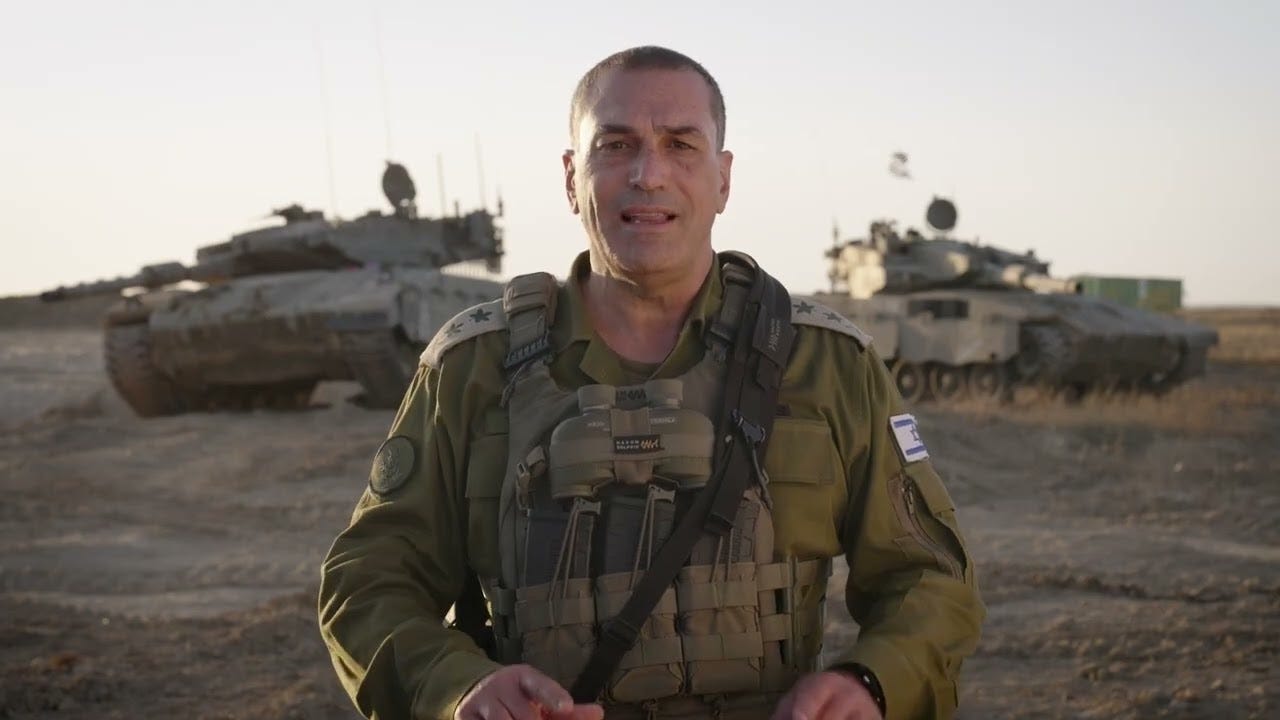
The dispute emerged as Netanyahu intensified warnings that an opposition victory could threaten Israel’s existence, circulating an AI-generated image of a nuclear explosion over Tel Aviv. Netanyahu denied reports of the disagreement, while Israel’s military maintained that operational decisions were based exclusively on security considerations.
Opposition leader Gadi Eisenkot criticised attempts to involve the military in election politics. Polls suggest his bloc could win more parliamentary seats than Netanyahu’s coalition, although neither appears assured of a governing majority. Renewed fighting with Iran could complicate the formation of a new government after the vote.
Sources: New York Times, The Guardian

A United Nations commission has accused Israel of continuing genocidal acts in Gaza despite the US-brokered ceasefire introduced in October 2025. Its latest report alleges Israeli forces continued using heavy munitions, drones, artillery and sniper fire in densely populated areas, while expanding territorial control beyond the ceasefire’s temporary demarcation line.
The inquiry also documented deteriorating conditions in the occupied West Bank where Palestinian deaths from airstrikes rose from six between 2008 and October 2023 to 254 over the following three years. Commission chair Srinivasan Muralidhar accused Israeli forces of pursuing a broader strategy of displacement and destruction.

Israel rejected the findings as politically motivated misinformation intended to undermine its right to self-defence. The commission also accused the Palestinian Authority of arbitrary detention, torture and targeting journalists and human rights defenders, while documenting allegations of sexual violence against Palestinian detainees by Israeli security personnel.
Sources: Reuters, Jerusalem Post

Senior security officials from Saudi Arabia, Pakistan and Turkiye travelled to Tehran on Monday for talks aimed at preventing renewed US military action against Iran and containing escalating regional tensions. The delegation, representing the Mecca Joint Defence Agreement, met Iranian President Masoud Pezeshkian and national security chief Mohsen Rezaei.
The initiative follows intensified Houthi attacks on Saudi Arabia and growing concerns that US President Donald Trump could authorise further strikes against Iran after next week’s congressional elections. Saudi Arabia said the discussions sought to encourage diplomatic solutions and support existing mediation efforts.
The alliance also reflects efforts to develop regional security arrangements less dependent on Washington. However, fundamental disagreements between Iran and the US remain unresolved, while analysts question whether the three countries possess sufficient influence to secure a lasting agreement. Iran and its visitors agreed to continue dialogue and strengthen regional security cooperation.
Sources: Al Jazeera, CNN

Hezbollah has spent three months rebuilding its military capabilities in Lebanon, supported by tens of millions of dollars in Iranian funding, according to Lebanese security sources. The group has been acquiring explosives, manufacturing attack drones and restoring command structures damaged during two wars with Israel since 2024.
Those conflicts killed thousands of Hezbollah fighters and destroyed much of its arsenal, while Israeli forces continue occupying positions in southern Lebanon. Fighting largely subsided following June’s ceasefire, although Israeli strikes have continued. Hezbollah remains on alert for renewed US-Iran hostilities that could reopen the Lebanese front.
However, its preparations remain incomplete. Security sources say weapons stockpiles and fighting forces have not been fully restored, while Israeli remotely operated weapons exposed weaknesses in Hezbollah’s battlefield organisation. The group has not committed to joining another conflict and says it wants to avoid providing Israel with grounds for renewed escalation.
Sources: Arab News, Israel Hayom

Venezuelan opposition leader María Corina Machado returned home on Sunday after nearly a year abroad, drawing tens of thousands of supporters demanding elections. Her return places her at odds with a US-backed negotiation process between acting President Delcy Rodríguez’s government and opposition groups that exclude Machado’s movement.
Washington supports talks to replace the electoral council and top court before elections but Machado has called for a presidential vote in 2027. US President Donald Trump has praised Rodríguez and said it is too soon to consider elections, despite Machado’s longstanding ties with his administration. US Secretary of State Marco Rubio said her safe return resulted from the negotiations and urged political actors to support them.
Machado’s public reception demonstrated her continuing ability to mobilise supporters but analysts warn that demands for a rapid vote could disrupt negotiations intended to secure a peaceful political transition.
Sources: Straits Times, BBC
If you like it - Please Restack or Share it

French student leaders have pledged to continue nationwide protests despite concessions from President Emmanuel Macron’s government, as unrest spreads beyond education and strains public finances. Measures include €4 billion in school renovation loans, limits on some class sizes and replacement of the university admissions system by 2028. Student representative Louis Letoublon said the proposals did not meet all their demands.
Trade unions and yellow-vest activists have joined demonstrations that have disrupted businesses and triggered violent confrontations. Interior Minister Laurent Nuñez reported 1,435 arrests on Saturday, while retailers have suffered falling sales and precautionary closures.
With national debt approaching 120% of GDP, the minority government has limited room for further spending. The unrest is also benefiting far-right presidential frontrunner Marine Le Pen, who polled between 32% and 33.5% ahead of next year’s election. Macron has warned of further demonstrations before a nationwide protest planned for November 5.
Sources: Reuters, France 24

US President Donald Trump’s approval rating rose one point to 32% from a record low but Republicans remain behind Democrats ahead of the November 3 congressional midterm elections. A nationwide poll found registered voters preferred Democrats by 47% to 36%, narrowing to 50% against 41% when undecided voters’ leanings were included.
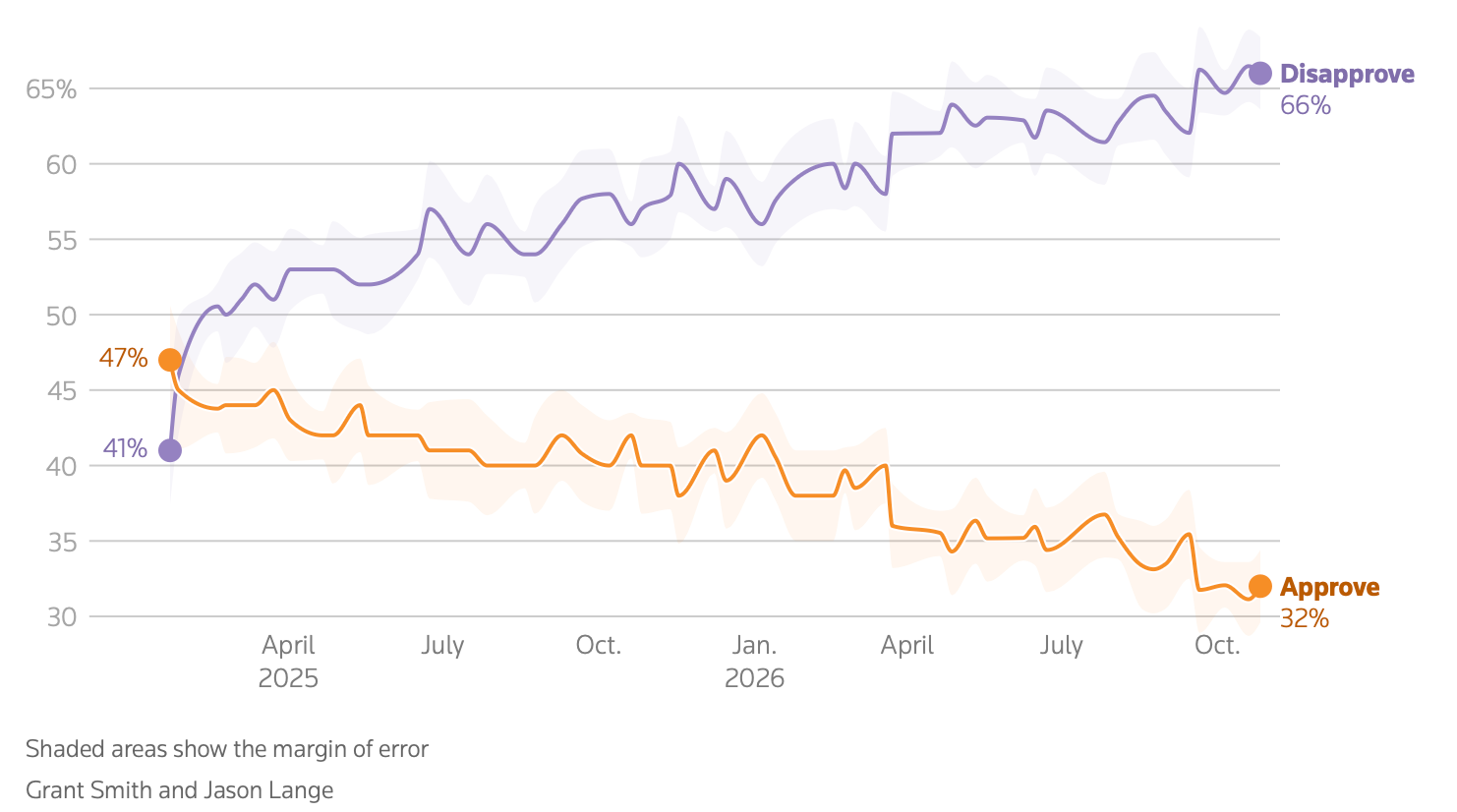
Economic dissatisfaction remains central to the contest. Inflation has risen since US strikes on Iran in February pushed petrol prices higher and 73% of respondents said living costs were heading in the wrong direction. Democrats now hold a narrow advantage over Republicans on economic management, reversing the position before the war.
Republicans are defending majorities in both congressional chambers. Analysts consider a Democratic House victory more likely than a Senate takeover, while the poll found Democratic voters more enthusiastic about participating.
Losing either chamber would complicate Trump’s legislative agenda during his final two years in office.
Sources: USA Today, Reuters

China’s Communist Party opened a four-day leadership meeting on Monday focused on tightening discipline and enforcing President Xi Jinping’s priorities, following extensive purges of senior officials. The closed-door fifth plenum is considering measures to strengthen internal governance, tackle corruption and punish officials who fail to implement central directives.
The scale of the campaign extends into the military. Researchers at the Asia Society Policy Institute estimate that 42 of the 44 military-affiliated members elected to the Central Committee in 2022 have been purged or disappeared. Analysts say the latest measures increasingly target ineffective administration and compliance, alongside corruption and political loyalty.
The meeting comes a year before the Communist Party Congress, when Xi is widely expected to secure a fourth term as party leader. Personnel appointments may be considered, although analysts expect any vacancies filled now to go to loyalists, reinforcing continuity ahead of the leadership transition.
Sources: NPR, BBC

Former Japanese prime minister Yasuo Fukuda, a longstanding advocate of closer relations with China, has died aged 90. He served from 2007 to 2008 and continued working to improve bilateral ties after leaving office including during disputes over islands in the East China Sea.
In 2014, Fukuda travelled to Beijing for talks with Chinese President Xi Jinping, helping arrange a subsequent meeting between Xi and then Japanese prime minister Shinzo Abe. His diplomacy drew on decades of engagement, including his role during negotiations surrounding the 1978 Treaty of Peace and Friendship and his hosting of Chinese President Hu Jintao in 2008.
His death comes amid renewed tensions following Japanese Prime Minister Sanae Takaichi’s comments about possible intervention in a Taiwan conflict. Wang Guangtao, deputy director of Fudan University’s Centre for Japanese Studies, said Fukuda’s credibility in Beijing would be difficult to replace.
Sources: South China Morning Post, Associated Press

Anthropic’s public offering filing has exposed the scale of the financial commitments underpinning the AI boom, pairing rapid revenue growth with enormous infrastructure obligations. The Claude developer reported $16.3 billion in first-half revenue, more than fourteen times the previous year’s figure but also an $80.7 billion net loss, largely reflecting financing-related accounting adjustments.
Its operating loss was considerably smaller at $693 million, while cash and cash equivalents totalled $112.4 billion. Anthropic has disclosed more than $475 billion in computing capacity agreements, most of them noncancelable, as it invests to meet uncertain future demand.
The company hopes to raise roughly $100 billion in an offering that could value it between $1.5 trillion and $2 trillion. Its prospectus also describes unusual governance arrangements that leave ordinary shareholders with little influence, alongside risks ranging from government intervention to potentially catastrophic consequences of advanced AI.
Sources: Bloomberg, Wall Street Journal
Restacking or sharing this publication means more people can read it. Commenting extends the conversation. Liking shows your appreciation.
On this day …
On this day in 1904, New York City’s first underground rapid-transit line opened to the public, running approximately nine miles from City Hall in Manhattan to 145th Street in Harlem. The Interborough Rapid Transit system offered an alternative to congested streets and elevated railways, transforming how New Yorkers travelled across the rapidly expanding city.
The subway subsequently grew into one of the world’s largest urban transit networks, supporting economic development, population growth and the emergence of new residential and commercial districts. Its expansion helped shape the modern metropolis.
More than a century later, New York’s subway illustrates how major infrastructure investments can influence a city’s development for generations.