


Glacial Collapse Triggers Massive Nepal-Tibet Floods (Asia)
Qatar Reopens Iran Talks As Hormuz Dispute Drags On (Diplomacy)
Hormuz Talks Advance But US-Iran Dispute Remains (Middle East)
Trump Declares Victory As Iran War Drags On (US)
Iran Sanctions Add New Risk To Xi-Trump Summit (Trade)
CIA Chief Warns Moscow Against Testing NATO (Geopolitics)
Russia Weighs Escalation As Ukraine Talks Collapse (Conflict)
Uganda Clears Ebola As Congo Outbreak Accelerates (Africa)
Nigeria Launches Rescue After Mass Mosque Kidnapping (Africa)
Meta Settlement Forces New Rules For Teen Social Media (Technology)
A succinct daily briefing delivered each weekday to help you stay on top of the stories shaping the world.

A glacial collapse in the Himalayas has triggered catastrophic flooding across the Nepal-Tibet border, leaving at least 162 people dead in Nepal and three dead in Tibet. China’s Xinhua News Agency said 558 people were missing in Tibet, including 260 foreigners, while Nepalese officials earlier reported 403 missing.
The US Geological Survey initially recorded an earthquake but later determined that the seismic event was a magnitude 5.2 glacial collapse, saying no earthquake had occurred. Climate researchers said an avalanche from a glacier likely caused the flash flood, with water levels on the Trishuli River rising by as much as nine metres in half an hour.
Scientists cautioned that the precise cause remains uncertain. Researchers have found glaciers across the Hindu Kush Himalaya are melting faster, with ice-loss rates doubling since 2000, while warming temperatures may have accelerated the collapse. Researchers also stressed the importance of early warnings in a warming Himalaya.
Sources: Associated Press, New York Times

Qatar’s prime minister will visit Tehran on Thursday to pursue mediation as the Iran war approaches its sixth month, with fighting largely paused but no diplomatic breakthrough. Qatar, a US ally and Iran’s Gulf neighbour, helped secure the June ceasefire and has served as a back-channel negotiator already.
The talks will address de-escalation and freedom of navigation in the Strait of Hormuz, where Iran has retained control as leverage and a revenue source. Oil flows through the strait fell to 5 million barrels per day on Monday, down from roughly 20 million daily before the war.
Washington has meanwhile signalled greater reliance on economic pressure, with increased sanctions planned against Iran’s trading partners. Iran and Oman are discussing a temporary transit corridor and mine-clearing project, but no agreement on control of the strait has been finalised. The military pause therefore leaves Hormuz at the centre of both the diplomatic effort and the continuing dispute.
Sources: Reuters, Arab News

Iran and Oman have discussed a temporary shipping corridor through the Strait of Hormuz and a joint mine-clearing project, raising hopes of a partial reopening even as Tehran says Washington is obstructing a wider agreement. Technical negotiations are continuing towards a permanent corridor and future administration of the waterway.
The dispute remains tied to the broader US-Iran confrontation. Iran’s Revolutionary Guard says the strait will remain closed unless Washington accepts Tehran’s conditions, while President Donald Trump insists it is already functioning and says he is in no hurry to restart negotiations.
Oil markets have responded to the prospect of improved access. Brent crude for October delivery fell 2.5% to $86.38 a barrel and WTI dropped 2.2% to $80.53. Analysts at ING said an Iran-Oman agreement alone would not restore pre-war oil flows without changes to the US blockade and sanctions.
Sources: CNBC, Wall Street Journal

US President Donald Trump declared “Mission Accomplished” in Iran on Wednesday even as the war continued without clear movement on several goals he had set for the conflict. Those included permanently ending Iran’s nuclear programme, preventing attacks on neighbouring states and proxy funding, and engineering regime change.
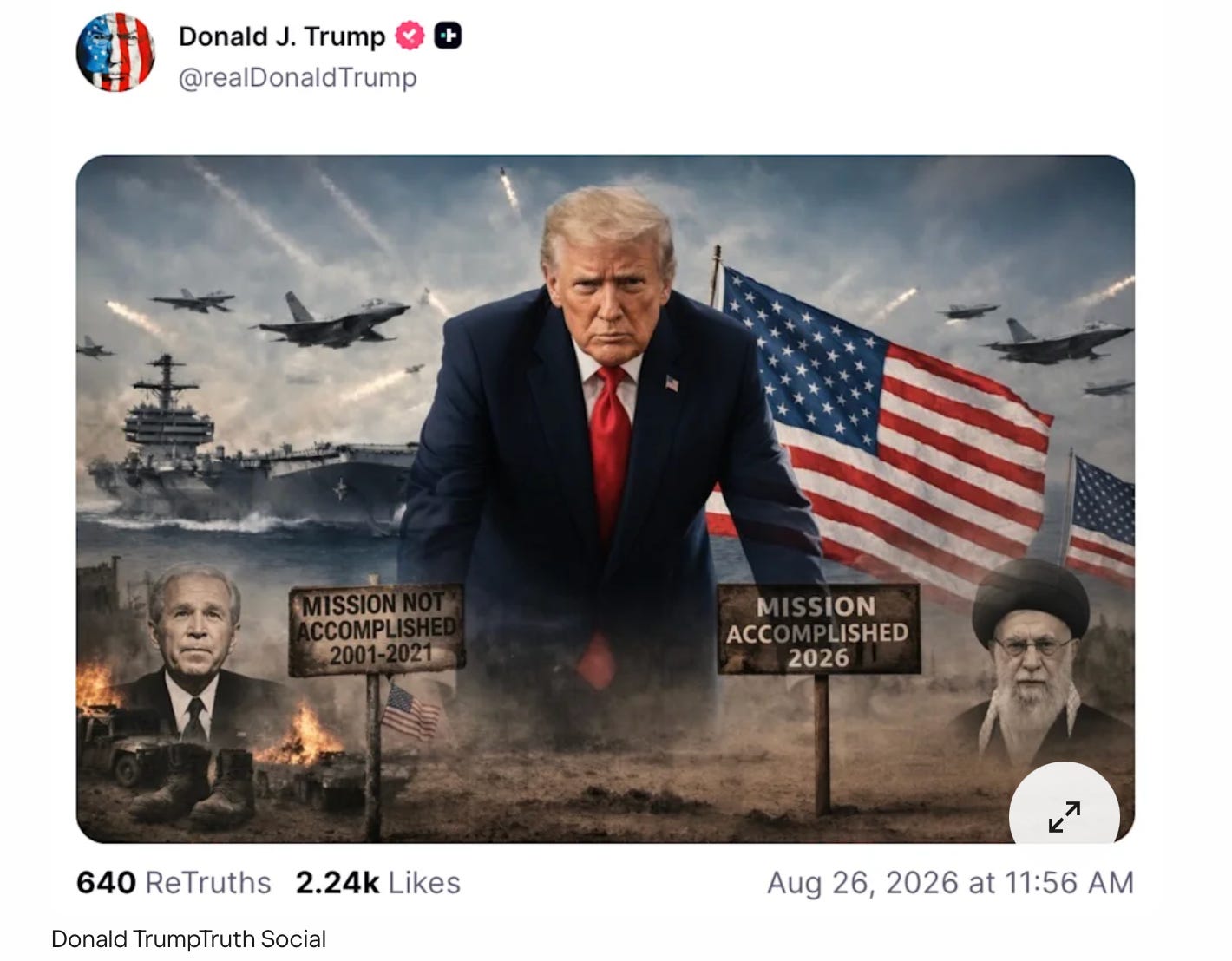
Iran is now led by Mojtaba Khamenei after the killing of his father, former supreme leader Ali Khamenei, while the regime appears little changed and more firmly entrenched. A recent Reuters/Ipsos poll found only 31 per cent of American voters supported Trump’s handling of Iran.
The political costs are also rising. Fuel prices have surged, Trump’s overall approval is below 40 per cent, and some Republicans fear the conflict could hurt the party in November’s midterm elections. The declaration therefore sharpens the contrast between the White House’s claim of success and a war that remains unresolved.
Sources: South China Morning Post, The Guardian

Beijing has vowed to protect its interests after Washington expanded Iran sanctions to Chinese entities, creating a new source of tension weeks before President Xi Jinping’s planned visit to the United States. Chinese Foreign Ministry spokesman Lin Jian called the measures illegal and said China-Iran cooperation was conducted within international law.
The US sanctions target Iran and its trading partners, including entities in mainland China and Hong Kong, as Washington increases economic pressure after months of military strikes and diplomacy failed to resolve the conflict. China remains a key customer for Iranian oil and opposes unilateral sanctions.
Analysts said the impact on US-China relations could depend on whether Washington extends secondary sanctions to major Chinese banks. Tsinghua University fellow Sun Chenghao said measures limited to individual companies might remain contained, while sanctions on core financial institutions could turn the summit towards damage control rather than advancing stability.
Sources: South China Morning Post, Al Jazeera
Restacking this post will help it reach more readers interested in the world

CIA Director John Ratcliffe used a rare visit to Moscow to warn Russia against attacking NATO members, according to US media reports, amid intelligence assessments that Moscow could seek to test the alliance. The Wall Street Journal said President Vladimir Putin could attempt a limited assault in the next few years.
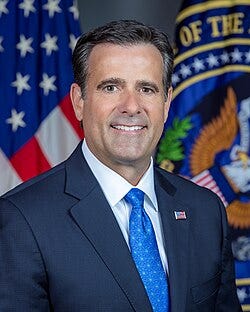
Ratcliffe met Russian intelligence counterparts but not Putin, according to the Kremlin. Kremlin spokesman Dmitry Peskov said Putin was briefed and described intelligence contacts as positive, while saying US-Russia relations remained in a profound crisis.
The visit came as Russia intensified its offensive in Ukraine and US-brokered peace talks stalled. Ratcliffe also discussed the Iran war, warning of additional sanctions if the Strait of Hormuz does not reopen to shipping. President Donald Trump described the Moscow trip as semi-routine and suggested its focus was ending the Ukraine war.
Sources: Japan Times, The Independent

Russia is preparing to intensify attacks on Ukraine after concluding that peace negotiations have reached a dead end, according to people close to the Kremlin. Moscow is weighing stronger conventional ballistic missile strikes on Kyiv, including the city centre and infrastructure in other Ukrainian cities.
The reported shift follows the collapse of negotiation frameworks and stalled US efforts to end the war. Kremlin-linked sources say Moscow sees few alternatives to further escalation in pursuit of its war goals and increasingly views Ukrainian strikes as attacks by NATO because alliance members provide weapons and intelligence.
Russia and Ukraine have already stepped up air attacks on each other’s territory, while Russian missile strikes have exposed shortages in Ukraine’s air defences.
Some Russian officials now discuss tactical nuclear weapons as a possible last resort, though there is no sign Moscow is preparing to use them and analysts assess the risk as extremely low.
Sources: Bloomberg, Kyiv Post

Uganda has been declared free of Ebola after completing the World Health Organization’s 42-day monitoring period without new transmission, following an initial outbreak that caused 20 cases and two deaths. The Ugandan government had declared the outbreak over on July 28, while WHO continued monitoring to ensure no transmission chains had been missed.
Across the border, the Democratic Republic of Congo is facing the second-deadliest Ebola outbreak on record. More than 5,600 cases and 2,700 deaths had been reported by Tuesday, with WHO official Dr Marie Roseline Belizaire saying transmission remained very active despite improvements in testing and contact tracing.
WHO has identified an immediate $30 million funding gap for logistics to deliver medical and protective equipment in the worst-hit areas of Congo. Belizaire warned that without the investment, progress in slowing the outbreak could stall, even as Uganda expands cross-border support.
Sources: Reuters, Al Jazeera

Nigeria has launched a major rescue operation after an estimated 600 worshippers were abducted during an attack near Dekera village in north-central Niger State. President Bola Tinubu ordered the military, police and intelligence agencies to act immediately, while local authorities continued trying to verify the number missing.
An official from Borgu district said 30 people were killed in the attack and buried on Sunday. Video released by the kidnappers showed large groups of captives in a forested area surrounded by armed men, with children heard crying.
Mass kidnappings for ransom have become common across parts of northern Nigeria and have increased since the start of the year. The issue is politically sensitive ahead of January’s presidential election, when security is expected to be a major campaign issue. Tinubu has ordered regular updates until all those abducted are accounted for.
Sources: RFI, Al Jazeera

Meta has agreed to pay up to $17.1 billion to 47 states, the District of Columbia and US territories and make major product changes to settle claims that Facebook and Instagram harmed children. The settlement ends a bellwether federal trial and will be paid over 10 years.
For US teen users across the country, Meta will impose two-hour daily limits across Instagram and Facebook, restrict use between midnight and 6 a.m., silence notifications during school hours, limit beauty filters and like counts, and strengthen age verification and parental controls.
Meta will initially pay about $12 billion, with another $5 billion due if Snap, TikTok and YouTube reach similar settlements involving financial penalties and product changes. The agreement is designed to encourage an industry standard rather than single out Meta. Thousands of other lawsuits against social media companies remain unresolved.
Sources: New York Times, BBC
Restacking or sharing this publication means more people can read it. Commenting extends the conversation. Liking shows your appreciation.
On this day …
On this day in 1955, the first edition of The Guinness Book of Records was published in Britain. The idea had emerged after Sir Hugh Beaver, managing director of the Guinness brewery, became involved in an argument over which was Europe’s fastest game bird and realised there was no readily available reference book capable of settling such disputes.
What began partly as a promotional exercise for a brewing company became an international publishing phenomenon. The book sold millions of copies, expanded into numerous languages and eventually became a global institution devoted to documenting extraordinary human achievements and natural phenomena.
Sometimes enduring businesses begin not with a grand strategy, but with somebody noticing a surprisingly simple gap in the market.