


Slimmed-Down Peace Plan Moves to Leaders for Decision
Russia Strikes Kyiv as Peace Plan Talks Intensify
Trump Balances China–Japan Rift as Taiwan Tensions Rise
Three-Month Ceasefire Declared Amid Deep Rift in Sudan’s War
US Terror Listing Escalates Pressure on Maduro’s Inner Circle
Judge Voids Trump-Era Indictments Over Illegal Appointment
Ethiopia Volcano Erupts, Sending Ash Across Regions
North Korea Expands Nuclear Sites as Seoul Unveils New Missile
Germany Lifts Israel Arms Pause Amid Amnesty Criticism
Pakistan Strikes Kill 10 Civilians, Taliban Warns of Escalation
On this day …..
On this day in 2016, Fidel Castro died.
Fidel Castro’s death closed the chapter on one of the longest political careers of the 20th century. His rule shaped Cuba’s domestic structures, foreign alliances, and its enduring confrontation with the United States. Reactions were sharply divided:
Havana declared national mourning, while exile communities marked the end of what they viewed as decades of repression. Internationally, governments reflected on Castro’s complex legacy—revolutionary symbolism for some, authoritarian rigidity for others.
Has Cuba’s political trajectory since 2016 shifted meaningfully, or has the system remained shaped by the structures Castro left behind?

U.S. and Ukrainian negotiators have produced a heavily revised peace framework after two days of tense talks in Geneva, setting aside the most sensitive questions for President Trump and President Zelensky to resolve.
Ukrainian officials stressed firm red lines on territory, military capacity and alliances, while both sides described the discussions as productive and said an updated draft would be taken back to their capitals for review. As a result, the process has moved into a political phase where the core decisions rest with the two leaders.
But the revisions leave major uncertainties. Earlier U.S. drafts, developed with Russian input, had proposed ceding land, limiting Ukraine’s forces and ruling out NATO membership - measures widely condemned in Kyiv and among European allies. Meanwhile, Washington signalled it may drop proposals such as army caps, and Europe reiterated that any settlement must preserve Ukraine’s sovereignty. With the most difficult issues deferred, the outcome remains unclear.
Sources: New York Times, FT

Russia launched a wave of attacks on Kyiv early Tuesday, damaging residential buildings in the Pechersk and Dniprovskyi districts and hitting energy infrastructure. Ukrainian officials said at least two people were killed, six injured, and 18 rescued, while a later strike in Brovarsky, Bila Tserkva and Vyshgorod wounded a 14-year-old. Video footage showed fires spreading through a nine-storey building, and authorities confirmed multiple floors were engulfed. Meanwhile, Russia said it destroyed 249 Ukrainian drones overnight across several regions, including Crimea.
The attacks came as US and Ukrainian negotiators met in Geneva to amend Washington’s 28-point peace proposal. Ukrainian delegates said talks were “very constructive”, though sensitive issues remain. President Volodymyr Zelenskyy said the updated framework includes “many of the right elements”, but territory questions must be resolved at leader level.
However, Kremlin spokesperson Dmitry Peskov said Moscow had not seen the revised plan.
Negotiations continue in parallel. A US official confirmed Army Secretary Dan Driscoll met Russian representatives in Abu Dhabi as all sides seek a deal to halt fighting “as quickly as possible”.
Sources: Associated Press, Al Jazeera

Donald Trump held back-to-back calls with Xi Jinping and Japanese Prime Minister Sanae Takaichi on Monday, as rising friction between China and Japan threatened to unsettle Washington’s trade truce with Beijing. Xi stressed that Taiwan’s “return to China” was central to Beijing’s postwar vision, while Trump’s public readout focused on trade and fentanyl discussions, omitting any reference to the island. Takaichi said Trump reaffirmed close ties with Tokyo and told her she could call him “any time”.
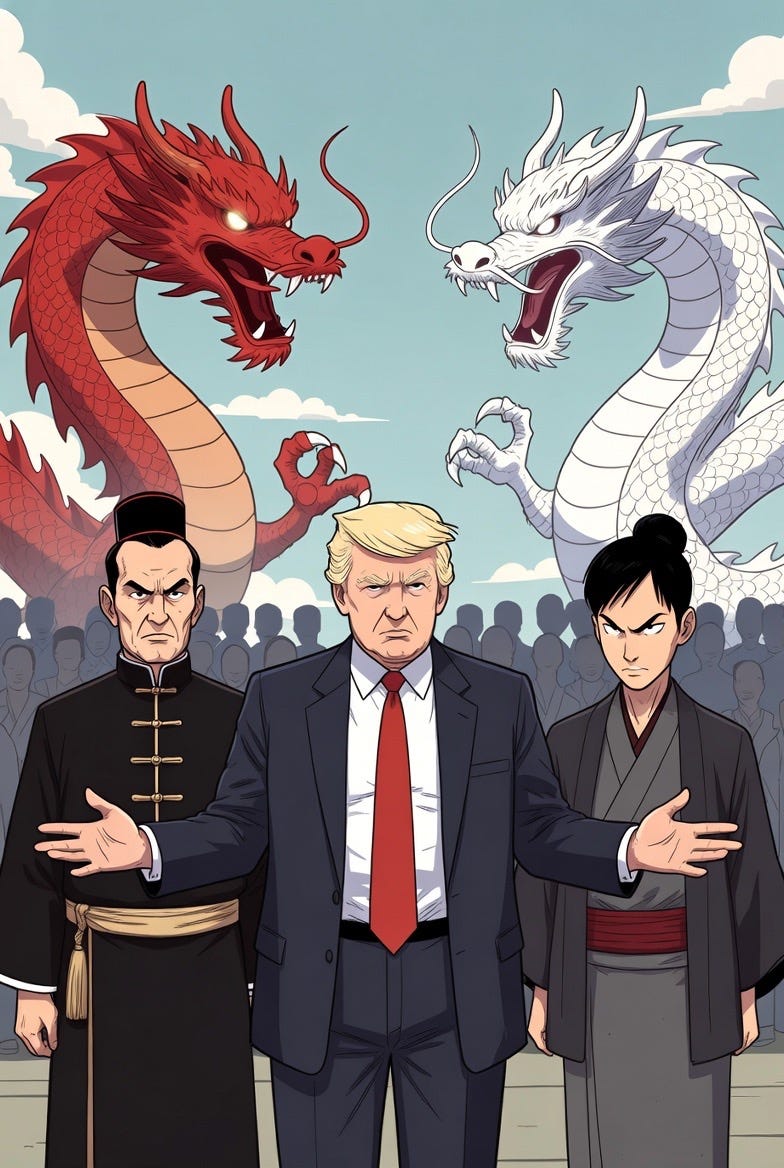
The diplomatic push follows Beijing’s anger over Takaichi’s recent suggestion that Japanese forces could be drawn into a Taiwan conflict, triggering retaliatory steps including travel restrictions, cultural suspensions and criticism of Japan’s missile deployments near Taiwan. Meanwhile, China has asked the UN to rebuke Japan for its remarks.
The balancing act comes as Trump prepares for an April visit to China. However, Beijing expects Takaichi to retract her comments, while Tokyo faces domestic pressure not to yield — leaving little room for de-escalation.
Sources: Bloomberg, Reuters

Sudan’s Rapid Support Forces (RSF) have declared a unilateral three-month humanitarian ceasefire, citing international efforts led by U.S. President Donald Trump. The announcement came after the United States, United Arab Emirates, Egypt and Saudi Arabia proposed a similar truce earlier this month, although Sudan’s army chief rejected the plan and criticised the UAE’s role as mediator. As a result, the ceasefire marks a break with the stalled diplomatic track but leaves the core dispute between the armed groups unresolved.

The RSF said it hoped the Quad countries would press the army to engage, yet the declaration follows a period of intensified RSF activity, including the takeover of al-Fashir and subsequent attacks in Kordofan. Meanwhile, General Abdel Fattah al-Burhan accused Washington’s proposal of weakening the army and refused to accept the RSF in any future settlement.
Both sides face international scrutiny, with accusations against the RSF over civilian attacks and U.S. sanctions imposed on both commanders. However, the war continues to kill civilians and drive famine across the country.
Sources: Reuters, France 24

The United States has designated Venezuela’s Cartel de los Soles as a foreign terrorist organisation, adding new sanctions to a network Washington says links senior officials, including President Nicolás Maduro, to drug trafficking. The move accompanies a major U.S. military build-up in the Caribbean, with an aircraft carrier strike group and other assets deployed as part of operations targeting suspected narcotics-running boats.
However, experts noted that the terrorism statute does not authorise military action, even though U.S. strikes have already killed dozens of people. As a result, the designation increases pressure without altering legal limits on force.
Venezuela dismissed the measure as a fabricated pretext for intervention. Analysts argue the “cartel” is better understood as a system of corruption rather than a structured organisation, while U.S. officials allege links with groups such as Tren de Aragua. Meanwhile, Washington continues to weigh additional options as tensions rise.
Sources: South China Morning Post, PBS

A federal judge has thrown out the criminal cases against former FBI director James Comey and New York Attorney General Letitia James after ruling that the prosecutor who brought them, Lindsey Halligan, was unlawfully appointed. Judge Cameron Currie found that Halligan, installed as interim U.S. attorney at President Donald Trump’s direction, lacked the authority to present cases to a grand jury. As a result, all actions flowing from her appointment were deemed unlawful and must be set aside.
The decision sharply rebuked Trump’s efforts to pursue the two officials, especially as Halligan acted alone in securing indictments despite having no prior prosecutorial experience. Meanwhile, the ruling raised wider questions about how the administration has filled key Justice Department roles, with other courts also scrutinising appointment practices.
However, the Justice Department signalled it would appeal, while the defendants welcomed the decision and suggested the prosecutions were politically driven. The ruling could also influence other challenges to Halligan’s authority.
Sources: Washington Post, NBC News

A long-dormant volcano in northern Ethiopia has erupted for the first time in millennia, sending ash clouds across the Red Sea and disrupting skies as far as India. The Hayli Gubbi volcano in the Afar region erupted for several hours on Sunday, producing plumes that rose up to 14km and drifted over Yemen and Oman.
According to local officials, nearby villages were blanketed in ash, and livestock herders now face shortages of grazing land. As a result, travel in the area was disrupted, with passengers stranded in Afdera.
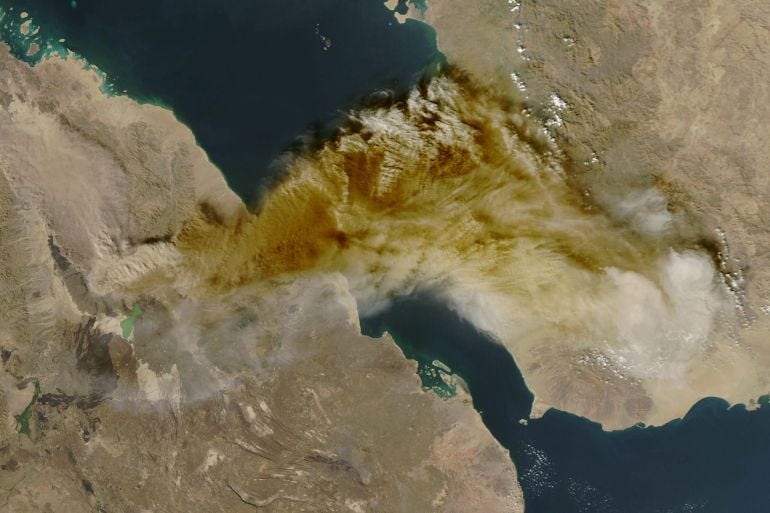
The plume later entered India’s airspace, passing over Gujarat, Rajasthan, Maharashtra, Delhi-NCR, Haryana and Punjab before beginning to drift towards China.
Aviation authorities issued warnings, advising aircraft to avoid affected airspace after visibility was reduced in several areas. Meanwhile, meteorologists said the ash was carried by strong upper-level winds across the Arabian Sea, and flight operations were adjusted as monitoring continued.
Sources: Al Jazeera, Times of India

New satellite imagery shows North Korea accelerating upgrades across its Yongbyon nuclear complex, aligning with Kim Jong-un’s call for the “exponential” growth of his arsenal. Analysts at 38 North identified expansion of suspected enrichment facilities, installation of six heat exchangers used for cooling centrifuges, and continued operation of the 5MWe reactor believed to produce weapons-grade plutonium. Meanwhile, signs of coolant discharge at the experimental light water reactor suggest ongoing pre-operational testing, while construction continues on a partially buried radioactive-waste site.
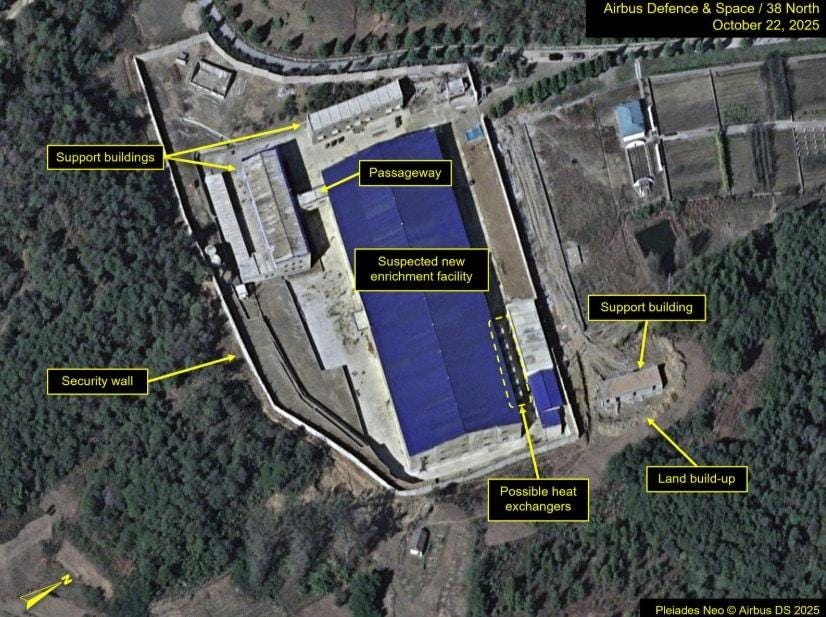
These developments come as South Korea underlines its non-nuclear stance. President Lee Jae-myung reaffirmed commitment to the Nuclear Non-Proliferation Treaty, highlighting reliance on US extended deterrence. However, Seoul is pressing ahead with more powerful conventional systems.
In contrast, Defence Minister Ahn Gyu-back confirmed that deployment of the new Hyunmoo-5 bunker-buster missile — capable of carrying an eight-tonne warhead — will begin at the end of the year.
Sources: South China Morning Post, News 1 Korea

Germany has lifted its partial suspension on weapons exports to Israel, prompting sharp criticism from Amnesty International, which called the decision “reckless” and “unlawful”. Berlin halted most arms transfers in August as Israel moved ahead with its ground operation in Gaza City, but government spokesperson Sebastian Hille said the October 10 ceasefire had brought “fundamental stabilisation”. As a result, export reviews have returned to a case-by-case basis.
Amnesty argued the decision removed one of the few forms of meaningful pressure on Israel, accusing Berlin of enabling ongoing violations of international law. However, Germany remains Israel’s second-largest arms supplier, having approved more than €485m in export licences since October 2023, including anti-tank weapons and tank components.
The criticism comes amid continued reports of Israeli attacks and severe aid restrictions in Gaza. Meanwhile, Germany’s government maintains that licensing controls remain intact. However, Amnesty said citing a ceasefire to justify resumed transfers was “wholly disingenuous” given ongoing displacement and shortages.
Sources: Al Jazeera, Amnesty

Afghanistan’s Taliban administration has accused Pakistan of carrying out overnight air strikes that killed 10 civilians in Khost province, including nine children and one woman. Spokesman Zabihullah Mujahid said a civilian home was bombed in the Gurbuz district, adding that further strikes in Kunar and Paktika wounded four people. However, Pakistan has not commented.
The attacks came a day after a suicide bombing on Pakistan’s Federal Constabulary headquarters in Peshawar, which killed three officers and wounded 11 others. While no group claimed responsibility, state broadcaster PTV reported the attackers were Afghan nationals, and President Asif Zardari blamed the “foreign-backed Fitna al-Khawarij”, Islamabad’s term for Tehreek-e-Taliban Pakistan militants. Meanwhile, another suicide blast in Islamabad earlier this month killed 12 people and was claimed by a TTP faction.
Relations between the neighbours remain tense. Ceasefire talks mediated by Qatar and Turkey have stalled, as Pakistan demands Kabul curb TTP fighters while Afghanistan accuses Islamabad of violating its sovereignty.