


Nvidia Reinstates Huang Following Trump Intervention (Technology)
Allies Warn Of Possible Russian Nuclear Weapon In Space (Geopolitics)
Russia Warns Estonia Its Actions Risk Open War (Europe)
Ukraine Confirms Strikes On Russian Ships Off Libya (Conflict)
Leaked Data Reveals Scale Of Russian Military Deaths (Conflict)
Solomon Islands To End Security Pact With China (Geopolitics)
Netanyahu Pushes Trump To Resume Strikes On Iran (Middle East)
Burnham Rules Out Rejoining EU Without Referendum (UK)
UK Sanctions Myanmar Generals Following Genocide Ruling (Asia)
Wars Threaten Food Aid For Another 7.3 Million People (World)
A succinct daily briefing delivered each weekday to help you stay on top of the stories shaping the world.

Nvidia has reinstated Jensen Huang as chief executive less than two weeks after he resigned following reports of an affair with a suspected Chinese spy. US President Donald Trump said he had personally persuaded Nvidia’s board to reverse its earlier decision, providing assurances that Huang’s return posed no national security threat.

Nvidia shares surged 31.5%, adding a record $952bn to its market capitalisation, while the Nasdaq 100 and S&P 500 gained 6.9% and 4.7% respectively. Trump acknowledged that Nvidia’s recent share price losses had probably influenced his intervention. His personal holdings in the chipmaker increased in value by as much as $15m on Monday.
The reinstatement has drawn bipartisan criticism in Congress, where lawmakers have raised concerns about national security and Nvidia’s compliance with export controls. Huang is due to testify publicly before the Senate Banking Committee on 3 December, with Democrats promising further investigations.
Share markets in Asia were broadly higher on Tuesday following the news.
Sources: BBC, FT

Western intelligence agencies have warned that Russia could launch a satellite designed to carry a nuclear warhead as early as December. Intelligence reports circulated among NATO countries in early November suggest the programme is more advanced than previously reported. Kremlin spokesman Dmitry Peskov dismissed the reports on Monday.

The warnings come amid growing competition between Russia, China and the US to develop offensive capabilities in space. US Air Force Secretary Troy Meink confirmed in September that Washington had deployed a weapon in orbit, without disclosing its capabilities. Placing a nuclear weapon in orbit would violate the 1967 Outer Space Treaty, to which Russia is a signatory.
The US Defence Intelligence Agency has warned that a nuclear weapon in space could damage or destroy thousands of satellites. The consequences would extend beyond military infrastructure, potentially disrupting civilian services including telecommunications and traffic control.
Sources: Bloomberg, The Guardian

Russia’s Foreign Ministry accused Estonia on Monday of hostile actions that risk triggering open war, following Tallinn’s decision to close its land border with Russia. Estonia, a NATO and European Union member, plans to close border crossings from 1 December for at least six months, after accusing Russian security services of an attempted arson attack on an Estonian defence company. Moscow denies involvement.
Russia summoned Estonia’s chargé d’affaires, accusing Tallinn of allowing Ukrainian drones to use its airspace to attack Russian targets and attempting to obstruct Russian shipping in the Baltic Sea. Estonia denied permitting its territory to be used for foreign military operations.
NATO Secretary General Mark Rutte said the alliance was monitoring developments in Estonia alongside last week’s incursion by Russian missiles into Polish airspace. He said NATO would continue assessing its deterrence and defence posture, making adjustments where necessary.
Sources: Reuters, Al Jazeera

Ukraine confirmed on Monday that it was behind Sunday’s attacks on two Russian vessels off Libya, extending its maritime operations against Russia beyond the Black Sea. Ukrainian President Volodymyr Zelensky said the strikes sank the Russian corvette Merkury, commissioned in 2023, and hit the cargo vessel MV Angara, which he said was transporting weapons.
The attacks follow years of Ukrainian operations against Russian naval assets and shipping, including vessels associated with Moscow’s shadow fleet in the Mediterranean. Russia has long supported Khalifa Haftar’s eastern Libyan government, using the region as a staging post for its military presence in North Africa and the Sahel.
Both of Libya’s rival governments condemned the attacks, with eastern authorities requesting an international investigation and the UN-recognised government in Tripoli rejecting foreign military operations on Libyan territory. The United Nations warned against Libya becoming a battleground for foreign conflicts.
Sources: RFI, The Guardian

More than 700,000 Russian soldiers are estimated to have died during the war in Ukraine, according to new analysis of leaked data from Russia’s state statistics agency, Rosstat. Researchers identified at least 490,000 military deaths recorded by September, with the higher estimate accounting for registration delays and missing personnel believed to be dead.
Separate analysis of the leaked records identified 1,087 military suicides since the full-scale invasion began. Recorded suicides increased from more than 50 in 2022 to 365 in 2025, with almost 300 already documented in incomplete records for 2026. Analysts believe the figures underestimate the actual number.
Military analysts attribute the strain on Russian personnel to heavy losses, harsh discipline, coercion and dangerous combat assignments. Michael Kofman, a senior fellow at the Carnegie Endowment for International Peace, estimates Russia remains on track to recruit approximately 409,000 soldiers in 2026, despite losing personnel faster than it recruits them.
Sources: The Guardian, New York Times

Solomon Islands has reportedly informed Beijing that it will not renew its security agreement with China when the five-year pact expires in April. Solomon Islands Prime Minister Matthew Wale and Australian Prime Minister Anthony Albanese are expected to sign a comprehensive treaty in Canberra on Wednesday, consolidating Australia’s position as the Pacific nation’s principal security partner.
The 2022 agreement allowed Solomon Islands to request Chinese police and military personnel and permitted Chinese naval vessels to make stopovers. Its signing prompted Australia to pursue security agreements with other Pacific nations, including Papua New Guinea, Fiji, Vanuatu, Nauru and Tuvalu.
The new Australian treaty is expected to cover security, education, health, infrastructure, justice and climate resilience, with leaked correspondence indicating Australian funding of $980 million by 2028. Solomon Islands opposition leader Manasseh Sogavare warned against abandoning the Chinese agreement without assessing the consequences for national interests and sovereignty.
Sources: Sydney Morning Herald, RNZ

Israeli Prime Minister Benjamin Netanyahu has reportedly urged US President Donald Trump to authorise renewed military strikes against Iran, arguing that another intensive campaign could bring down the Iranian government. US administration officials, however, say Washington has decided to delay military action for at least a week, with Trump indicating a preference to wait until after New Year.
White House advisers remain divided between maintaining the economic blockade, which officials believe is producing results, and launching another military offensive. Qatar continues to mediate between Washington and Tehran, while some US advisers question whether renewed strikes would achieve Netanyahu’s objectives.
Israeli military intelligence officials have reportedly warned that unilateral action could trigger a wider regional war involving Lebanon, Syria and Gaza. Some White House advisers also suspect domestic political motivations behind Netanyahu’s proposal, as he continues to lead a caretaker government without a parliamentary majority.
Sources: The Independent, YNet News

British Prime Minister Andy Burnham told Parliament on Monday that it would be “unthinkable” for Britain to rejoin the European Union without another referendum. While personally favouring renewed membership, Burnham said his government had no predetermined position and would outline options for closer European ties next month.
Britain and the EU have agreed to explore several possible arrangements, including Swiss-style sectoral alignment, membership of the single market and customs union and full EU membership. Burnham has ruled out rejoining the single market or customs union during the current Parliament, with concrete steps towards a deeper relationship expected after the next general election.
The announcement follows Friday’s agreements covering food and drink checks, emissions trading and youth mobility, which the government estimates will eventually add £17 billion annually to Britain’s economy. Four former Conservative prime ministers have warned Burnham against reopening the Brexit debate.
Sources: The Guardian, Straits Times

Britain imposed sanctions on five senior Myanmar military officers on Monday after the International Court of Justice (ICJ) ruled last week that Myanmar had committed genocide against the Rohingya minority in 2017. The judgment marked the first time a state had been found responsible for genocide, with the court determining that approximately 10,000 Rohingya were murdered during military operations in Rakhine state.
British Foreign Secretary Ed Miliband announced forthcoming legislation prohibiting the supply of aviation fuel to Myanmar, following the expulsion of its defence attaché last week. Britain will also raise the issue at the UN Security Council and provide £8 million in additional assistance to Rohingya survivors and affected communities.
Fourteen countries, including Britain, Australia and Canada, issued a joint statement acknowledging the ruling and calling on Myanmar to comply with its binding legal obligations. Myanmar has denied the allegations against it.
Sources: BBC, South China Morning Post

World Food Programme (WFP) Executive Director Luke Lindberg warned the UN Security Council on Monday that disruption to shipping routes caused by wars in the Middle East and Ukraine could increase the agency’s costs by $727 million by mid-2027, jeopardising food assistance for another 7.3 million people.
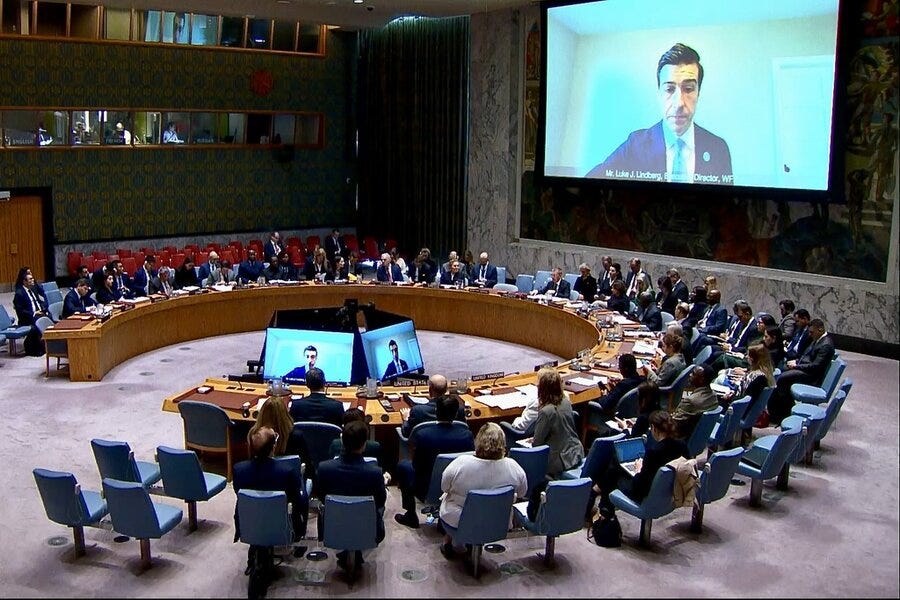
Restrictions on shipping through the Strait of Hormuz, Bab el-Mandeb Strait and Black Sea are increasing food and transport costs. Approximately 30% of global fertiliser supplies pass through Hormuz, with supply constraints threatening agricultural yields next season. Globally, 266 million people already face acute hunger, with parts of Sudan, South Sudan and Somalia at risk of famine.
Lindberg called for a renewed Black Sea humanitarian grain corridor covering both Russian and Ukrainian exports. Approximately 10 million tonnes of wheat from the two countries, enough to feed 44 million people, may not reach global markets this year.
Sources: Reuters, Kurier
Restacking or sharing this publication means more people can read it. Commenting extends the conversation. Liking shows your appreciation.
On this day …
On this day in 1859, British naturalist Charles Darwin published On the Origin of Species, presenting his theory of evolution through natural selection.
Drawing on decades of observation and research, Darwin argued that species changed over generations as inherited characteristics affecting survival and reproduction became more or less common. His work challenged prevailing explanations of the natural world and generated considerable scientific, religious and philosophical debate.
The book became a foundation of modern evolutionary biology, transforming scientific understanding of life’s diversity and the relationship between species.
More than 160 years later, Darwin’s work remains an example of how scientific discoveries can fundamentally alter humanity’s understanding of itself and the world that we inhabit.