


France’s Heatwave Forces Closures And Raises Risks (Climate)
Global Trust In US Falls Under Trump (World)
Congress Rebukes Trump Over Iran War Powers (US)
Inspection Dispute Clouds US Iran Talks (Middle East)
UN Evacuates Sailors From Hormuz Strait (Middle East)
UN Inquiry Accuses Israel Over Gaza Children (Middle East)
Russia Faults US Over Trump Putin Talks (Geopolitics)
China Supercomputer Tops US Machines (Technology)
Alibaba Challenges US Defence Blacklist (US)
Myanmar War Deepens Civilian Catastrophe (Conflict)
A succinct daily briefing delivered each weekday to help you stay on top of the stories shaping the world.

France recorded its hottest day since records began as a heatwave pushed temperatures above 43C in parts of the country and left at least 40 people dead after swimming in unsupervised areas to escape the heat.
Prime Minister Sebastien Lecornu said the victims were mainly young people, while local authorities linked the deaths of two children found unconscious in a car to the extreme conditions. The International Federation of Red Cross and Red Crescent Societies warned of serious health risks across Europe.
The heatwave strained power grids and public services, with schools adjusting timetables and major tourist sites shortening opening hours. The Eiffel Tower and Louvre announced early closures, while more than half of mainland France remained under the highest alert level.
Britain, Spain and Italy also faced unusually high temperatures as forecasters warned the pattern would persist.
Sources: Al Jazeera, France 24

A new Pew Research Center survey found sharply negative global views of US President Donald Trump and declining confidence in the United States as a reliable partner. Across 36 countries, a median of 23 percent of adults expressed confidence in Trump’s leadership of world affairs, while 57 percent held an unfavourable view of the US.
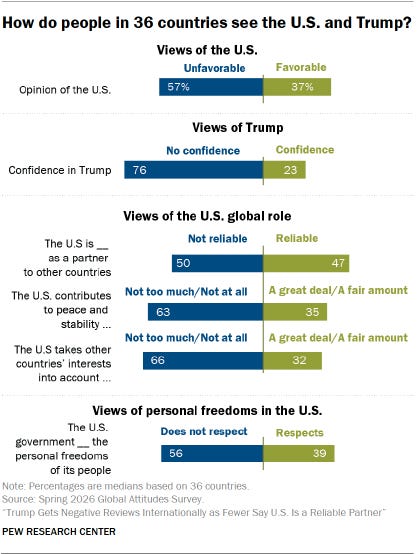
The survey, conducted from February 8 to May 13, also found steep declines in perceptions of US reliability since 2022, including among longstanding economic and security partners. In Canada, the share describing the US as reliable fell from 83 percent to 35 percent, while large declines were also recorded in Asia-Pacific partners.
The findings point to a broader deterioration in America’s international standing, with Trump receiving poor marks on tariffs, Gaza, Iran, Greenland and the Russia-Ukraine war, and only 32 percent saying the US considers other countries’ interests.
Sources: The Hill, Axios, Pew Research

The US Senate backed a war powers resolution directing US President Donald Trump to halt military action against Iran, after the measure had already passed the House of Representatives. The 50-48 vote marked the first time both chambers had approved a resolution directing a president to remove US forces from hostilities since the War Powers Act was enacted in 1973.
The resolution is likely to remain largely symbolic, with the White House saying it has no force of law and that hostilities ended with an April 7 ceasefire. Trump called the vote “poorly timed and meaningless” and said it had made his job more difficult.
The vote nevertheless exposed strain inside Congress as the conflict nears its fifth month. Four Republican senators joined most Democrats in the vote, while the administration is expected to seek tens of billions of dollars to pay for the war.
Sources: South China Morning Post, BBC

US and Iran remained at odds over whether Tehran had agreed to allow UN inspections of its nuclear sites, as talks continued in Switzerland on ending the war and reopening the Strait of Hormuz. US President Donald Trump said Iran had agreed to inspections and warned he would cut off talks if it had not.
Iranian Foreign Ministry spokesman Esmail Baghaei said inspectors were not scheduled to examine nuclear sites bombed by the US and Israel in June 2025. Iran’s President Masoud Pezeshkian also said curbs on missile capabilities would never be part of a future peace agreement.
The dispute exposed unresolved gaps in a deal reached last week, which calls for Tehran to dilute enriched uranium, waives US-backed sanctions and gives both sides 60 days to reach broader agreements, while a UN maritime agency works to free ships trapped in the Gulf.
Sources: Associated Press, New York Times
The United Nations’ International Maritime Organization has begun evacuating more than 11,000 sailors stranded in the Strait of Hormuz after the United States and Iran signed a memorandum of understanding to end the US-Israel war on Iran. IMO Secretary-General Arsenio Dominguez said the operation would involve Iran, Oman, other coastal states, the United States and the maritime industry.
Tehran had effectively closed the strait after the war began on February 28, leaving vessels stuck on the waterway. The IMO said 14 seafarers died during the conflict and that safety guarantees had been secured for navigation.
Shipping traffic has increased since last week’s agreement, with at least 36 commercial vessels passing through the strait on Monday. US Secretary of State Marco Rubio said Iran would not be allowed to charge tolls, while Tehran’s top negotiator said the strait would never return to the pre-war status quo.
Sources: Al Jazeera, Axios, IMO
Restacking this post will help it reach more readers interested in the world.

A UN independent commission of inquiry said Israel continues to commit genocide by deliberately targeting Palestinian children in Gaza, including after an October 2025 ceasefire. The report said about 30 percent of people killed by Israeli forces have been children, and that deliberate targeting was a key element in establishing genocidal intent.
Srinivasan Muralidhar, the commission’s chair, said evidence showed Palestinian children had been deliberately targeted and killed by Israeli security forces. The commission said Israeli forces continued using high-payload munitions in densely populated areas despite mounting child casualties.
Israel rejected the report as a “libellous sham” and denied the allegations. The inquiry also said repeated displacement, starvation caused by blockade, attacks on healthcare and reproductive facilities, and near-universal psychological harm had severely damaged children’s health, development and survival.
Sources: The Guardian, CBC, UN

Russia accused the United States of failing to deliver on “understandings” reached between Russian President Vladimir Putin and US President Donald Trump at a summit in Alaska last August, signalling growing frustration in Moscow. Three senior Russian officials made the claim in three days without providing specifics.
The comments followed intensified Ukrainian drone strikes deep inside Russia, including two attacks last week on a Moscow oil refinery, and a G7 summit where Ukrainian President Volodymyr Zelenskiy told Western leaders that Kyiv was turning the tide of the war. Moscow rejected that and continued heavy attacks of its own.
Russian Foreign Minister Sergei Lavrov suggested the Alaska summit may have been a US “ploy to buy time to rearm the Kyiv regime”. Analysts said Moscow wants Washington to resume diplomacy to help Russia end the war on its own terms.
Sources: Reuters, Canberra Times

China’s LineShine supercomputer has become the world’s fastest machine in the Top500 ranking, displacing the US system El Capitan and marking the first time since 2017 that a Chinese computer has led the list. The Shenzhen-based system debuted at number one after achieving 2.198 exaflops, or more than 2 quintillion calculations per second.

LineShine runs entirely on conventional computer chips rather than graphics processors commonly used for AI, and requires about 42.2 megawatts of electricity to operate. Experts said the result may show Beijing’s desire to display self-sufficiency in computing systems rather than dominance in AI.
The ranking comes as the US and China increasingly compete in advanced computing. US President Donald Trump signed an executive order on Monday aimed at putting the US ahead of China in quantum computing.
Sources: The Guardian, Reuters

Alibaba sued the US government after being placed on a Pentagon list of Chinese businesses linked to China’s military, arguing the designation has “no basis in fact or law”. The complaint was filed in federal court in San Jose after the Defence Department expanded its blacklist of alleged Chinese military companies on June 8 to 188 entities.
The Pentagon accused Alibaba of being a “military-civil fusion contributor” to China’s defence industrial base through ties to China’s Ministry of Industry and Information Technology, and said it was indirectly affiliated with SASAC. Alibaba said it is governed by an independent board with no military affiliation and that its products serve retail, logistics and enterprise information technology, not weapons, defence or intelligence.
The lawsuit seeks removal from the list. Under recent US law, the Pentagon cannot contract with listed companies from this month, or buy their products through third parties from 2027.
Sources: Reuters, BBC

Myanmar’s civil war has left the country fractured five years after the military seized power in a 2021 coup, with rebel groups outgunned and civilians facing raids, airstrikes and forced isolation. The United Nations says more than 90,000 civilians and combatants have been killed nationwide and 3.7 million people displaced.
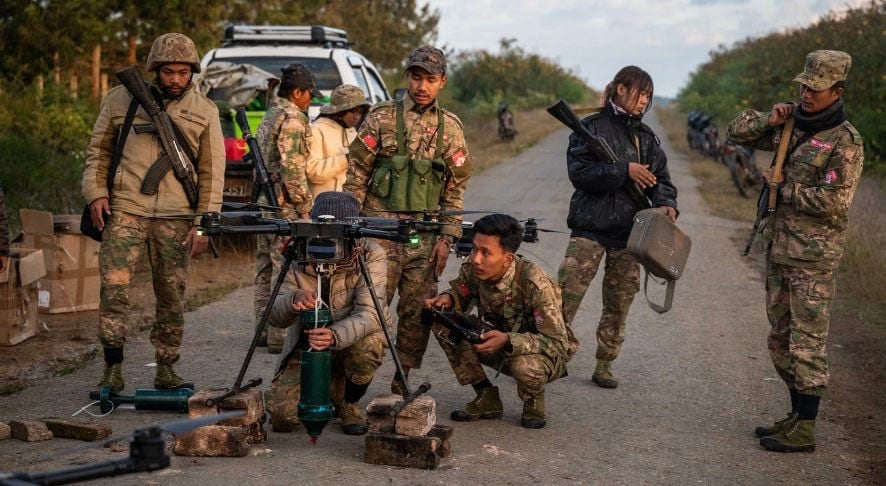
In Anyar, a central region that has become a stronghold of armed resistance, the military has used drones, fighter jets, helicopters, gyrocopters and paragliders to attack villages. In March, about 240 airstrikes killed more than 400 people, many in Anyar, according to A.C.L.E.D.
A separate UN report said the military was responsible for at least 702 civilian deaths during the six-month election period, including 224 women and 153 children. UN Human Rights Chief Volker Türk said Myanmar’s people had been “forgotten” outside the country.
Sources: New York Times, BBC
Restacking or sharing this publication means more people can read it. Commenting extends the conversation. Liking shows your appreciation.
On this day …
On this day in 1948, the Soviet Union began the Berlin Blockade, cutting off road, rail and canal access to West Berlin in an attempt to force the Western Allies out of the city.
In response, the United States and its allies organised the Berlin Airlift, delivering food, fuel and supplies by air for almost a year.
The crisis became one of the first major confrontations of the Cold War and demonstrated the growing division between East and West.
It also helped shape the alliances and institutions that defined the post-war era.
Crises often reveal the foundations of a new international order.