


World Leaders Gather as UN Faces Test of Relevance (Diplomacy)
Trump Heads Into UN With Allies Fraying (Diplomacy)
US Proposes $10 Billion Gulf Energy Rebuild Fund (Middle East)
UK Backs Saudi Air Defence Against Houthi Attacks (Conflict)
United Russia Wins Record Duma Majority (Politics)
Trump Faces Media Lawsuit After White House Ban (US)
China’s Farm Buying Tests US Trade Truce (Trade)
China Expels Top Generals Over Disloyalty (China)
UK Brings First Charges Over Rwanda Genocide (UK)
Seven Planetary Boundaries Reach Record Breaches (World)
A succinct daily briefing delivered each weekday to help you stay on top of the stories shaping the world.
World leaders are gathering at the United Nations as wars, economic disruption and artificial intelligence test an institution already facing questions over its relevance. Some 130 heads of state & government are expected to speak, while major conflicts including Iran, Gaza, Ukraine, Sudan, Congo and Myanmar dominate the agenda.

The meeting comes as the UN confronts financial strain and calls for reform. Its 193 members have agreed to a package including updates to institutions such as the Security Council. The US has only recently paid part of its outstanding dues. Secretary-General Antonio Guterres’ second term ends on 31 December, with no clear successor yet established.
AI is also moving towards the centre of the agenda. The Security Council has added a high-level meeting on the technology for Wednesday, as concerns grow over the absence of industry controls and global guardrails.
Sources: Associated Press, CNN

Donald Trump enters a week of diplomacy increasingly isolated from traditional US allies as he prepares to address the UN General Assembly and host Chinese President Xi Jinping. Canada remains locked in a trade war with Washington, European allies have been unsettled by Trump’s approach to Greenland and Iran, while Taiwan is worried about a possible shift in US policy.
The strains complicate Washington’s approach to Beijing. Analysts say countries that share US concerns about Chinese trade practices or military power are simultaneously managing shifting and uncertain American demands, hampering a coordinated strategy. Trump, meanwhile, has eased his rhetoric towards China and has alternated between tariffs and efforts to secure trade deals.
The immediate agenda is narrower. Trump is expected to meet Gulf leaders over Iran, sign a Greenland security agreement and pursue talks with Xi, where concrete achievements may be modest.
Sources: Washington Post, New York Times

The Trump administration has proposed investing $5 billion in a new fund to rebuild Middle Eastern energy infrastructure damaged during the Iran war and reduce reliance on the Strait of Hormuz. Washington would seek matching contributions from eight regional partners, creating a $10 billion fund managed by the US Development Finance Corporation.
The proposal targets bypass routes, restoration of energy flows, protection against future attacks and rebuilding essential infrastructure. Potential projects include expanding Saudi Arabia’s Hormuz bypass, Oman’s Port of Duqm and reviving an Iraq-Syria pipeline to the Mediterranean.
The plan comes as Iranian strikes have damaged refineries, oil fields and gas terminals, while attacks have also shut Saudi Arabia’s bypass pipeline. Gulf producers are already pursuing alternative routes, but officials and analysts warn reconstruction before a peace deal could leave new infrastructure exposed to further attacks and create new dependencies between regional states.
Sources: Wall Street Journal, Bloomberg

Britain will provide Saudi Arabia with limited military support against Houthi attacks, with an RAF Voyager refuelling Saudi aircraft conducting defensive missions. Prime Minister Andy Burnham said he approved Saudi Arabia’s request for defensive air-to-air refuelling on the advice of Defence Secretary Wes Streeting and Foreign Secretary Ed Miliband.
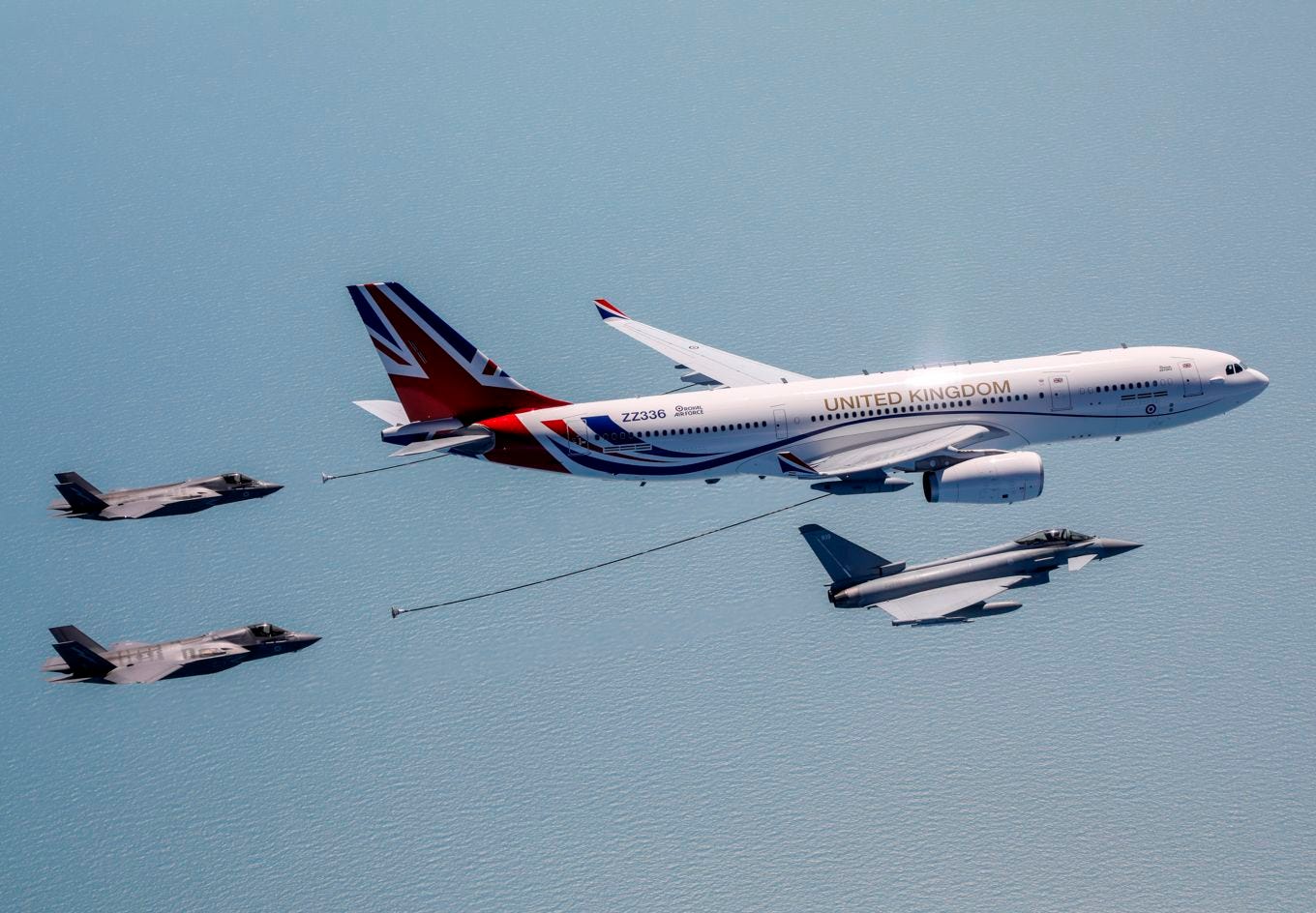
The mission is expected to begin within days and initially last for weeks. UK officials said support could help Saudi jets shoot down incoming Houthi missiles and drones but would not support strikes against the Houthis.
The deployment follows renewed Houthi missile and drone attacks on Saudi Arabia and advances in Yemen, including the seizure of Mokha and Perim Island near the Red Sea.
Burnham linked the decision to British and regional interests, saying Saudi Arabia faced potential further disruption and that key pathways needed to remain open.
Sources: BBC, Al Jazeera

President Vladimir Putin’s United Russia party has won a record 355 seats in Russia’s State Duma, according to near-complete official results, giving it nearly 80 percent of the 450-seat chamber. With more than 95 percent of votes counted, the party had 57.83 percent, up from 49.8 percent in 2021.
The result maintains United Russia’s constitutional majority, allowing it to pass laws and initiate constitutional amendments without other parties. The vote was Russia’s first parliamentary election since its full-scale invasion of Ukraine in 2022. President Putin had presented the vote as a test of support for the war.
Yabloko, Russia’s only registered anti-war party, won no national seats after many of its candidates were barred, although it entered the Novgorod regional parliament. Russia did not invite OSCE observers, while election commission chair Ella Pamfilova called the vote “clean” despite allegations of widespread rigging from opposition activists in exile.
Sources: Al Jazeera, Reuters
If you are getting some value from 10 Things Global News then please restack it

News outlets CNN, Politico and MS NOW have sued President Donald Trump and administration officials after their journalists were barred from the White House. The outlets allege the ban, imposed after Trump accused them of negative and false coverage, constitutes viewpoint discrimination violating the First Amendment.
The dispute has spread beyond the three organisations. ABC, CBS, CNN, Fox News and NBC suspended presidential television pool coverage after the White House prevented CNN from carrying out its assigned duties, leaving no replacement primary TV pooler. The five networks said administrations should not restrict organisations because they object to their reporting.
The lawsuit asks a federal court in Washington to rule the ban unconstitutional and prevent its enforcement. Trump denied attacking press freedom, describing the targeted organisations as fake news and a national-security threat while providing no examples to support that claim.
Sources: BBC, MS NOW

China is more than halfway towards its pledge to buy 25 million tonnes of US soybeans this year but progress on a separate commitment to purchase at least $17 billion of American farm goods has largely stalled. In the first seven months, China bought $3.9 billion of US agricultural products excluding soybeans.
The split highlights Beijing’s selective agricultural buying ahead of this week’s summit between President Donald Trump and Chinese President Xi Jinping. Soybean purchases have accelerated, while sales of corn and wheat for the 2026-27 season remain at zero. Chinese tariffs on US farm goods continue to impede trade.

Meeting the broader commitment would require faster purchases and challenge China’s strategy of diversifying supplies among countries including Canada, Argentina, Brazil and Australia. The two countries have discussed reducing tariffs on American energy and agricultural products, which traders say could enable increased US purchases.
Sources: Japan Times, New York Times

China has expelled two top military leaders, Z hang Youxia and Liu Zhenli, from the Communist Party and military over alleged disloyalty, corruption and serious disciplinary breaches. Zhang was President Xi Jinping’s second in command as vice-chairman of the Central Military Commission and had long been seen as Xi’s closest military ally. Liu was a CMC member and chief of staff of its Joint Staff Department.
The expulsions deepen a sweeping corruption and discipline crackdown that has increasingly targeted the military. Investigations and removals have left only two active figures on the formerly seven-member CMC, including Xi, who serves as chairman.
State media said Zhang and Liu formed cliques and factions and were disloyal and dishonest to the party. Their suspected criminal cases will now be handed to military prosecutors just days before Xi travels to the US for talks with President Donald Trump.
Sources: Al Jazeera, Reuters

UK prosecutors have brought the country’s first charges relating to the 1994 Rwanda genocide, charging Dr Vincent Brown, 65, after a seven-year investigation. Brown, formerly Vincent Bajinya, faces one offence of conduct ancillary to genocide and six offences relating to murder as a crime against humanity.
Frank Ferguson, head of the Crown Prosecution Service’s Special Crime and Counter Terrorism Division, said Brown is alleged to have directed and incited acts of murder and genocide carried out by others. The investigation began in 2019 after a formal request from Rwanda to investigate people allegedly involved in genocide in Kigali’s Rugenge district.
Brown is due before Westminster Magistrates’ Court on Tuesday. Police said other investigations into similar offences remain ongoing in Britain as well. An estimated 800,000 ethnic Tutsis and politically moderate Hutus were killed over 100 days in 1994 by Hutu extremists.
Sources: BBC, Al Jazeera

Seven of Earth’s nine planetary boundaries are now being breached at their highest recorded levels, according to the 2026 Planetary Health Check produced by more than 60 scientists. The transgressed boundaries include climate change, biosphere integrity, land system change, freshwater change, biogeochemical flows, novel entities and ocean acidification, which first breached its boundary in 2025.
Only stratospheric ozone depletion and atmospheric aerosol loading have improved over the past decade, although unsafe aerosol levels persist in some regions. Lead report author Boris Sakschewski said the risk of large-scale, persistent and potentially irreversible change is increasing as the margin for addressing the problems shrinks.

The report also questions whether models may overestimate the resilience of the land carbon sink. Vegetation and soils absorb a substantial share of human carbon dioxide emissions but repeated heat, drought, fire and ecosystem degradation can weaken that uptake.
Sources: The Guardian, Oceanographic Magazine
Restacking or sharing this publication means more people can read it. Commenting extends the conversation. Liking shows your appreciation.
On this day …
On this day in 1980, Iraq launched air strikes against Iranian airfields and began a ground invasion across the border, turning months of deteriorating relations into full-scale war.
The conflict followed Iran’s 1979 revolution and would continue for nearly eight years, ending only after both countries accepted a UN-backed ceasefire in 1988.
Neither side achieved the decisive outcome it sought, while the fighting inflicted enormous human and economic costs and included trench warfare and chemical weapons. The conflict also reshaped security calculations across the Gulf for decades.
How much of the modern Middle East can still be understood through the consequences of the Iran-Iraq War?