


Russia Votes As Ukraine Strikes Moscow (Russia)
UN Gathering Exposes A More Fragmented World (Geopolitics)
Canada Accelerates Its Turn Towards Europe (Diplomacy)
Trump Targets ICC With Sweeping Sanctions (US)
Merz Stays Course After Historic CDU Defeat (Politics)
Meloni Moves To Tighten Rules In Italian Schools (Politics)
Trump Pulls Back From Strikes On Houthis (Middle East)
Oil Falls As Diplomacy Hopes Meet Stronger Saudi Flows (Markets)
North Korea Fires Two More Ballistic Missiles (Asia)
Greenland Deal Expands US Arctic Security Role (Europe)
A succinct daily briefing delivered each weekday to help you stay on top of the stories shaping the world.

Ukraine launched its largest ever drone attack on Moscow and the surrounding region as Russia completed its first parliamentary election since the full-scale invasion began in 2022. Russia’s Defence Ministry said it downed nearly 2,000 Ukrainian drones and eight cruise missiles. Three people were killed in the Moscow region and a facility at Moscow’s oil refinery was damaged.
Moscow Mayor Sergei Sobyanin said the attack was intended to disrupt the election. Ukrainian President Volodymyr Zelensky praised the long-range strikes but did not mention the vote, saying targeted facilities brought in billions of dollars sustaining Russia’s war machine.
Partial official results put the ruling United Russia party on 57.5%, comfortably ahead of its rivals. Most anti-war candidates were barred from the ballot, while permitted opposition parties trailed heavily. The Kremlin is likely to present the result as evidence of public backing for President Vladimir Putin’s policies and the war.
Sources: CNN, Reuters
Nearly 130 heads of state will gather in New York for the UN General Assembly as wars in the Middle East and Ukraine, artificial intelligence and questions over the institution’s relevance dominate the agenda. The UN is facing financial strain after US contribution cuts. Secretary-General Antonio Guterres completes his term at the end of 2026 with no clear frontrunner to replace him.
The meeting comes as countries are building new diplomatic, military and trading relationships amid uncertainty over US policy. Former American allies are among those seeking greater self-reliance, while groupings including BRICS and the Shanghai Cooperation Organisation are deepening cooperation.
The shift extends across regions. Turkey, Pakistan and Saudi Arabia signed a defensive military alliance in August, Europe is debating greater responsibility for its own defence and Canada is seeking closer ties with Europe.
The emerging system is more fragmented, with countries increasingly hedging against dependence on established alliances.
Sources: Reuters, The Guardian
Canada is accelerating its turn towards Europe, with Prime Minister Mark Carney and French President Emmanuel Macron agreeing to deepen cooperation after the EU proposed making Canada its first associate member. The unprecedented status does not currently exist in the bloc, and its terms remain undefined.
Carney and Macron directed their space agencies and defence departments to develop and share infrastructure including space-launch systems. Canada and Norway also agreed to pursue enhanced defence cooperation, while Canada chose a German-Norwegian bid in July for what Carney described as the country’s largest military procurement.
The moves follow a worsening trade dispute with the US, which imposed additional 50% tariffs on $20 billion of Canadian exports. Canada retaliated with tariffs on a roughly equal amount of US products. Carney has framed closer European ties as strengthening sovereignty and resilience, while saying deeper relationships between NATO allies also strengthen the alliance and include the United States.
Sources: Bloomberg, New York Times

The Trump administration is preparing sweeping sanctions against the International Criminal Court that would target the institution rather than individual officials. The measures would prohibit most transactions with the ICC after a grace period, potentially cutting it off from US dollar transactions and much of the global financial system.
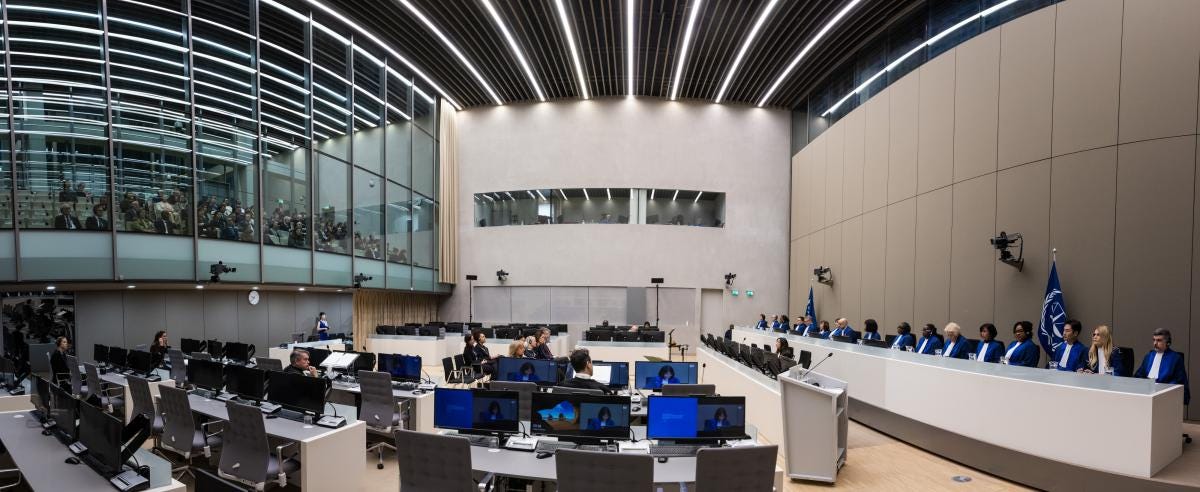
The sanctions could be finalised during this week’s UN General Assembly or soon afterwards. They could disrupt the court’s ability to buy IT and insurance services, hire investigators and make routine payments. European nations and Japan have pledged to protect the ICC, although how remains unclear.
US Secretary of State Marco Rubio said in July that Washington would dismantle the court “brick by brick” if necessary, arguing that pursuing officials from nonmember states threatens US sovereignty. The US and Israel are not ICC members. Relations with the ICC deteriorated after warrants were issued for Israeli Prime Minister Benjamin Netanyahu and former Defence Minister Yoav Gallant.
Sources: Wall Street Journal, Al Jazeera

German Chancellor Friedrich Merz has vowed to remain in office and press ahead with economic, tax and welfare reforms after his CDU suffered damaging defeats in two state elections. In Mecklenburg-Western Pomerania, projections put the party at 4.9%, below the threshold for parliamentary representation and its lowest result in any German state since World War Two.
The AfD led there with 37.9%, while in Berlin the CDU was projected second on 19.1%, behind the Left party on 25.3%. The results follow the CDU’s defeat to the AfD in Saxony-Anhalt two weeks earlier and renewed speculation over Merz’s leadership.
Merz called the Mecklenburg-Western Pomerania result a “disaster” but said the reforms “have to come”. The package includes income-tax cuts for low- and middle-income families, pension reform and reduced bureaucracy. The AfD made gains in both states but was not close to forming a regional government.
Sources: BBC, Associated Press

Italian Prime Minister Giorgia Meloni is preparing legislation to ban burqas and niqabs in schools, limit the number of foreign pupils in each class and require Italian lessons for parents of pupils facing serious integration difficulties. The measures must pass parliament after government approval.
Italy already has a 30% limit on non-Italian pupils under a 2010 ministerial circular, although it has often gone unenforced. Neither burqas nor niqabs are expressly banned, while a 1975 law prohibits garments that make identification difficult without justification.

The proposals come before next year’s election as Meloni faces growing competition from parties further to the right. Retired general Roberto Vannacci’s Futuro Nazionale has called for tougher measures, including action against full-face veils. Constitutional law professor Salvatore Curreri warned that a restrictive pupil cap could conflict with the constitutional right to education if children were forced to attend schools far from home.
Sources: Euronews, Al Jazeera

President Donald Trump has decided against US airstrikes on Yemen’s Houthis for now, after weeks of Saudi appeals and a brief reversal that brought an operation close to launch. Crown Prince Mohammed bin Salman had urged Trump to intervene as Houthi forces advanced, prompting him to order the Pentagon to prepare strikes before pulling back on Sunday.
The decision exposes competing demands on Washington. The Houthis have avoided attacking US ships while targeting Saudi Arabia, whose cooperation the US needs in its war with Iran. In May, Riyadh blocked a US plan to escort oil tankers through the Strait of Hormuz by withholding access to Saudi airspace and American bases.
US officials also doubt limited strikes would force the Houthis to negotiate after last year’s campaign hit more than 1,000 targets without ending their resistance. Renewed fighting could further threaten global energy markets around the Bab al-Mandab Strait.
Sources: New York Times, Times of India

Oil prices fell to their lowest in more than a week as traders weighed possible diplomacy over the US-Iran war alongside stronger-than-expected regional oil flows. Brent dropped 2.08% to $101.71 a barrel, while West Texas Intermediate fell 2.14% to $98.15, breaking below $100.
President Donald Trump said he would be open to meeting Iranian President Masoud Pezeshkian during this week’s UN General Assembly, while Iran has conveyed conditions to mediators for renewed negotiations. Supply risks remain, with the Houthis attacking Saudi targets and the East-West pipeline still disrupted.
Saudi exports have nevertheless recovered above 4 million barrels a day in September from 2.4 million in August. Saudi oil moving through the Strait of Hormuz averaged 2.9 million barrels a day over the past six days, up from 700,000 in August, as Aramco redirected exports through the waterway.
Sources: Reuters, Bloomberg
North Korea launched two short-range ballistic missiles from its eastern Wonsan area on Sunday, three hours apart, according to South Korea’s military. The first flew about 280 miles and the second more than 370 miles before falling into the sea. US Pacific Command said the launches posed no immediate threat to US personnel, territory or allies.
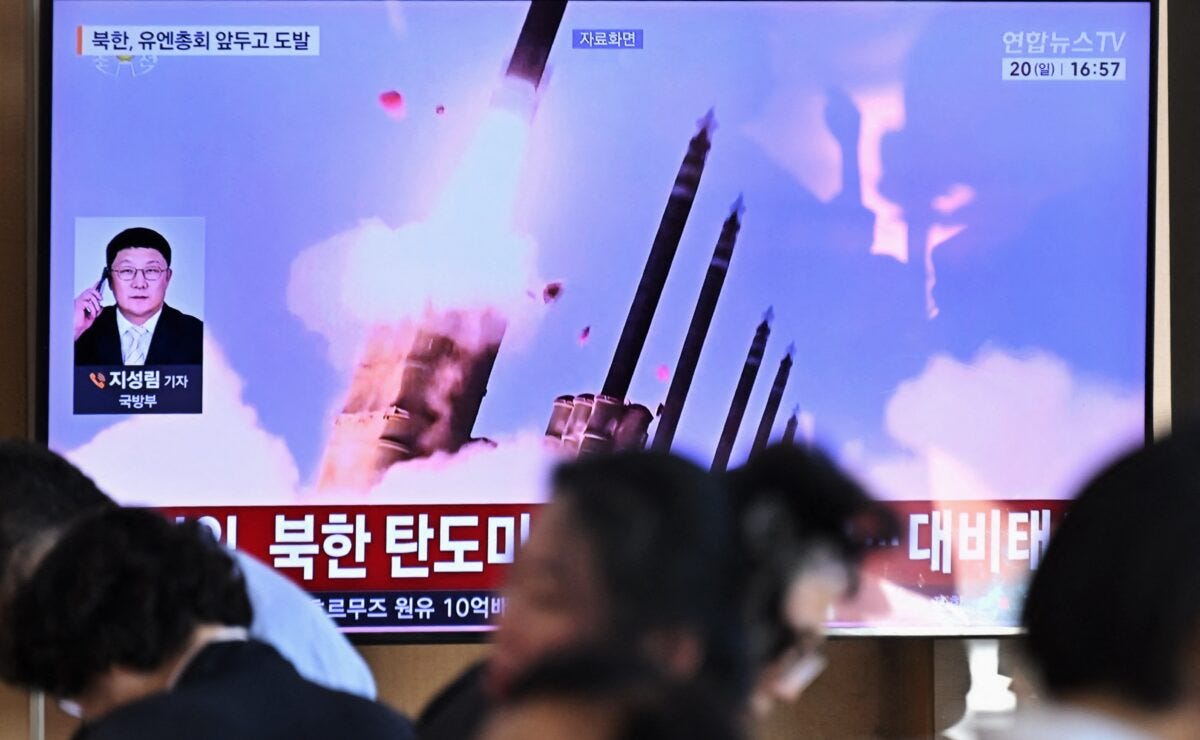
The tests came days after Pyongyang reasserted its nuclear-armed status and rejected a UN resolution demanding it halt nuclear activities. They also followed President Donald Trump’s decision last month to scale back a joint US-South Korean military exercise in an apparent attempt to revive diplomacy with North Korean leader Kim Jong Un.
Kim’s sister and senior official Kim Yo Jong has dismissed the overture and criticised US-led regional exercises. Japan’s Defence Minister Shinjiro Koizumi said North Korea has conducted at least 15 ballistic missile launches this year across nine instances, describing the security situation as increasingly severe.
Sources: CBS News, ABC News
The US, Denmark and Greenland have reached a security agreement allowing Washington to expand its military presence in Greenland while barring US adversaries from establishing bases there. President Donald Trump said the US would have “permanent control” over Greenland’s security and the ability to do what it considers necessary to defend the territory and the United States.
Denmark and Greenland said the agreement would respect the kingdom’s sovereignty, territorial integrity and Greenlanders’ right to self-determination. The deal is expected to be signed during next week’s UN General Assembly and requires parliamentary procedures before entering into force.
The agreement’s text has not been published, leaving key details unclear. An unnamed US State Department official said it includes permanent access, basing and overflight rights and allows the US to build additional military structures without Danish or Greenlandic approval.
NATO said the agreement would advance security, stability and cooperation in the region.
Sources: BBC, The Guardian
Restacking or sharing this publication means more people can read it. Commenting extends the conversation. Liking shows your appreciation.
On this day …
On this day in 1991, Armenia held a referendum on whether to become an independent democratic state outside the Soviet Union. More than 99 per cent of those voting supported independence, with turnout exceeding 95 per cent. The vote followed Armenia’s declaration of independence the previous year and came as Soviet authority was rapidly disintegrating across the union. Armenia formally became an independent state two days later.
The referendum was one of a succession of votes and declarations that transformed the political map of Eurasia in 1991. For Armenians, however, independence carried a deeper historical resonance. The Armenian genocide of 1915-17 had destroyed much of the Armenian population of the Ottoman Empire, while the short-lived independent Armenian republic established in 1918 was absorbed into the Soviet system in 1920.
More than seven decades later, the 1991 referendum restored Armenian sovereignty. For a people whose 20th-century history had encompassed genocide, lost statehood and Soviet rule, independence represented more than the collapse of an empire - it marked the recovery of a state.