


Hormuz Traffic Falls As Ships Navigate Rival Routes (Middle East)
US Escalates Iran Pressure With Sanctions Threat (Middle East)
Army Winds Down Drone Unit Built From Ukraine Lessons (US)
Fedorov Election Gamble Backfires in Ukraine (Europe)
Nord Stream Suspect Arrested Again in Croatia (Europe)
Romania Destroys Drone Near Black Sea Gas Project (Europe)
Russia Fuel Shortages Deepen After Ukrainian Strikes (Russia)
Taiwan Proposes Record Defence Budget for 2027 (Asia)
Hong Kong Convicts Tiananmen Vigil Organisers (Asia)
Imran Khan Taken to Hospital After Court Order (Asia)
A succinct daily briefing delivered each weekday to help you stay on top of the stories shaping the world.

Traffic through the Strait of Hormuz remains sharply constrained as ships try to navigate competing US and Iranian demands. Kpler data showed seven commodity ships transited on Thursday, half Wednesday’s tally, with four entering and three exiting. No very large crude carriers or LNG tankers were recorded, although one very large gas carrier left via the Iranian route.
The latest figures follow data showing 236 ships crossed Hormuz between August 1 and 19. Of those, 83 openly used the Iranian route, three the Omani route and two the pre-war central route, while 148 went dark or used unknown routes. Vessels travelling with transponders switched off are absent from tracking data.
The pattern leaves control difficult to determine. Iran retains significant capacity to disrupt maritime traffic while alternative logistics and ship-to-ship transfers indicate that its ability to exert influence through the strait is not absolute.
Sources: Al Jazeera, Reuters

The United States is preparing what Treasury chief Scott Bessent called “the toughest sanctions in history” against Iran, alongside an existing naval blockade. Bessent said the measures could reduce the likelihood of a large-scale return to military force and promised details on Monday.
President Donald Trump had earlier threatened “Economic Warfare and Isolation on an unprecedented scale”, warning that countries providing Iran with financial or commercial support would face economic consequences.
Oil prices rose to more than a three-week high after the threats.
Washington also imposed new sanctions on an alleged Hezbollah financing network and amended the group’s terrorist designation to state that it operates in service to Iran under the command of the Islamic Revolutionary Guard Corps. The measures target 10 people accused of helping move cash outside the formal financial system.
Together, the steps place economic coercion at the centre of Washington’s next move in the Middle East.
Sources: Reuters, Times of Israel

The U.S. Army plans to phase out an experimental drone assault battalion in Europe that was created to study lessons from the war in Ukraine and develop concepts for fighting with drones and ground robots. After exercises in Germany, the unit will report its findings and return to its core role as an airborne infantry battalion.
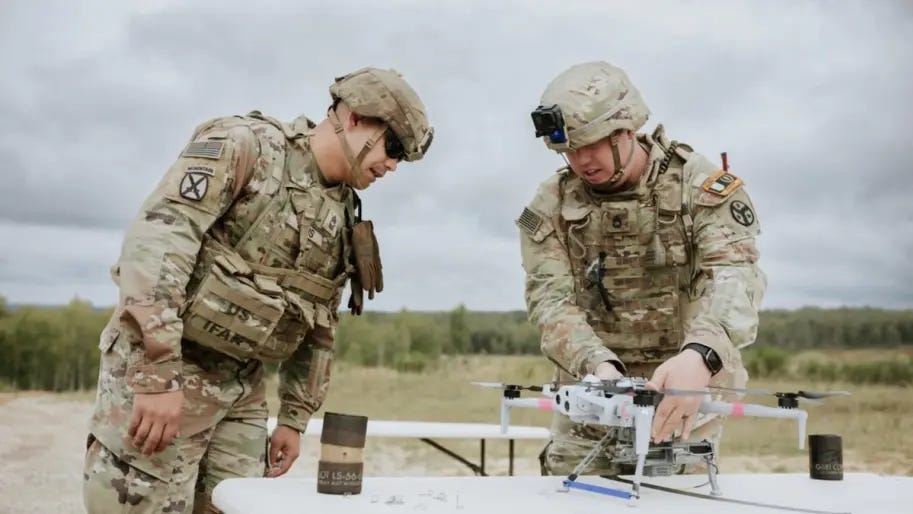
The move forms part of a broader back-to-basics approach under acting Army Chief of Staff Gen. Christopher LaNeve, who succeeded Gen. Randy George after Defense Secretary Pete Hegseth ousted him in April. The Army says it remains committed to accelerating military drone dominance.
Critics argue the phaseout could slow adaptation to a form of warfare that has transformed battlefields in Ukraine and the Middle East. The Army has not said how it will accelerate drone-warfare capabilities after the battalion is wound down.
Sources: The Hill, Wall Street Journal

Ousted Ukrainian defence minister Mykhailo Fedorov’s attempt to broaden his dispute with President Volodymyr Zelenskiy by calling for wartime elections has failed to win over protesters who had demanded his return.
Parliament approved Zelenskiy’s choice of Yevhenii Khmara as defence minister on Wednesday while only a few dozen protesters remained in a Kyiv square where thousands had previously gathered.
Fedorov’s July dismissal had triggered demonstrations over concerns about his removal and Ukraine’s war effort. But an August 5 poll found 57% of Ukrainians wanted elections only after fighting ends and protest organisers rejected the idea of voting while troops remain at the front.
The episode marks a reversal for Fedorov, who had been seen as a potential challenger to Zelenskiy. Analysts said his election call misjudged public sentiment and could damage his political capital before a vote can realistically be held.
Sources: Reuters, Bloomberg
Croatian police have arrested Ukrainian diver Volodymyr Zhuravlev under a German European arrest warrant over the 2022 Nord Stream explosions. German prosecutors accuse him of helping plant explosives on the Baltic Sea pipelines linking Russia and Germany, three of whose four lines were destroyed.
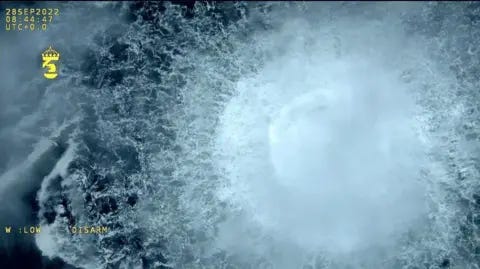
Zhuravlev had previously been detained in Poland, where a court refused Germany’s extradition request, ruling that any Ukrainian attack could be considered a legitimate act of war. His lawyers are expected to challenge extradition from Croatia on similar grounds.
The case creates a fresh test of European legal consistency. Zhuravlev’s Polish lawyer Tymoteusz Paprocki said Croatia would effectively be considering the same person, facts, laws and arrest warrant already examined in Poland, raising the question of whether EU courts will interpret international law differently.
Germany is seeking his extradition to face prosecution there.
Sources: Euronews, The Guardian
Restacking this post will help it reach more readers interested in the world.
Romania scrambled F-16 fighter jets to destroy a marine drone detected a few hundred metres from the Neptun Deep gas project in the Black Sea. Defence Minister Radu Miruta said the drone contained explosives and was destroyed to protect several hundred people working on the platform and secure critical infrastructure.
President Nicusor Dan blamed Russia, condemning what he called an intensification of irresponsible incidents by the Russian Federation. Ukraine told Romania that the drone was not operated by its forces, while Russia issued no immediate public comment.
The incident follows the destruction of two Gerbera-type drones near Neptun Deep earlier this month. The offshore project is expected to make Romania the EU’s largest gas producer when it starts production in 2027, while NATO states Romania, Bulgaria and Turkey have already neutralised more than 150 mines drifting across Black Sea trade lanes.
Sources: Politico, Reuters

Petrol was available at just 28% of Russian filling stations on Wednesday, down from 41% a week earlier, as Ukrainian drone strikes continue to disrupt the country’s refining system. Fuel rationing, purchase limits and long queues have spread across multiple regions, including Moscow, where some stations have imposed caps on sales.
Russian President Vladimir Putin again described the shortages as “non-critical”, while acknowledging that Ukrainian attacks were causing damage. Russia has banned fuel exports, increased imports and reintroduced lower-grade petrol previously prohibited under tighter fuel standards.
Authorities have also detained or fined residents who complained publicly about shortages. In Volgograd, five people were detained after recording an appeal about rationing, while a resident in Perm was fined over a planned protest.
The combination of supply disruption and repression is turning the fuel crisis into a broader domestic test for the Kremlin.
Sources: Euronews, The Independent
Taiwan has proposed a record NT$1.12 trillion ($35 billion) defence budget for 2027 as military pressure from China increases. The plan would lift spending by 18.2% from this year and push defence expenditure above NT$1 trillion for the first time.
President Lai Ching-te has pledged to raise defence spending to 5% of GDP by 2030. The 2027 proposal would put the figure at about 3% of GDP, with additional funding directed towards weapons, ammunition, military operations and payments for US arms purchases including F-16V fighters and Himars rocket systems.
The budget still requires legislative approval. Analysts warned that Taiwan’s rapid economic growth could make the 5% target harder to reach even as nominal defence spending rises, while the government argues stronger AI and technology-driven growth has expanded revenues enough to increase military spending without cutting other programmes.
Sources: The Independent, South China Morning Post
A Hong Kong court has found activists Lee Cheuk-yan and Chow Hang-tung guilty of incitement to subversion over their role in organising annual vigils marking the 1989 Tiananmen crackdown. The pair, former leaders of the now-disbanded Hong Kong Alliance, face up to 10 years in prison, with sentencing expected later.
The case centred on the Alliance’s slogan calling for an “end to one-party rule”. The court found that Lee and Chow intended to cause others to lose confidence in the Chinese Communist Party by stirring hostility and division, while the defence argued they were exercising freedom of speech.
Hong Kong and Macau were once the only places on Chinese soil permitting public Tiananmen vigils. Public commemoration has effectively been banned in Hong Kong since Beijing imposed the national security law in 2020, after the previous year’s pro-democracy protests.
Sources: The Guardian, Al Jazeera

Former Pakistani Prime Minister Imran Khan has been transferred from Adiala prison to Shifa International Hospital in Islamabad after the Supreme Court ordered authorities to arrange a medical examination within 48 hours. His party said the transfer took place under heavy security, while officials had earlier pledged to comply with the ruling.
The order requires Khan to be examined by specialists, including an eye doctor, after months of complaints from his family and lawyers about his health and access to care. It also allows family visits, which he had been denied for months.
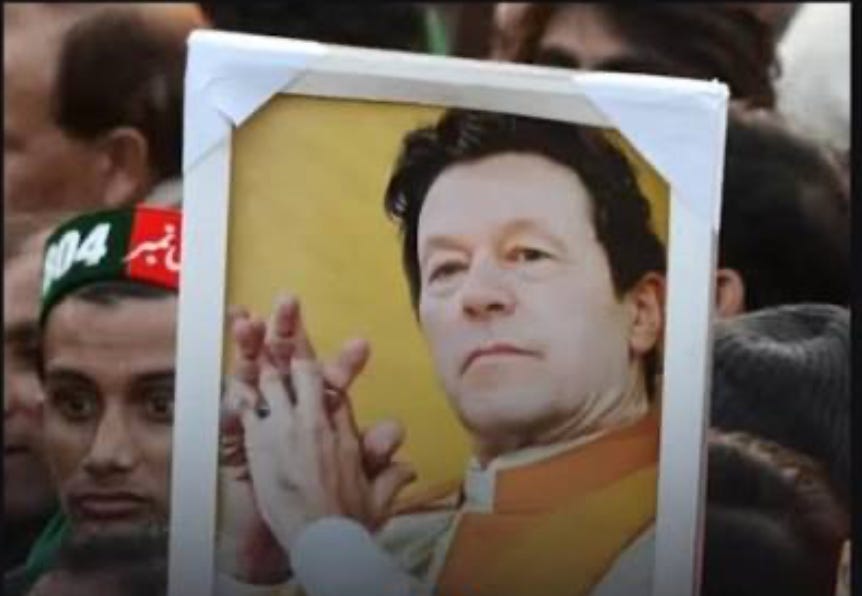
The ruling represents Khan’s most significant judicial relief since his imprisonment in 2023. The court has barred political activity outside the hospital, while it remains unclear whether he will return to prison after examination or remain there for treatment.
Sources: BBC, CNN
Restacking or sharing this publication means more people can read it. Commenting extends the conversation. Liking shows your appreciation.
On this day …
On this day in 1911, Leonardo da Vinci’s Mona Lisa was stolen from the Louvre in Paris. The painting disappeared for more than two years after museum employee Vincenzo Peruggia removed it from the gallery and concealed it while attempting to return it to Italy.
Newspapers around the world followed the investigation, turning the theft into an international sensation. Public fascination with the missing artwork elevated the Mona Lisa from an admired Renaissance painting into one of the most recognisable cultural symbols in the world.

When the painting was recovered in 1913, its reputation had grown far beyond the art world. The theft demonstrated how media attention can transform an object into a global phenomenon.
Did the crime create the modern legend of the Mona Lisa?