


Dubai Becomes The New Front In Trump’s Iran Strategy (Geopolitics)
U.S. Opens A Protected Oil Corridor Through Hormuz (Middle East)
Israel Strikes Syria Over Turkey’s Expanding Role (Middle East)
Israel Opens Criminal Probe Into Hind Rajab Killing (Middle East)
Trump Says He Will Meet Kim As Contact Is Disputed (Asia)
U.S. Debt Hits $40 Trillion As Borrowing Costs Rise (US)
Russians Pull Billions From Banks As War Fears Grow (Russia)
mRNA Cancer Vaccine Clears Late-Stage Trial Test (Medical)
National Guard’s Crime Role Looks Ineffective In Washington (US)
Golden Dome May Fuel A New Missile Arms Race (US)
A succinct daily briefing delivered each weekday to help you stay on top of the stories shaping the world.

The United Arab Emirates has suspended all financial and economic transactions with Iran, placing one of Tehran’s most important commercial and financial relationships at the centre of President Donald Trump’s strategy to weaken the Iranian economy.
Washington has spent weeks pressing Emirati officials to target Iranian financial networks operating in the country, arguing that restricting money flows linked to Iran could be more damaging than the existing naval blockade of Iranian ports.

President Trump warned that any country providing a financial or commercial lifeline to Iran would face “TREMENDOUS Economic Consequences”.
The challenge is that Dubai has long functioned as Iran’s principal gateway to imports, foreign currency and sanctions-evasion networks. Before the war, the UAE supplied more than 30% of Iran’s imports, worth about $21 billion in 2024. Emirati officials have described the latest measures as a gradual escalation rather than a complete rupture, reflecting concerns that an aggressive crackdown could damage the UAE’s trade-dependent economy and trigger further Iranian retaliation.
Sources: Wall Street Journal, Reuters

The U.S. military is moving millions of barrels of oil through the Strait of Hormuz using a protected southern corridor near Oman, helping restore exports despite continued Iranian attacks on shipping.
U.S. officials say 15-20 tankers have entered and exited the strait each night in recent weeks - with average daily exports now close to 10 million barrels. The operation schedules inbound empty tankers and outbound loaded vessels in separate time slots, while U.S. aircraft, ships and other assets provide protection against drones and missiles.
The corridor has become one of Washington’s main efforts to loosen Iran’s grip on the strait and limit further disruption to global oil supplies. However the operation remains resource-intensive and dangerous. At least 15 ships using southern routes have been hit since the start of June with large shipping companies continuing to avoid the strait until there is a lasting ceasefire.
Sources: Axios, New York Times
Israel bombed Syria’s Abu al-Duhur airbase only after warning Damascus against allowing Turkish troops to deploy there, sharpening tensions over Ankara’s growing military relationship with President Ahmed al-Sharaa’s government.
Four days before the strike, Mossad chief Roman Gofman spoke with Syrian Foreign Minister Asaad al-Shaibani about Turkey’s military presence, arms supplies and drones. Prime Minister Benjamin Netanyahu later said Israel would not tolerate a Turkish military establishment in Syria that threatened Israeli security.
Al-Shaibani denied that Turkish forces were preparing to deploy at the base, saying it was largely empty and still being rehabilitated, although Turkish officers had visited days earlier as part of military cooperation. Turkey rejected Israel’s allegations, while U.S. envoy Tom Barrack called the strikes an unnecessary escalation.
Washington is working on a deconfliction mechanism among Israel, Turkey and Syria as Turkish influence in Syria draws increasing Israeli concern.
Sources: Reuters, Times of Israel

The Israeli military has acknowledged for the first time that its troops fired on the car carrying five-year-old Hind Rajab and six relatives in Gaza in January 2024 and has opened a criminal investigation into the killings.
The IDF had previously said its forces were not near the vehicle or within firing range. Rajab survived the initial attack and spent hours on the phone with Palestinian paramedics seeking rescue. An ambulance sent to reach her was also fired upon, killing two medics. The bodies, including that of Hind Rahab were recovered 12 days later.
The investigation follows an IDF review that also opened a criminal probe into the March 2025 killing of 15 Palestinian medics and first responders.
However, the military declined criminal investigations into three other attacks on aid workers, including the April 2024 World Central Kitchen strike that killed seven people.
Sources: The Guardian, CNN
President Donald Trump says he plans to meet North Korean leader Kim Jong-un later this year but Kim’s sister has cast doubt on his claim that recent communications have already taken place.
Trump said Kim had responded to his request for a conversation and later said, “Yeah, I will be,” when asked whether he expected to meet him this year. Kim Yo-jong said she was “completely unaware” of any such contact. While she acknowledged that her brother retained good memories and feelings towards Trump she further noted that the US remained an enemy of Pyongyang.
The diplomatic signals come as Washington reduces this year’s joint military exercises with South Korea from 10 days to five. Kim Yo-jong said the change should not be treated as a gesture of goodwill, while South Korean President Lee Jae Myung welcomed Trump’s effort to create conditions for dialogue and reiterated support for taking greater responsibility for the peninsula’s defence.
Sources: The Guardian, CNN
Restacking this post will help it reach more readers interested in the world.

The U.S. national debt has reached a record $40 trillion as government borrowing continues at a historic pace and higher interest costs deepen concern about the country’s fiscal trajectory.
Treasury data show gross federal debt has risen by $3 trillion over the past year, its fastest increase outside the pandemic era. Government spending is expected to exceed tax revenues by more than $2 trillion this year, while interest payments now exceed $1 trillion annually and rank as the government’s second-largest expense after Social Security.
Investors are demanding higher returns to hold U.S. debt. Thirty-year Treasury yields reached a 19-year high this week, while the U.S. recently paid its highest borrowing costs on 30-year bonds since 2001.
Debt held by the public now exceeds $32 trillion, roughly equal to the size of the U.S. economy.
Sources: NPR, FT

Russian depositors are withdrawing billions from banks as fears grow that the Kremlin could seize private savings to finance the war in Ukraine, adding strain to a financial system already dealing with rising bad debts.
Nearly 286.4 billion roubles was withdrawn in the first two weeks of August, following 7.3 billion in July and more than 4.5 billion in June. Sberbank executive Taras Skvortsov said withdrawals this year could nearly double the amount removed during the first year of Russia’s full-scale invasion.
The outflows are creating liquidity problems and have already undermined government borrowing. The Finance Ministry was forced to cancel planned bond issues as banks struggled to spare cash, while the January-July budget deficit reached 6.46 trillion roubles, far above the 3.8 trillion forecast for the full year. Some businesses are also moving money abroad to reduce exposure to possible asset seizures.
Sources: The Independent, Washington Post

Moderna and Merck say their personalised mRNA cancer vaccine Intismeran reduced both recurrence and spread of melanoma in a late-stage trial, the first positive result of its kind for an mRNA cancer vaccine.

The treatment combines Moderna’s made-to-order vaccine, based on mutations in each patient’s tumour, with Merck’s immunotherapy drug Keytruda. The trial enrolled 1,137 high-risk patients whose stage IIB-IV melanoma had been surgically removed. Interim results showed the combination met its primary goal on recurrence and its secondary goal on preventing spread compared with Keytruda alone.
Detailed results and overall survival data are not yet available but the companies are already in talks with regulators. Moderna President Stephen Hoge said the vaccine could be available as soon as next year if approved.
Similar mRNA approaches are being tested against lung, breast and pancreatic cancers.
Sources: Reuters, AL Jazeera

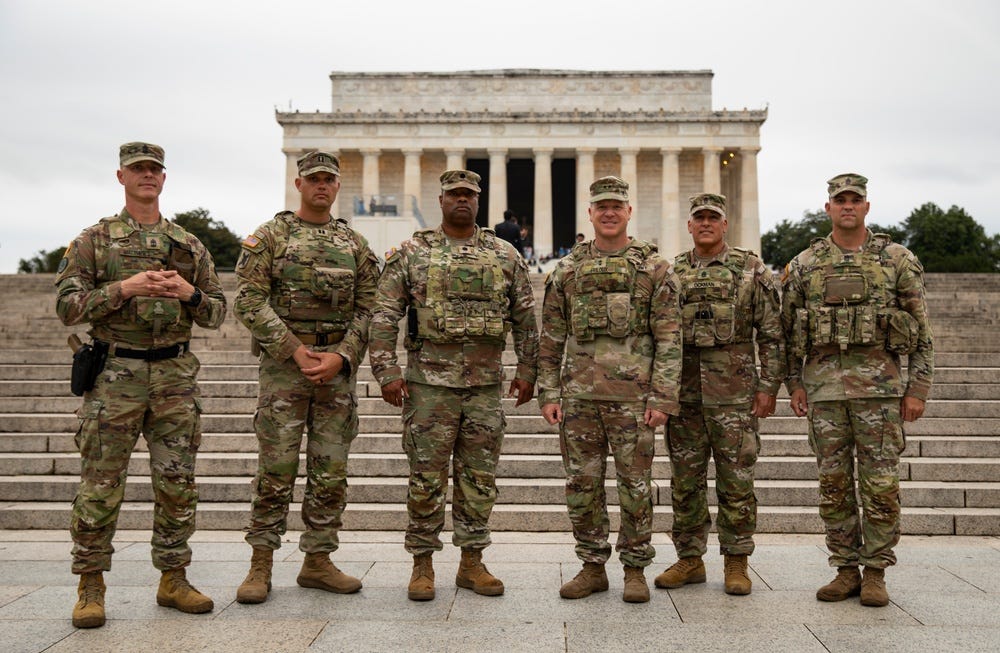
President Donald Trump’s National Guard deployment in Washington has put roughly 4,500 soldiers on the streets but a review found they were mentioned in only about 1.3% of criminal cases filed since the deployment began.
The troops outnumber the city’s roughly 3,200 police officers, yet their role is limited. They can detain suspects but generally must call police to make formal arrests. It was found that there were 217 cases mentioning Guard involvement, including 62 in which soldiers stopped suspects independently and 43 in which they assisted police, often in relatively minor offences.
The deployment also appears concentrated away from the areas with the city’s most serious violence. There are no court-record references to soldiers conducting law enforcement in neighbourhoods where about 82% of Washington’s murders occurred over the past five years.
Violent crime between January and mid-August was about 4% higher than a year earlier.
Sources: Reuters, Modern Diplomacy

The Golden Dome missile-defence plan may improve U.S. protection against airborne threats but analysts warn it could also accelerate an arms race with China, Russia and North Korea without eliminating America’s vulnerability.
The Congressional Budget Office said the system would be far more capable than current defences but would not be an impenetrable shield against a large attack by Russia or China. Analysts also argue that stronger U.S. defences could encourage adversaries to expand offensive arsenals to overwhelm them.
The most ambitious element is a space-based interceptor network. Estimates range from roughly 1,900 interceptors for continuous coverage against one missile to about 7,800 against 10 simultaneous ICBMs. Cost estimates also vary sharply, from the administration’s $185 billion to the CBO’s $1.2 trillion over 20 years, with space interceptors accounting for most of that total.
Sources: South China Morning Post, Scientific American
Restacking or sharing this publication means more people can read it. Commenting extends the conversation. Liking shows your appreciation.
On this day …
On this day in 1988 a United Nations-brokered ceasefire between Iran and Iraq came into effect, ending nearly eight years of conflict. The war had begun in 1980 when Iraqi forces invaded Iran triggering one of the twentieth century’s longest conventional wars.
The conflict caused enormous human and economic losses with hundreds of thousands killed and both countries left financially and physically exhausted. Fighting extended beyond the battlefield to include attacks on cities, energy infrastructure and shipping in the Persian Gulf.
Although the ceasefire ended active hostilities, many of the political disputes that contributed to the conflict remained unresolved.
The Iran-Iraq War demonstrated that even the longest wars often conclude through exhaustion rather than decisive victory.
This war also illustrates something relevant to what is going on today - Iran is both capable and willing to engage in long, drawn out conflict when it sees the need to do so.