


Trump Deal Leaves Iran With New Leverage (Middle East)
Republican Backlash Hits Trump Iran Deal (USA)
G7 Unity Masks Washington’s Ukraine Distance (Geopolitics)
AI Split Tests Democratic Tech Alliances (Technology)
Trump And Modi Seek Trade Thaw (Geopolitics)
Warsh Opens Fed Era With Less Guidance (Economy)
US Administration to Buy Back Four More Wind Farms (Environment)
China Debt Strain Threatens Demand (China)
G7 Targets China Minerals Dependence (China)
Finland Opens Door To NATO Nuclear Role (Europe)
A succinct daily briefing delivered each weekday to help you stay on top of the stories shaping the world.

President Donald Trump demanded Iran’s “unconditional surrender”, but the released deal to wind down the conflict read nothing like surrender. Iran survived confrontation with the United States, secured the resumption of oil sales and now enters longer nuclear talks with economic pressure eased.
The memorandum that has been released, and which was ceremonially signed by Donald Trump at the Palace of Versailles, also suggests Iran may negotiate a permanent way to exercise sovereignty over the Strait of Hormuz, despite Secretary of State Marco Rubio previously saying anything short of free passage was “not acceptable”. President Trump said frozen assets would be released only for “good behavior”, while talks over Iran’s nuclear programme are now expected to run beyond 60 days.
The central lesson is leverage. President Trump said he ended the war because he did not want “economic catastrophe”, while Iran had treated disrupted oil markets and Gulf instability as its strongest weapon from the beginning.
Sources: New York Times, Bloomberg
President Donald Trump’s interim deal with Iran has drawn criticism from Republicans who say it makes major concessions while doing too little to restrict Tehran’s nuclear programme.
The 14-point memorandum of understanding commits the United States and Iran to an immediate and permanent end to military operations, including in Lebanon. Tehran agreed to reopen the Strait of Hormuz, while Washington pledged to develop a plan to provide $300bn for Iran’s reconstruction and development.
Republican Senator Bill Cassidy called the agreement “the worst foreign policy blunder in decades”, saying Iran’s nuclear ambitions were not curbed and that Tehran had learned threatening the Strait of Hormuz worked. Republican Senator Ted Cruz urged President Trump not to “fund the rebuild”, while Republican Senator Thom Tillis said the reported $300bn figure was concerning and that he needed the details.
Sources: The Guardian, Al Jazeera
G7 leaders claimed new unity on Ukraine as President Donald Trump signalled a tougher line on Moscow, agreeing to increase pressure on Russia’s war economy and strengthen sanctions on fossil fuel revenues.
French President Emmanuel Macron said President Trump had accepted that Russian President Vladimir Putin showed no serious willingness to discuss peace, while Italian Prime Minister Giorgia Meloni said there was no friction or divergence. The leaders also agreed to increase supplies of air defence equipment to Ukraine and grant licences for Ukraine-based companies to produce long-range missiles and air defence systems.
The shift comes as President Trump met Ukrainian President Volodymyr Zelensky at the summit and said Russia had to seek a deal. Yet he also said the war had “no impact” on the United States beyond weapons sales, underscoring the distance between tougher summit language and Washington’s strategic detachment.
Sources: France 24, Washington Post

Anthropic chief executive Dario Amodei told G7 leaders to “resist the temptation to splinter” over advanced AI, days after the United States blocked his company from exporting its latest models on national security grounds.
The warning drew support from OpenAI chief executive Sam Altman, while Google DeepMind chief executive Demis Hassabis joined both executives in calling for US-led collaboration on AI model development. They underlined risks including bioterrorism and cyber security if democratic alliances fractured.
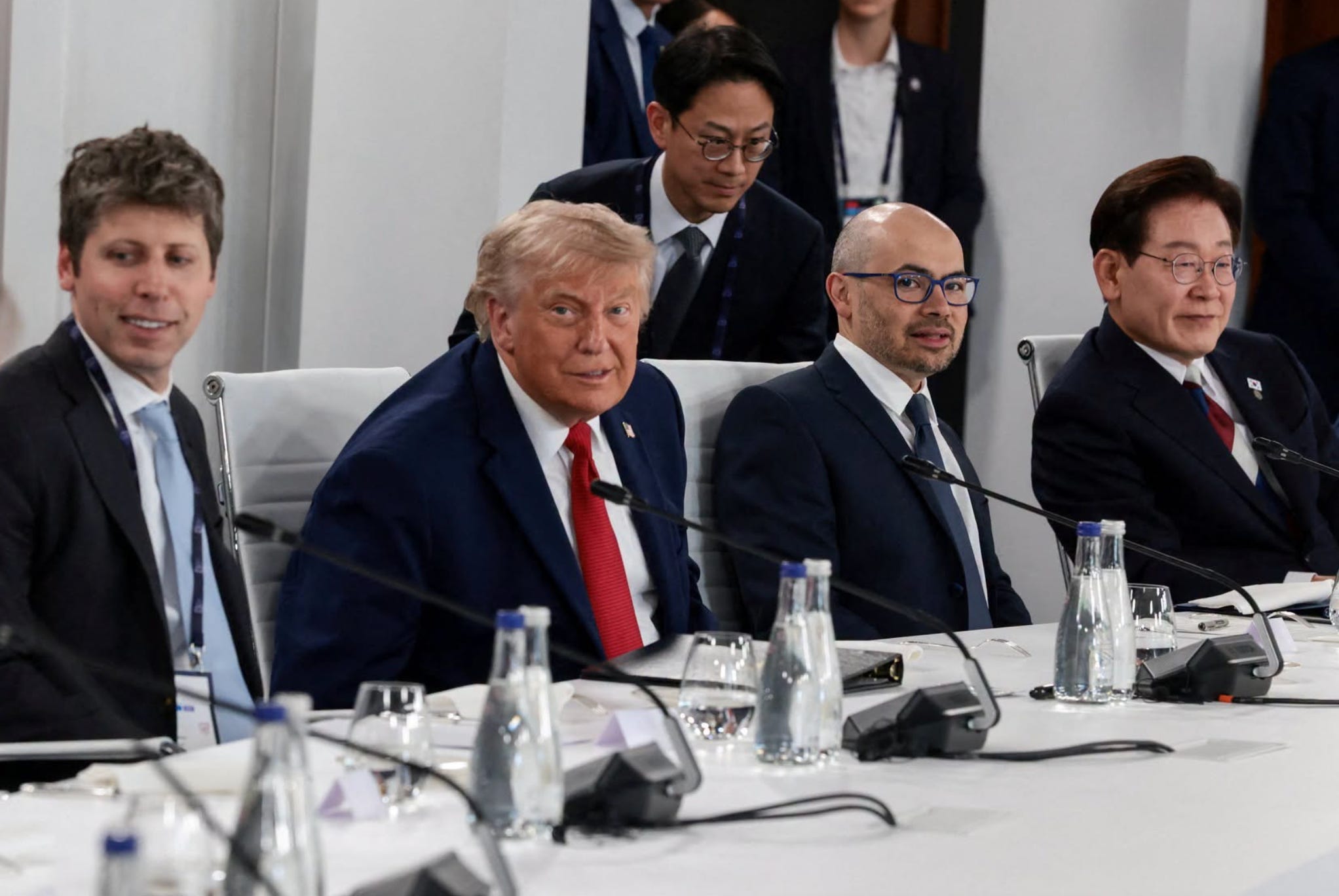
French President Emmanuel Macron said the Anthropic dispute had “clarified the stakes” for the United States and its allies, warning that Washington’s ability to “turn off the switch” could damage the US companies leading the AI race. The debate now links AI safety, frontier-model access and supply-chain control to a wider question of democratic co-operation.
Sources: FT, Axios
President Donald Trump and Indian Prime Minister Narendra Modi used their first in-person meeting in more than a year to signal a thaw in relations, with Trump saying the United States and India were “very close” to finalising a long-awaited trade agreement.
The meeting followed strains over tariffs, Pakistan, the war in Iran and a recent US attack on Indian-crewed vessels in the Gulf of Oman that left at least three sailors dead. Modi raised maritime security, saying freedom of navigation should be ensured and that Indian seafarers’ safety was equally important.
Trump called Modi a “tough negotiator” and promised to visit India, while saying the United States would help India if it were attacked. Yet analysts warned that personal rapport may not resolve disputes over market access, tariffs and India’s immediate neighbourhood.
Sources: Bloomberg, BBC
Restacking this post will help it reach more readers interested in the world.

New Federal Reserve Chairman Kevin Warsh opened his first meeting by leaving interest rates unchanged and launching a sweeping review of how the central bank conducts policy, including its balance sheet, communications, data sources, productivity and jobs, and the inflation framework.
The statement dropped forward guidance, with Warsh saying it was not “well suited” to the current economic moment. He said he could not say what the Fed would do next, while projections showed nine of 19 policymakers now expect a rate rise by the end of 2026.
The shift marks an immediate break from recent Fed communication, returning towards a shorter Greenspan-era style. It also complicates President Donald Trump’s hopes for rapid rate cuts, as markets sold off and short-term bond yields jumped after Warsh’s first policy announcement.
Sources: Reuters, CNN

The Trump administration will pay Invenergy $765m to surrender four offshore wind leases in federal waters, extending a buyback strategy that has now cost roughly $2.5bn to cancel offshore wind projects. The leases covered projects in the New York Bight, off California’s Central Coast and in the Gulf of Maine.

Invenergy said it would put the money into at least five new natural gas-fired plants in the Midwest and geothermal projects in the Western United States. Similar deals since March have required companies including TotalEnergies to abandon wind farms in exchange for fossil fuel investments.
The shift follows President Donald Trump’s attempts to block new wind turbines and halt projects already under construction, moves courts struck down. Offshore wind proponents warned replacing coastal wind with geothermal or natural gas elsewhere does not address reliability challenges or potential power gaps in the Northeast and mid-Atlantic.
Sources: New York Times, Washington Post

China’s growing pile of bad consumer debt is threatening Beijing’s effort to revive domestic demand, with as many as 100 million consumers struggling to service personal borrowing.
Non-performing household debt rose 21% last year to at least 2.22tn yuan, or $329bn, while estimates suggest up to 10.6% of China’s adult population were behind on payments at the end of 2025. The strain is weakening consumer lending and blunting subsidies aimed at big-ticket purchases such as cars, home renovations and electronics.
The pressure reflects a deeper policy dilemma. Online platforms continue to push short-term loans, while regulators have begun capping average rates and testing lower ceilings. UBS analyst May Yan said stronger borrowers are unwilling to take on debt amid uncertainty and falling household wealth, while more vulnerable groups are borrowing excessively.
Sources: Bloomberg, RBC Ukraine

G7 leaders agreed to reduce dependence on any single supplier outside the group and partner countries for rare earths and permanent magnets to below 60% by 2030, with an ambition to reach 50% as soon as possible.
The plan includes a Critical Minerals Resilience and Production Alliance and a cooperation platform using the International Energy Agency and OECD to monitor markets, share data and provide early warnings of distortions. Leaders also pledged to align stockpiling, expand recycling and start transparency mechanisms with lithium and nickel before extending them to five new minerals each year.
The push follows concern over concentrated supply chains and arbitrary export restrictions. China controls 90% of processed rare earths and magnets, making the target difficult unless policy support turns into investment across mining, processing and downstream capacity.
Sources: Reuters, Bloomberg, Élysée Palace

Finnish lawmakers voted 125 to 61 to lift the country’s longstanding ban on nuclear weapons, clearing the way for Finland to receive, transport and facilitate their movement on its territory as part of allied defence operations.
The change brings Finland closer to NATO’s deterrence policy after it joined the alliance in 2023 in response to Russia’s full-scale invasion of Ukraine. Defence Minister Antti Häkkänen called the reform “essential” for Finland’s security and said it strengthened Finland and NATO, while insisting Helsinki had no plans to permanently station nuclear arms on its soil.
The vote also comes as Finland weighs closer participation in French President Emmanuel Macron’s proposal for a broader European nuclear deterrent. Prime Minister Petteri Orpo has signalled interest in co-operating, but said no final decision has been made.
Sources: Politico Europe, Euronews
Restacking or sharing this publication means more people can read it. Commenting extends the conversation. Liking shows your appreciation.
On this day …
On this day in 1815, allied forces led by the Duke of Wellington and Gebhard von Blücher defeated Napoleon Bonaparte at Waterloo in present-day Belgium. The battle ended Napoleon’s final attempt to regain power and brought more than two decades of revolutionary and Napoleonic conflict in Europe to a close.
The settlement that followed helped shape the nineteenth-century European order and influenced the balance-of-power diplomacy that governed relations between major states for decades.
Waterloo remains a reminder that military victories can reshape international systems long after the fighting itself has ended.