


Trump’s Iran Deadline Expires As War Grinds On (Conflict)
Trump Threatens Oman As Hormuz Talks Advance (Geopolitics)
Saudi Oil Finds New Route Around Hormuz (Middle East)
Kushner Says Gaza Rebuilding Waits On Disarmament (Middle East)
Trump Approval Hits New Low As Iran War Drags On (US)
Ukraine’s Patriot Shortage Exposes Air Defence Gap (Conflict)
Russia Expands Drone Bases Within Reach Of NATO (Europe)
Champagne Harvest Starts Earlier Than Ever (Climate)
Trump Says Kim Responded As Korea Drills Scaled Back (Asia)
US Pushes Drug War Onto Latin American Soil (South America)
A succinct daily briefing delivered each weekday to help you stay on top of the stories shaping the world.

Sixty days after President Donald Trump signed a memorandum of understanding with Iran with great pomp & circumstance in the Palace of Versailles and described it as a “historic breakthrough”, the deadline for converting the interim agreement into a broader settlement has expired without any material progress. The Strait of Hormuz remains largely shut, detailed nuclear negotiations never began and the conflict has entered its sixth month.
The United States has resumed its blockade of Iranian ports and withdrawn sanctions waivers that briefly allowed Iranian oil sales during the truce. Tehran is demanding concessions that Washington has rejected, while Iranian officials say the 60-day negotiating window is no longer relevant. President Trump continues to insist that preventing Iran from obtaining a nuclear weapon remains his primary objective.
The administration is now relying heavily on economic pressure while analysts warn that a prolonged campaign of economic attrition could trigger renewed warfare. The conflict has also become an economic and political challenge inside the United States as disrupted oil shipments continue to affect energy markets.
Sources: Washington Post, New York Times

President Donald Trump threatened to bomb Oman if it obstructed US efforts to reopen the Strait of Hormuz, even as Iran and Oman said they were close to finalising their own shipping arrangement for the waterway. The strait has been largely closed for nearly six months, disrupting a route through which about a fifth of the world’s oil and liquefied natural gas usually passes.
Iranian Foreign Ministry spokesman Esmaeil Baghaei said an understanding had been reached on a transit route and that both sides were finalising details before a joint statement. Trump separately claimed the United States had opened a direct backchannel with Iran’s Islamic Revolutionary Guard Corps but an IRGC spokesman denied any talks.
The confrontation comes as a 60-day US-Iran memorandum of understanding expires without an agreement to end the war. Neither side has signalled willingness to extend it, while Tehran says negotiations never properly began.
Sources: BBC, Al Jazeera

Saudi Arabia is offering Arab Medium and Arab Heavy crude to some Asian refiners from locations outside the Strait of Hormuz, using ship-to-ship transfers off Oman and the UAE. The move resembles arrangements used by Abu Dhabi National Oil Co as Gulf producers adapt to prolonged disruption around the waterway.

The origins of the grades make it highly likely the barrels were produced inside the Persian Gulf before being moved outside the strait. Satellite imagery showed vessels with at least 9 million barrels of transport capacity loading at or near Ras Tanura over the past week while Saudi supertankers have gathered outside the gulf.
The arrangements allow Asian refiners to receive crude without sending their own tankers through Hormuz where security concerns have deterred many shipowners. Sustained shipments outside the strait have already helped ADNOC sell more than 100 million barrels through tenders.
Sources: Reuters, Bloomberg

United States envoy Jared Kushner said Gaza will not be rebuilt until Hamas is fully demilitarised, after talks with Israeli Prime Minister Benjamin Netanyahu failed to produce a breakthrough on implementing a US-backed roadmap.
Kushner said Washington would not restrict Israel from acting against imminent threats and urged Israel to take small steps to test whether Hamas is serious about disarmament. Under the proposed process, Hamas would hand weapons to the Palestinian technocratic government, which would transfer them to an International Stabilization Force for destruction.
The four-hour meeting produced agreement on two working groups covering demilitarisation and humanitarian conditions plus a deconfliction mechanism involving Egyptian mediators.

Netanyahu’s office reiterated that demilitarisation must be completed before reconstruction begins, while a Board of Peace official said Israel would give the plan a chance if Hamas demonstrates compliance.
Sources: Al Jazeera, Axios

President Donald Trump’s approval rating has fallen to 33%, the lowest of his current presidency as Americans grow increasingly pessimistic about the Iran war. A Reuters/Ipsos poll found 64% disapproved of his performance, while 80% expect US involvement in Iran to continue for an extended period.
The conflict has paralysed a fifth of global oil trade and pushed up gasoline prices, while Iran has kept traffic through the Strait of Hormuz largely constrained. Only one in five Americans, and half of Republicans, now say the war has been worth it.
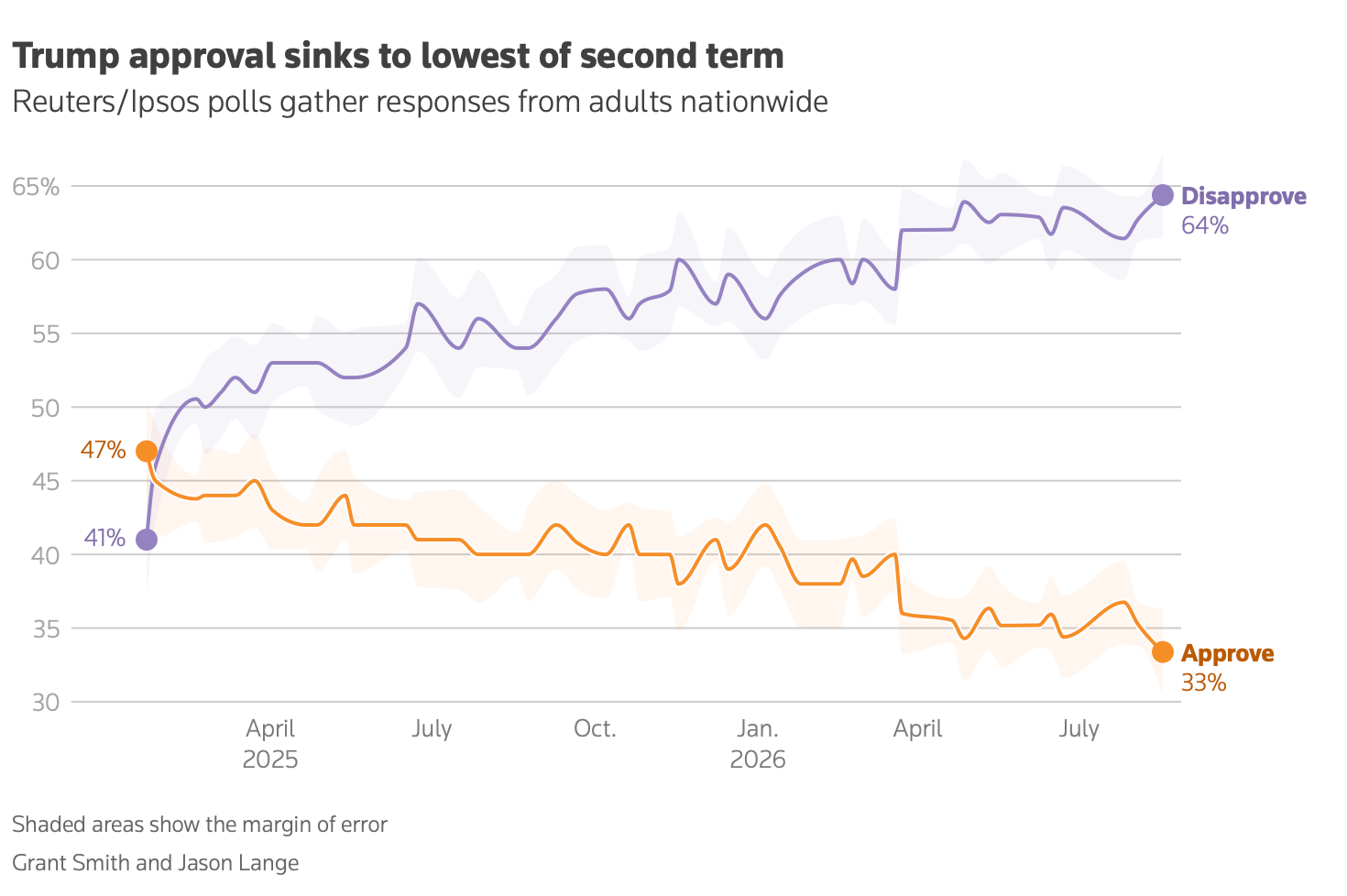
The political consequences are widening ahead of the November midterm elections. Reuters/Ipsos polling this month showed voters preferring Democrats over Republicans on handling the economy for the first time in about a decade, while Republicans’ advantage on immigration narrowed to two percentage points from 26 points in January 2025 among registered voters.
Sources: Reuters, Forbes
Restacking this post will help it reach more readers interested in the world.

Ukraine’s Patriot launchers are sitting empty as the country runs short of interceptors capable of destroying Russian ballistic missiles exposing a critical gap in its air defences ahead of winter.
President Volodymyr Zelensky says Ukraine needs 5% of the US stockpile to survive the winter but currently has only 1%.
The shortage follows heavy interceptor use during the Iran war. Coalition forces used an average of 225 interceptors a day during the first four days, while manufacturer Lockheed Martin produced 620 interceptors in 2025, equivalent to 1.7 a day.
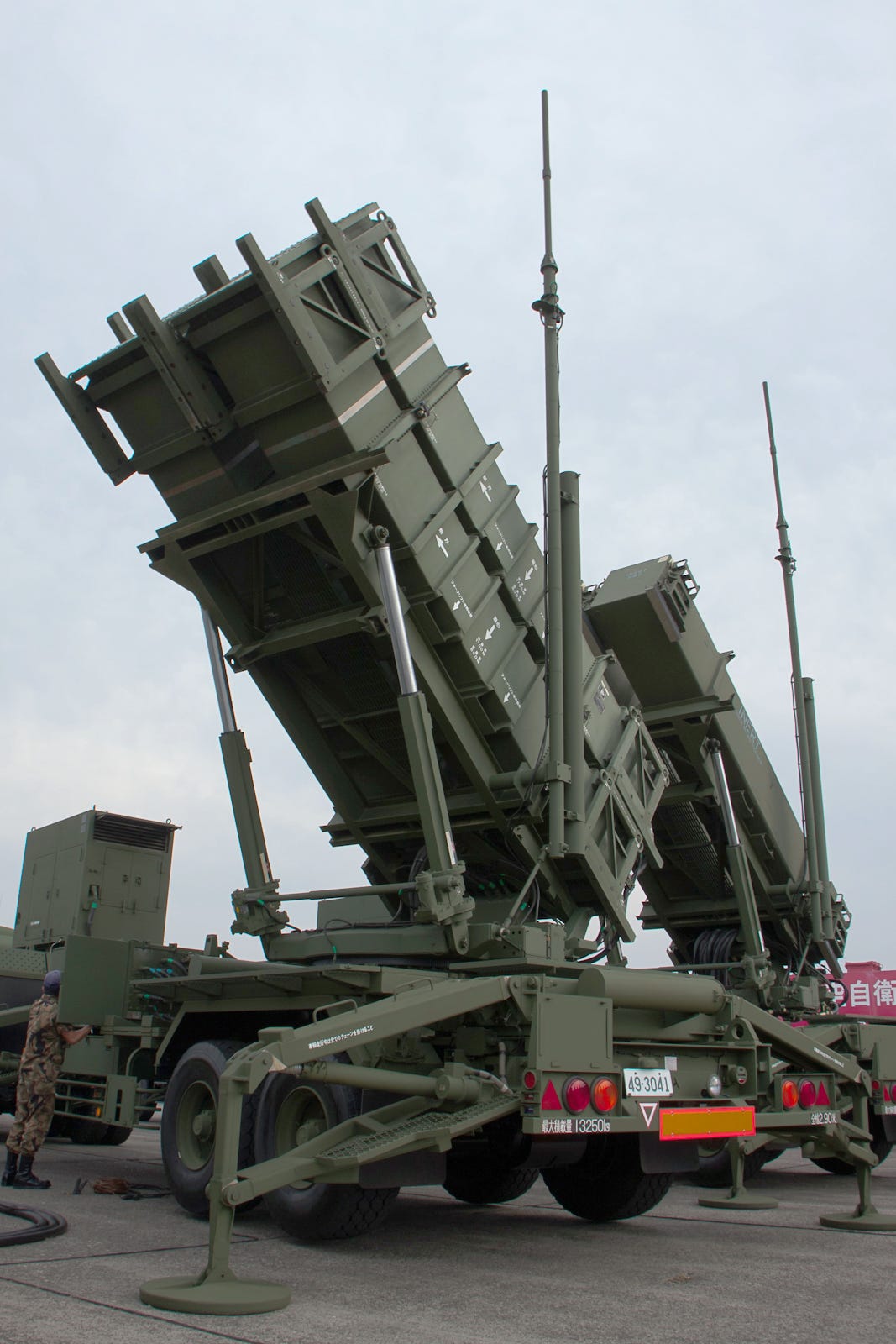
Kyiv estimates it needs at least 300 PAC-3 interceptors to withstand another winter of Russian attacks on power, gas and water infrastructure. Russia launched a record 198 ballistic and hypersonic missiles in July. US caution and depleted allied stockpiles are leaving Ukraine increasingly exposed.
Sources: CNN, FT

Russia has built and expanded at least 10 drone bases with at least 59 new launch rails, creating infrastructure capable of sending long-range attack drones deep into NATO territory. Around 20 rails have been extended to launch sophisticated long-range drones while one base reportedly has storage space for 1,000 aircraft.
The sites have been used primarily against Ukraine but their location near Russia’s borders with Ukraine and Belarus puts NATO territory within reach. NATO has faced repeated drone incursions, including one shot down over Romania on Sunday and another intercepted over Latvia two days earlier.
The alliance says it is investing nearly $40 billion in counter-drone capabilities over five years and plans to train five times as many drone operators by the end of 2027.
Russia denies planning to attack NATO territory, while alliance officials warn Moscow could test NATO with a limited military operation or intensified hybrid attacks.
Sources: The Independent, Newsweek

Champagne producers have begun their earliest harvest since records started in the early 20th century after heat and drought accelerated grape ripening across northeast France. The Champagne Committee brought the official start forward to August 12, more than a week earlier than last year, while one grower received permission to begin on August 6 as acidity levels fell sharply.
Higher temperatures increase sugar content and make it harder to preserve champagne’s characteristic flavour and acidity. Across French vineyards, harvest dates have moved forward by about 21 days over the past 50 years, according to agroclimatologist Serge Zaka.
This year’s crop has also been hit by spring frost which destroyed around 30% of it, while heat and drought further reduced yields. Producers are drawing on reserve wines and considering more resilient grape varieties and ground cover as they adapt within strict appellation rules.
Sources: Reuters, NTV
President Donald Trump said North Korean leader Kim Jong Un has responded to his outreach, a day after ordering joint US-South Korean military exercises to be substantially reduced. Trump described Kim as respectful and said scaling back the drills was making the Korean Peninsula safer, although North Korea has not publicly confirmed any renewed contact.
The 11-day Ulchi Freedom Shield exercises nevertheless began as scheduled, involving roughly 18,000 South Korean troops alongside US forces. North Korea regards the annual drills as preparations for war, while Washington and Seoul describe them as defensive.
Trump linked his decision to Seoul’s refusal to join the US-led war against Iran, arguing that allies receiving American protection should help Washington in return.
The comments widen the significance of the move beyond North Korea, tying regional security arrangements more directly to burden-sharing expectations from US allies.
Sources: Japan Times, Reuters

The Trump administration is seeking to extend its military campaign against suspected drug trafficking from strikes at sea to joint operations on land with Latin American partners. Defence Secretary Pete Hegseth said Colombia, Ecuador, Guatemala and Honduras were among countries working with Washington, although Guatemala denied agreeing to such operations.
The shift follows more than 60 US strikes on boats in the Caribbean and eastern Pacific that have killed more than 200 people.
Direct combat alongside local forces would represent a major escalation from the traditional US role of providing weapons, intelligence and training.
The expansion could face political resistance over sovereignty and risks to civilians. Ecuador has already conducted joint raids with the United States despite voters rejecting foreign military bases in 2025, while Mexico has thus far resisted a US military role against cartels on its territory.
Sources: Associated Press, Firstpost
Restacking or sharing this publication means more people can read it. Commenting extends the conversation. Liking shows your appreciation.
On this day …
On this day in 1920, Tennessee became the 36th state to ratify the Nineteenth Amendment to the United States Constitution, providing the final approval required for the amendment to become law. The measure prohibited states from denying citizens the right to vote on the basis of sex.
The decision marked the culmination of decades of campaigning by suffragists who organised, petitioned and advocated for political equality across the United States. Although barriers to voting remained for many women, particularly women of colour, the amendment represented a significant expansion of democratic participation.
The ratification of the Nineteenth Amendment became an important reference point for voting rights movements around the world. How do societies measure progress when legal equality arrives before practical equality?