


Houthi Drone Intercepted Near Mecca (Conflict)
Canada Seeks a Unique Alliance With Europe (Diplomacy)
Trump Approves $2.8 Billion Bomb Sale to Israel (Middle East)
US Redirects Military Aid Towards Americas (US)
US Acknowledges Weapons Deployed In Orbit (US)
Gaza Remains Renew UN War Crimes Concerns (Middle East)
Russian Frigate Fires Flares At Danish Helicopter (Europe)
US Democracy Indicators Fall To 50 Year Lows (US)
Turkey Widens Crackdown On LGBTQ+ Activists (Society)
Pollution Rose After US Embassy Monitoring Ended (Environment)
A succinct daily briefing delivered each weekday to help you stay on top of the stories shaping the world.
Saudi air defences intercepted and destroyed a Houthi drone south of Mecca on Tuesday before it entered prohibited airspace over Islam’s holiest city according to Saudi-led coalition spokesperson Turki al-Malki. Saudi Arabia briefly activated a security alert in Mecca, the first such alert there in nearly a decade.

Al-Malki said the security of Islam’s two holiest sites and pilgrims was a “red line” and that the coalition would take deterrent measures. Houthi spokesperson Hazem al-Assad rejected the claim that Mecca had been targeted. The Organisation of Islamic Cooperation condemned the incident and blamed the Houthis.
The incident comes as Houthi attacks on Saudi Arabia intensify after a UN-brokered truce in 2022 largely halted strikes on Saudi territory. The group declared a blockade on Saudi shipping in July and has seized parts of Yemen’s Red Sea coast overlooking the Bab al-Mandab, threatening Saudi oil exports rerouted from the Strait of Hormuz.
Sources: Al Jazeera, The Guardian
Canada is seeking a “unique alliance” with the European Union as Prime Minister Mark Carney moves to deepen ties with Brussels amid escalating trade tensions with US President Donald Trump. Carney is attending European Commission President Ursula von der Leyen’s State of the Union address in Strasbourg before addressing the European Parliament on Thursday.
The relationship is already expanding beyond trade. Canada joined the EU’s Security Action for Europe defence fund earlier this year, while officials are discussing closer cooperation in technology, energy, critical minerals, trade and defence procurement. Canada’s government has committed to doubling non-US trade over the next decade.
Yet diversification has clear limits. The US buys about 70% of Canadian exports with Canada-US bilateral trade worth nearly US$900bn last year, compared with $130bn between Canada and the EU.
Brussels and Ottawa are seeking deeper ties, but replacing established American customers and supply chains remains a substantial challenge.
Sources: BBC, Politico Europe

The Trump administration has approved a $2.8 billion munitions sale to Israel that includes 40,000 2,000-pound bombs, according to a US official. The package contains 20,000 MK-84 and 20,000 BLU-117 bombs and has been sent to congressional committees for informal approval.
The sale would also include 20,000 I-2000 penetrator warheads, designed to explode after passing through soil, rock or concrete. Israel’s use of 2,000-pound bombs in Gaza and Lebanon has drawn scrutiny over civilian harm, while Israel says militants embed themselves among civilians and in tunnels or bunkers requiring heavy munitions.
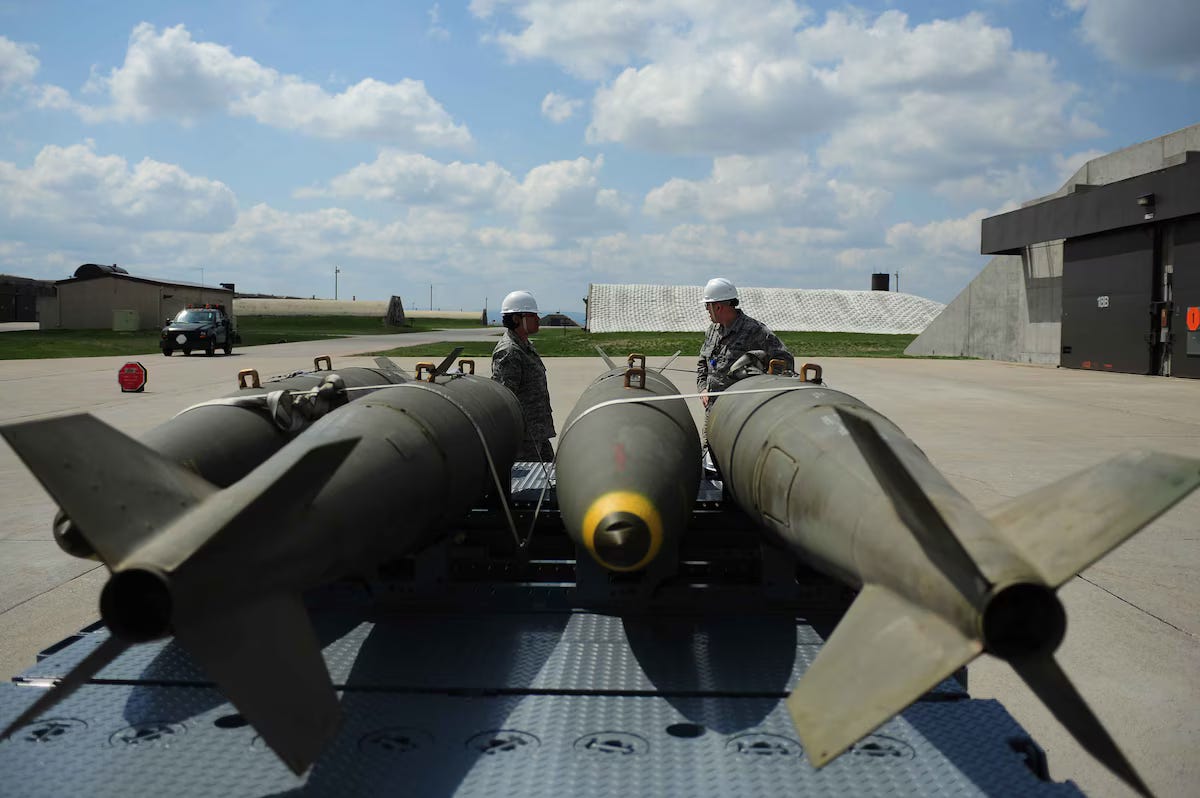
The Biden administration paused a shipment of 2,000-pound bombs in 2024 over concerns about their use in crowded civilian areas. President Donald Trump allowed that shipment to proceed after taking office and his administration agreed in February to sell roughly $2.7 billion in munitions to Israel, including 35,000 one-ton bombs.
Sources: New York Times, Arab News

The Trump administration is redirecting $52 million in US military financing from Slovakia, North Macedonia, Tunisia and Iraq to Panama, Peru, Ecuador and Colombia as Washington prioritises the Western Hemisphere. The State Department notified Congress of the reallocation on Tuesday.
The department said the money would help combat “narcoterrorism”, secure the Panama Canal and prevent adversaries from establishing strategic footholds in the hemisphere. US Secretary of State Marco Rubio visited Colombia, Ecuador and Peru last week, pledging additional support as the administration emphasises drug trafficking and illegal immigration.
The shift does not eliminate military financing for the four countries losing funds, although remaining amounts are unclear. Slovakia and North Macedonia are NATO members and the move follows other reductions in money or troop deployments to Europe amid US President Donald Trump’s complaints that NATO allies are not spending enough on defence.
Sources: Associated Press, Euronews

The United States has publicly acknowledged operating weapons in Earth’s orbit for the first time, with US Air Force Secretary Troy Meink saying the country has “on-orbit space control weapons” capable of defending American forces against hostile action. US Space Force chief General Douglas Schiess said personnel already operate such weapons and that the arsenal will expand.
Neither official disclosed what systems have been deployed. Possible capabilities include communications jamming, lasers or anti-satellite weapons. US officials have repeatedly warned that China and Russia are developing offensive space capabilities.
The disclosure comes as the three powers expand satellite networks and manoeuvrable spacecraft that could attack or interfere with other systems. No country is known to have physically attacked another nation’s satellite in orbit but satellites have become increasingly important to military communications, navigation and intelligence. Strategic norms and laws governing conflict in space remain underdeveloped.
Sources: CNN, Japan Times
Restacking this post will help it reach more readers interested in the world.
Hundreds of bodies recovered from buildings destroyed by Israeli strikes in Gaza have renewed concerns about possible war crimes said UN High Commissioner for Human Rights Volker Türk. Palestinian Civil Defence says more than 630 bodies and human remains have been recovered since November 2025, while Palestinian authorities estimate more than 8,000 people remain buried beneath the wreckage.
Türk said remains of what appeared to be entire families were being unearthed, including women & children, and warned the discoveries may be “only the tip of the iceberg”. He linked them to concerns raised in a 2024 UN report that found Israeli strikes on residential and civilian sites may have violated international humanitarian law.
Türk called for international investigators to receive access to all parts of Gaza to preserve evidence. Israel has repeatedly rejected allegations that it deliberately targets civilians and says it acted in accordance with international law while fighting Hamas.
Sources: Reuters, UN

A Russian frigate fired two flares towards a Danish Air Force Fennec helicopter during a routine photographic operation in international waters off Gedser, Denmark’s armed forces said. One flare passed close to the helicopter. Danish Prime Minister Mette Frederiksen called the incident “reckless action from Russia”, while Foreign Minister Lars Løkke Rasmussen summoned Russia’s ambassador.

Russian Ambassador Vladimir Barbin disputed Denmark’s account, accusing the helicopter of provocative actions and saying Danish aircraft had previously carried out dangerous manoeuvres near Russian warships outside Denmark’s territorial waters. He said Russia would investigate the incident.
The confrontation comes amid heightened Baltic Sea tensions since Russia’s 2022 invasion of Ukraine. Denmark, a NATO member and supporter of Ukraine, has accused Russia of hybrid operations on its territory, while Danish intelligence warned this month that Russia was actively preparing sabotage targeting the country’s defence industry.
Sources: South China Morning Post, Euronews

A global democracy report has found that nearly half of the indicators measuring US democracy have fallen to their lowest levels in 50 years. The International Institute for Democracy and Electoral Assistance recorded seven statistically significant US declines between 2020 and 2025, including access to justice, freedom of expression, press freedom and judicial independence.
The report described the United States as the most prominent example and accelerator of a wider deterioration in the rule of law, arguing that the effects extend beyond its borders. It said President Donald Trump had concentrated power in the executive branch, undermining domestic and international rule of law and testing alliances and multilateral cooperation.
Globally, 57% of countries declined in at least one key indicator of democratic performance between 2020 and 2025. Judicial independence fell to a 36-year low, while credible elections reached their lowest level in 30 years.
Sources: NPR, Al Jazeera

Turkish police detained dozens of demonstrators outside Istanbul’s Caglayan courthouse on Tuesday as they demanded the release of LGBTQ+ activists taken into custody during a wider crackdown. Authorities had raided LGBTQ+ groups, association offices, homes and popular venues on Sunday, detaining dozens and blocking organisations’ websites.
Justice Minister Akin Gurlek said the operation, called “My Family is Safe”, targeted 162 suspects, nine associations and 13 businesses and aimed to protect children, the institution of the family and public order. Same-sex relations are not an offence in Turkey.
Council of Europe Commissioner for Human Rights Michael O’Flaherty expressed concern over the raids and detentions, saying references to family values or protecting children could not justify human rights restrictions. He called for anyone detained for human rights or civil society work to be released. President Recep Tayyip Erdogan’s ruling party banned Istanbul Pride in 2015, and attempted Pride gatherings have since been dispersed by authorities.
Sources: BBC, The Hill

A study has found that satellite-measured air pollution rose after the Trump administration ended a US embassy monitoring programme covering more than 80 diplomatic sites in March 2025. Researchers examining 46 cities found pollution increased by 24% to 33% over subsequent months, with levels rising about three to four months after reporting stopped.

The programme began in Beijing in 2008 and had expanded internationally, providing public air-quality data in countries where local monitoring was sometimes limited. Previous research linked the programme to lower pollution levels.
The new study found the largest average increases in Southeast Asia, sub-Saharan Africa and South Asia, although researchers said it could not establish why pollution rose. Pollution later declined from its peak but remained around 24% above pre-shutdown levels by November 2025. The State Department said it is restoring public reporting of air-quality monitoring data but provided no timeframe.
Sources: NPR, Washington Post
Restacking or sharing this publication means more people can read it. Commenting extends the conversation. Liking shows your appreciation.
On this day …
On this day in 1987, countries meeting in Montreal adopted the Montreal Protocol on Substances that Deplete the Ozone Layer. The agreement established international controls on chemicals damaging the Earth’s protective ozone layer and entered into force in January 1989.
The treaty was subsequently strengthened as scientific understanding developed, expanding the substances covered and accelerating required reductions. Today, the protocol has 198 parties, making participation effectively universal.
Its significance extends beyond the environmental problem it was designed to address: governments accepted scientific evidence, negotiated binding international rules and progressively tightened them as circumstances changed.