


G7 Allies Seek Clarity On Trump Iran Deal (Geopolitics)
Trump Iran Deal Tests Netanyahu (Geopolitics)
EU Broadens Russia Sanctions Network (Europe)
EU Opens Ukraine Accession Talks (Europe)
Kyiv Cathedral Burns After Russian Strikes (Conflict)
EU Says China Trained Russian Troops (China)
Iran War Price Shock To Linger (Economy)
Trump Approval Rises Modestly As Price Angst Eases (USA)
Congo Ebola Outbreak Strains Response (Africa)
Climate Threats Hit Half The World’s Children (Society)
A succinct daily briefing delivered each weekday to help you stay on top of the stories shaping the world.
G7 leaders left a Lake Geneva dinner still unclear about the terms of President Donald Trump’s agreement with Iran, according to officials familiar with the talks. The one-and-a-half page text has not been published, and Washington and Tehran have issued sometimes contradictory accounts since the virtual signing on Sunday.
The uncertainty is important because the deal is meant to reopen the Strait of Hormuz, continue negotiations to end the war, and frame European help with mine removal. Trump said the text may be released after Friday, while a senior US official said it would appear earlier publicly in the name of transparency.
Key practical questions remain unresolved, including tolls in the strait, Iran’s near-bomb-grade uranium, centrifuges, inspections and sanctions relief. Vice President JD Vance said technical negotiations would determine some issues, leaving allies weighing commitments before they know the agreement’s terms.
Sources: CNN, New York Times
President Donald Trump’s agreement with Iran has left Israeli Prime Minister Benjamin Netanyahu facing public pressure at home and strain with Washington after the two leaders launched the war together in late February.
The memorandum could reopen the Strait of Hormuz and ease economic sanctions on Tehran while delaying talks on Iran’s nuclear programme and ballistic missile arsenal. Netanyahu said there were cases in which he and Trump did not see eye to eye, adding that he was responsible for Israel’s security interests.
Israeli criticism spread across Netanyahu’s coalition and opposition. National Security Minister Itamar Ben Gvir said Trump’s agreement did not bind Israel, while Finance Minister Bezalel Smotrich called it bad for Israel and the free world. Israeli officials also insisted they would not stop striking Hezbollah or withdraw Israeli troops from Lebanon.
Sources: CNN, Washington Post

EU ministers expanded Russia sanctions on Monday, adding 34 individuals and 47 entities linked to Moscow’s military and industrial complex, its shadow fleet of oil and gas tankers, political interference and the Ukraine war effort.
The list included Tahir Garayev, founder of Coral Energy, which later became 2Rivers Group, and Konstantin Rogach. The EU said Garayev enabled the shipment and export of Russian crude, including from sanctioned Rosneft, by concealing its origin, while Rogach facilitated insurance and administrative support for vessels carrying Russian crude or petroleum products.
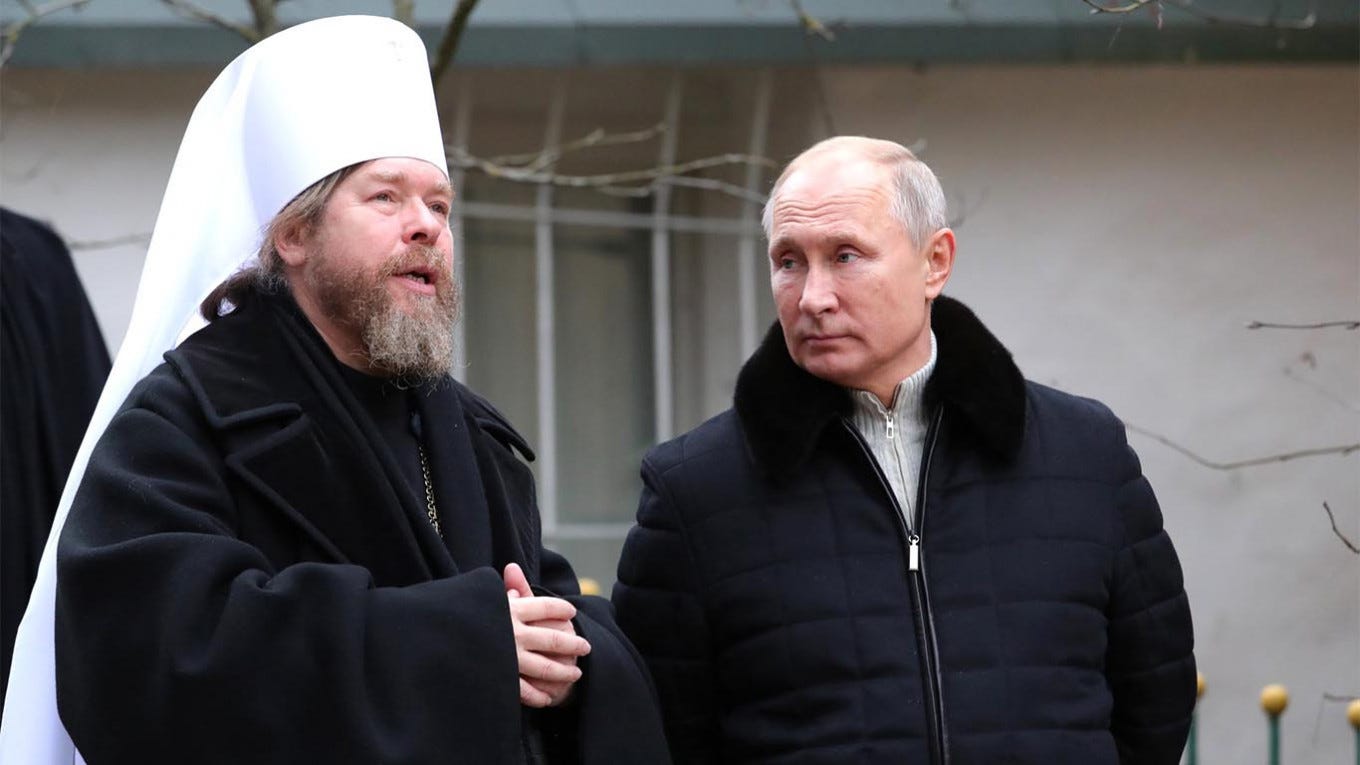
The measures also targeted Russian judges and prosecutors linked to Alexei Navalny’s 2024 poisoning death, as well as a Russian bishop, Georgiy Shevkunov (known as “Putin’s confessor”) who is accused of spreading disinformation to justify Russia’s war. EU foreign policy chief Kaja Kallas said ministers were discussing a 21st wider package and that sanctions had cost Russia’s economy between €1 trillion and €1.3 trillion.
Sources: Reuters, CBS News

The EU formally opened the first stage of accession negotiations with Ukraine and Moldova on Monday, two years later than planned after Hungary’s former Prime Minister Viktor Orban had blocked the process.
The launch begins a long process of political reform and legal alignment while Ukraine continues fighting Russia’s invasion. The first negotiating cluster, known as fundamentals, covers judiciary and fundamental rights, economic criteria and the functioning of democratic institutions. Prospective members must meet EU standards across six clusters and 33 chapters, with two further chapters negotiated separately.
European Commission President Ursula von der Leyen called the opening of the first cluster a huge step forward, while Ukraine’s President Volodymyr Zelenskyy said it showed Europe’s progress could not be stopped. Accession usually takes years or decades, and Ukraine’s talks are likely to take years, with final accession unlikely while the country remains at war.
Sources: DW, Al Jazeera

Russian attacks across multiple Ukrainian cities killed 11 people, injured dozens and set fire to the Dormition Cathedral in Kyiv on Monday, the Ukrainian government said. Two drones also struck the historic monastic complex that houses the cathedral, President Volodymyr Zelenskyy said.
The site, within the Kyiv-Pechersk Lavra, dates to the 11th century and has helped shape Eastern Europe’s monastic tradition. Hundreds of Ukrainian religious sites, museums, monuments and libraries have been damaged or destroyed during the war, but the cathedral attack stood out because of its historical and religious weight.
President Volodymyr Zelenskyy called it one of Russia’s largest crimes against Christian culture. Russia’s Defence Ministry denied targeting civilian infrastructure and said it had struck only military targets, while suggesting that American Patriot missiles had misfired. The cause of the damage has not been independently confirmed.
Sources: New York Times, ABC News
Restacking this post will help it reach more readers interested in the world.
EU foreign policy chief Kaja Kallas said the bloc had verified reports that China’s military trained Russian personnel to fight in Ukraine, intensifying Brussels’ criticism of Beijing’s role in the war.
Kallas, speaking after a meeting of EU foreign ministers in Luxembourg, said the EU was carefully assessing the implications. She did not elaborate on the reports, but Reuters reported last month that China had covertly trained about 200 Russian military personnel in 2025, with some returning to fight in Ukraine. The reported training focused on drones and was outlined in an agreement signed by senior Russian and Chinese officers in Beijing last July.
The EU also added two mainland Chinese manufacturers and two Hong Kong shipping firms to its sanctions list. Brussels is weighing a tougher economic and security stance as EU-China trade tensions widen.
Sources: South China Morning Post, Bloomberg
A tentative US-Iran deal may ease war fears, but economists and industry analysts warned that higher prices for gasoline, groceries, air travel, shipping and retail goods are likely to persist.
The war disrupted crude, refined fuel, fertiliser, food and footwear supply chains through the Strait of Hormuz. Oil prices fell on Monday to about $80 a barrel after the agreement, but remained above the $67 level before the war. Refineries buy crude a month or more ahead, so cheaper oil will take time to reach fuel pumps.
Food costs may prove stickier. Roughly 30% of the world’s fertiliser passed through Hormuz before the war, while fuel accounts for 15% to 30% of food costs. Bundesbank President Joachim Nagel said oil supply could take months to normalise, and warned that monetary policy could not passively ignore the shock.
Sources: Associated Press, Wall Street Journal

President Donald Trump’s approval rating ticked up one point to 36% as public dissatisfaction over the cost of living eased, according to a four-day Reuters/Ipsos poll that closed on Monday.
The survey gathered responses before and after Trump announced that he and Iranian leaders had agreed to end a war that had pushed gasoline prices sharply higher. Optimism over peace talks has pushed gasoline prices lower in recent weeks, though Americans are still paying roughly a dollar more per gallon than before the United States and Israel launched attacks on Iran on February 28.
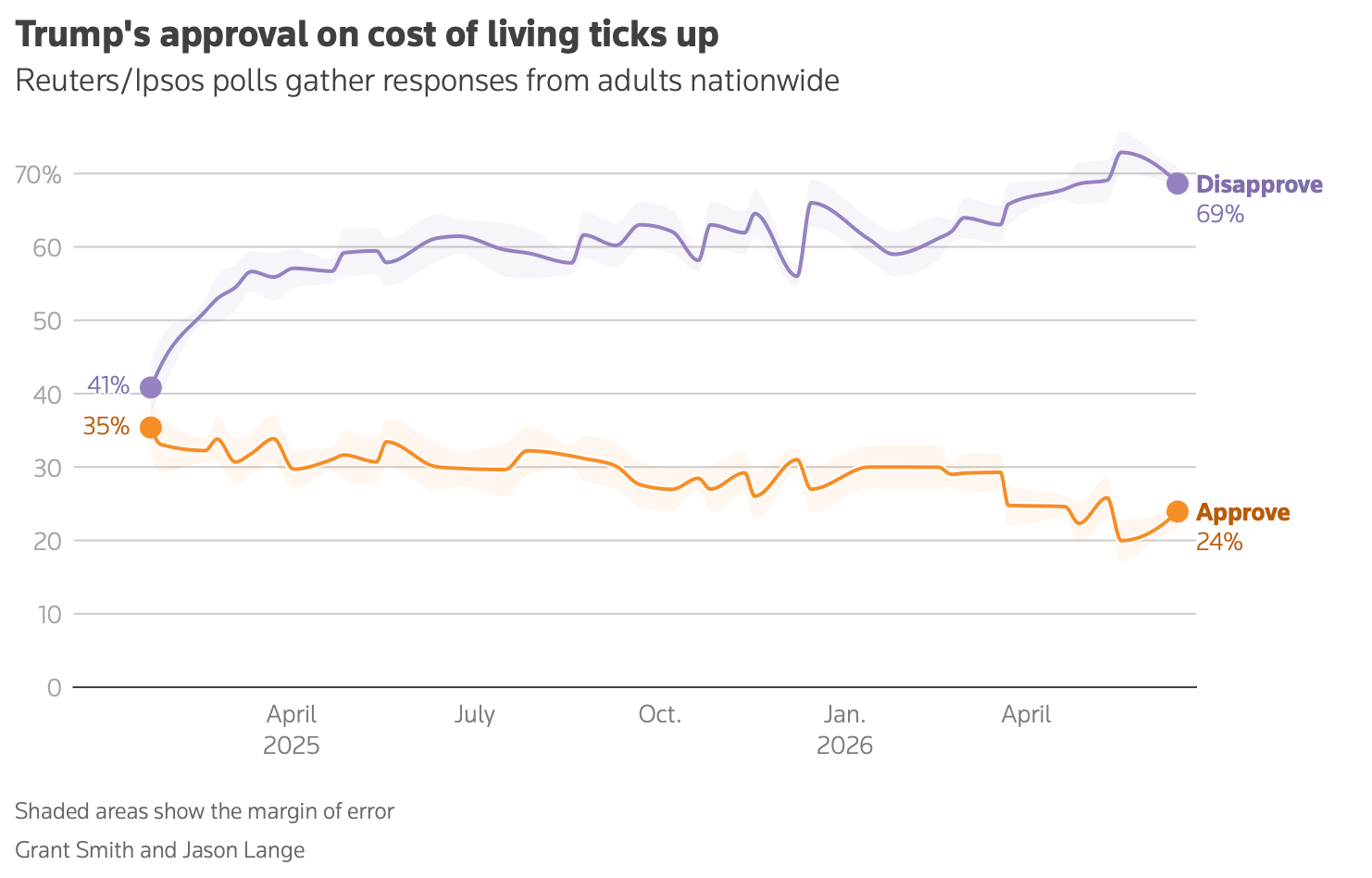
Trump’s cost-of-living approval rose to 24%, from 22% a week earlier and 20% a month ago. His overall rating remains near the lowest levels of his political career, while registered voters favoured Democrats over Republicans by 41% to 38% ahead of the November 3 midterm elections.
Sources: Reuters, SRN News

Ebola treatment centres in eastern Democratic Republic of Congo are becoming overwhelmed as confirmed cases passed 800 and health workers struggle to track transmission chains, aid groups warned ahead of an emergency summit of African leaders.
Congo’s National Institute of Public Health reported 808 confirmed cases and 192 deaths on Monday, while Uganda has confirmed 19 infections. Ituri province, where the outbreak first emerged, accounts for more than 90% of cases in Congo. Médecins Sans Frontières official Kate White said no one knew the true scale or exactly where the disease was spreading.
The outbreak is already the third largest Ebola epidemic on record and the biggest caused by the Bundibugyo strain. Burundi President Evariste Ndayishimiye, who chairs the African Union, will host a virtual summit on Tuesday to rally support for a $518 million response plan.
Sources: Bloomberg, Associated Press

Nearly half of the world’s children, or 1.1 billion, are exposed to at least three overlapping climate hazards threatening their health, education and survival, according to a new UNICEF report.
The report maps exposure to eight frequent threats, including coastal floods, droughts, extreme heat, fires, heatwaves, river floods, sand and dust storms, and tropical storms. Almost every child faces at least one climate hazard, while more than 4 million could face as many as six overlapping threats. Drought, extreme heat and heatwaves are the most widespread combination, affecting more than 296 million children.

UNICEF Executive Director Catherine Russell said children’s lives were being upended by heatwaves, wildfires, droughts and floods. UNICEF called on governments and businesses to reduce emissions, improve climate adaptation and strengthen services including health, education, water and sanitation.
Sources: The Guardian, UNICEF
Restacking or sharing this publication means more people can read it. Commenting extends the conversation. Liking shows your appreciation.
On this day …
On this day in 1903, the Ford Motor Company was incorporated in Detroit. Under Henry Ford’s leadership, the company helped transform manufacturing through the large-scale use of assembly-line production, making automobiles affordable to a much wider public.
Ford’s success reshaped not only transportation but also labour, urban development and global industry. The methods pioneered by the company became a model for twentieth-century manufacturing and influenced how goods are produced around the world.
The industrial systems that emerged from this era continue to shape economic debates about productivity, automation and the future of work.