


Gaza Strikes Kill At Least 12 Amid Truce Dispute
Trump Says Board Pledges $5bn For Gaza
Israel Approves West Bank Land Registration Plan
Iran Signals Openness To Nuclear Compromise
Netanyahu Demands Iran Nuclear Dismantlement
Ukrainian Drones Hit Key Russian Oil Port
Ex Energy Minister Detained In Corruption Case
AI Data Centres Fuel Rising Memory Chip Shortage
Europe Seeks Stronger Defence Pillar After Greenland Push
Canada Turns To Build-At-Home Defence Strategy

Israeli air strikes across the Gaza Strip on Sunday killed at least 12 Palestinians and injured several others, according to Palestinian officials, as the military said it was responding to ceasefire violations by Hamas. Gaza doctors said a strike on a tent encampment housing displaced families killed at least four people, while health officials reported five killed in Khan Younis and another person shot dead in the north. Hospitals confirmed receiving multiple bodies.
An Israeli military official described the strikes as precise and said militants had crossed the Yellow Line agreed under the October ceasefire, calling this an explicit violation.
Hamas accused Israel of committing a new massacre and breaching the truce days before the first meeting of Donald Trump’s Board of Peace, where a reconstruction plan is expected to be announced.
Sources: South China Morning Post, The Guardian

President Donald Trump said members of his newly created Board of Peace have pledged $5 billion toward rebuilding war-ravaged Gaza and will commit thousands of personnel to international stabilisation and police forces for the territory. The pledges will be formally announced when board members gather in Washington on Thursday for their first meeting.
Details of which member nations are contributing funds or personnel have not been disclosed. Indonesia’s military said up to 8,000 of its troops are expected to be ready by the end of June for a potential deployment as part of a humanitarian and peace mission.
The United Nations, World Bank and European Union estimate reconstruction will cost around $70 billion, underscoring the scale of the task despite a 10 October ceasefire deal intended to halt more than two years of war.
Sources: PBS, Euronews

Israel’s government has approved a plan to make it easier for Israeli settlers to purchase land in the occupied West Bank and to register large areas as state property if Palestinians cannot prove ownership. The decision shifts parts of the territory’s administration from military to civilian authorities and paves the way for the first formal land registration process since 1967.

Under the policy, when an area undergoes registration, anyone claiming the land must submit documents proving ownership, even though most land has never been formally registered. The move will apply to Area C, which is under full Israeli military control and home to more than 300,000 Palestinians.
The Palestinian Authority called the step a de facto annexation, while regional governments and the European Union condemned it as a violation of international law.
Sources: DW, Al Jazeera

Iran is ready to consider compromises to reach a nuclear deal with the United States if Washington is willing to discuss lifting sanctions, according to deputy foreign minister Majid Takht-Ravanchi. He said Tehran was prepared to discuss limits on its nuclear programme, including its stockpile of highly enriched uranium, and pointed to an offer to dilute 60 per cent enriched material as evidence of flexibility.
Indirect talks were held in Oman earlier this month, with a second round set for Geneva on Tuesday. Takht-Ravanchi described the contacts as more or less in a positive direction but said it was too early to judge.
He stressed that zero enrichment was not on the table for Iran, while President Donald Trump has said the United States does not want any enrichment, underscoring a central gap in the negotiations.
Sources: BBC, The Independent

Israeli Prime Minister Benjamin Netanyahu said any US deal with Iran must require the dismantling of Iran’s nuclear infrastructure, not merely a halt to enrichment. Speaking in Jerusalem, he said all enriched material must leave Iran and there should be no enrichment capability, including the equipment and infrastructure that allows enrichment.
His comments come as US and Iranian officials prepare for a second round of talks in Switzerland on Tuesday. Netanyahu said he raised scepticism with President Donald Trump during a recent meeting and argued that any agreement must address Israel’s security concerns.
Iran has indicated it will consider compromises if sanctions are discussed but regards zero enrichment as a red line. The United States has built up its military presence in the region while saying it prefers diplomacy over direct attacks.
Sources: Reuters, BBC

Ukrainian drones struck infrastructure at the Black Sea port of Taman overnight, damaging a fuel storage tank, warehouse facilities and port terminals, according to the governor of Russia’s Krasnodar region. Firefighters tackled blazes at the site and emergency services deployed 126 personnel and 34 units of equipment. Two people were hospitalised and are receiving medical assistance.
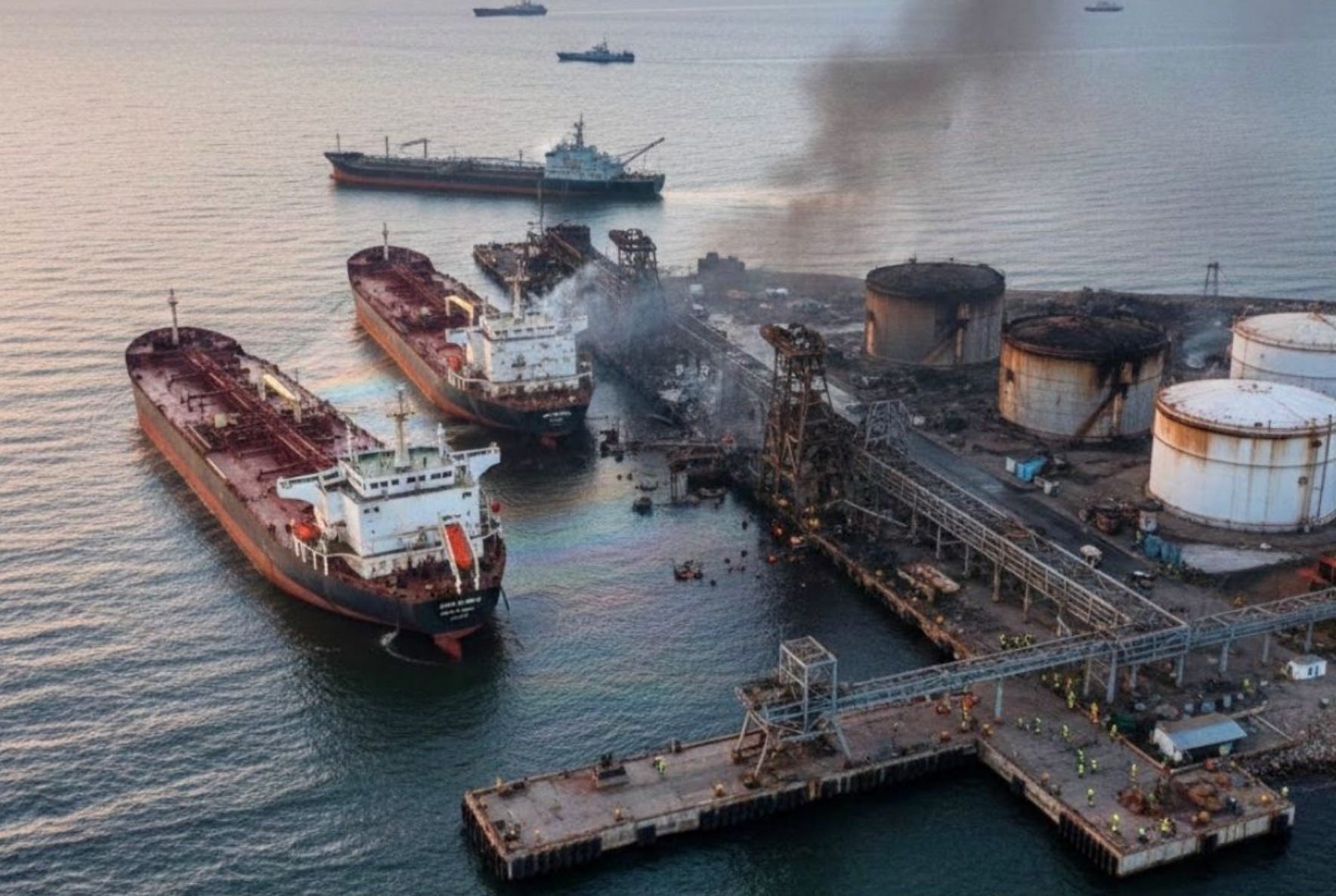
Taman is a key export facility for Russian fossil fuel products, as well as grain and fertilisers. Ukraine’s General Staff confirmed the attack without detailing the extent of the damage.
The strike comes as Russian and Ukrainian negotiators are expected to gather in Geneva on Tuesday for US-led peace talks. Russia has repeatedly struck Ukrainian energy infrastructure, while Kyiv has targeted refineries, oil terminals and ports linked to Moscow’s war effort.
Sources: Politico Europe, Bloomberg

Ukraine’s National Anti-Corruption Bureau said it detained the country’s former energy minister German Galushchenko as he was trying to cross the state border, as part of the “Midas” case. The bureau said initial investigative proceedings were ongoing in accordance with the law and court sanctions.
The case centres on an alleged $100 million scheme in the energy sector involving kickbacks from contractors working with state-owned businesses including Energoatom. Investigators said contractors were forced to pay bribes of 10 to 15 percent to avoid losing contracts or facing payment delays.
The scandal triggered resignations last year, including that of the serving and a former energy minister, who denied wrongdoing. Battling corruption remains a key priority for Kyiv as it pursues reform and European Union membership.
Sources: CNN, Al Jazeera

A shortage of memory chips is beginning to hammer profits and inflate prices across consumer electronics, automobiles and data centres, as surging AI demand absorbs supply. Major companies have warned that constrained DRAM availability will compress margins and limit production, while one type of DRAM rose 75% from December to January, accelerating price rises across the holiday quarter.
The squeeze is driven by the buildout of AI data centres, as companies buy Nvidia AI accelerators that come with huge allotments of memory. In the first half of 2025, the global semiconductor market reached $346 billion, and WSTS forecasts 2026 growth of more than 25% to $975 billion. WSTS analysis also found memory chip prices rose by 50% last year.
Consumers may face longer delivery times and higher prices, with a study projecting average smartphone prices could rise by up to 8%.
Sources: Bloomberg, DW

European Commission President Ursula von der Leyen told the Munich Security Conference that “some lines have been crossed that cannot be uncrossed anymore”, as European leaders described a profound shift in transatlantic ties. Donald Trump’s push to annex Greenland has increased doubts about Washington’s commitment to protect Europe through NATO.
European leaders said they would accelerate efforts to boost their own defences and rely less on the United States. Trump’s administration says it expects Europe to take primary responsibility for conventional defence, while Washington would keep its nuclear umbrella over Europe and uphold NATO’s mutual defence pact.
German Chancellor Friedrich Merz said he had begun talks with Emmanuel Macron about a European nuclear deterrence. Europe’s spending has risen, with NATO members agreeing last year to raise core defence from 2% of GDP to 3.5% and add 1.5% for other security investments, but major joint projects have struggled amid disputes over workshare and “buy European” rules.
Sources: Reuters, Politico Europe

Canada plans to unveil a new defence industrial strategy this week that shifts billions of dollars in military spending away from US defence companies and toward domestic manufacturers. Prime Minister Mark Carney has framed the change as a response to relations after US tariffs and repeated suggestions that Canada should become the 51st American state.
Carney has said Canada will no longer acquire 70 to 75 percent of its weapons from the United States, and the plan sets a goal of awarding 70 percent of federal defence contracts to Canadian firms within a decade. It proposes buying and maintaining most of the military’s equipment domestically, backed by $6.6 billion carved out of an $81.8-billion defence reinvestment plan.
The strategy targets higher serviceability rates after figures showed 54 percent of the navy, 55 percent of the air force and 46 percent of army vehicles were “not serviceable”, and it proposes increasing defence exports by 50 percent.
Sources: New York Times, CBC
On this day …..
On this day in 1959, Fidel Castro was sworn in as Prime Minister of Cuba, consolidating control after the overthrow of Fulgencio Batista the previous month.
The appointment formalised the political transformation set in motion by the Cuban Revolution and marked the beginning of a new alignment that would soon place Havana at the centre of Cold War tensions.
Within two years, relations with the United States had ruptured and Cuba had drawn closer to the Soviet Union. The consequences would reshape hemispheric politics for decades.
Almost seventy years later the US is still trying to overthrow the regime that followed.