


Russian Drone Strike Narrowly Misses Boris Johnson (Conflict)
Oil Jumps As Gulf-Iran Hormuz Talks Are Postponed (Middle East)
Saudi Pipeline Outage Puts 4% Of Global Supply At Risk (Markets)
Houthi Advance Deepens Yemen Crisis At Bab Al-Mandab (Conflict)
Trump Defends AI Speed As Calls For Safeguards Grow (Technology)
BRICS Preserves Unity By Softening Its Divisions (Diplomacy)
Canada Seeks Deeper EU Ties As US Trade War Escalates (Diplomacy)
US Moves To Erase Power Plant Carbon Limits (Environment)
Trump Calls On Ukraine To Stop Russian Refinery Strikes (Conflict)
Russia Turns Cheap Tech Into Mass-Produced Weapons (Technology)
A succinct daily briefing delivered each weekday to help you stay on top of the stories shaping the world.

A Russian drone struck a passenger train at Yahodyn, about 2km from Poland, shortly after a train carrying former UK Prime Minister Boris Johnson and European security officials had passed through. The strike hit the locomotive after passengers were evacuated, with no casualties reported. Ukraine’s rail operator said the officials’ train may have been the target. Ex-CIA Director David Petraeus was on the station when the drone hit, he was not injured.
Russia said it struck railway infrastructure in western Ukraine used to transport military cargoes from Europe. Ukrainian Foreign Minister Andrii Sybiha described the attack as Russian President Vladimir Putin’s terror reaching the doors of the EU and NATO, while Polish Prime Minister Donald Tusk said Russian actions were escalating closer to Poland’s border.
Russia has stepped up attacks near the Polish border in recent weeks. Yahodyn is a major route for Western military and humanitarian aid into Ukraine, while Ukrainian railways remain the country’s main mode of transport since air travel was suspended after Russia’s full-scale invasion in 2022.
Sources: BBC, CNN

Oil prices surged after Gulf states postponed a meeting with Iran on managing the Strait of Hormuz because of a lack of consensus. Brent crude rose 3.5 per cent to more than $108 a barrel as trading opened in Asia, while Oman’s Foreign Minister Badr Albusaidi said the regional meeting had been postponed “in the interests of consensus”.
The talks were expected to discuss an interim Iran-Oman arrangement under which vessels would enter the strait through Iranian waters and exit mostly through Omani territory. Iran has restricted shipping through Hormuz since the US and Israel launched their war in February, while a fifth of the world’s oil and gas passed through the waterway before the conflict.
The delay comes as Saudi Arabia’s East-West Pipeline was forced to close after a drone attack from Iraq, while Houthi forces have also attacked Saudi energy infrastructure and advanced along Yemen’s Red Sea coast.
Sources: FT, New York Times

Saudi Arabia could lose the ability to export up to 4 per cent of global oil supply within days unless it restarts its East-West Pipeline to the Red Sea. Drone attacks forced the pipeline offline on Friday, and industry sources said storage at Yanbu could sustain exports for only five to seven days.
The pipeline has allowed Saudi Arabia to bypass the wartime shutdown of the Strait of Hormuz, rerouting about 4 million barrels a day to the Red Sea. Repair estimates range from sooner with partial pumping to as long as five to six weeks.
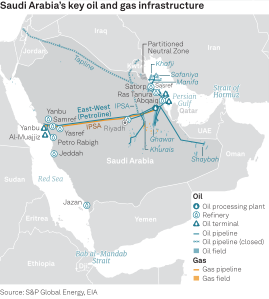
The disruption adds to an existing global supply crunch that has pushed fuel prices to record highs and increased inflation. Brent crude rose above $108 a barrel on Sunday, while Saudi oil production fell to 6.2 million barrels a day in August from 10.9 million in February before the war.
Sources: The Guardian, Reuters

The Houthi advance along Yemen’s Red Sea coast has displaced tens of thousands of civilians, deepening the country’s humanitarian crisis while tightening the group’s position around the Bab al-Mandab strait. The International Organization for Migration said 85,818 people had been displaced, including 82,000 since the start of September, while more than 2,000 had fled across the strait to Djibouti.
The Houthis seized the strategic port of Mocha and overran coastline and islands surrounding Bab al-Mandab, forcing families from entire villages. The 20-mile strait is a vital trade and energy route linking Asia and Europe. Rerouting around southern Africa would add thousands of nautical miles if shipping were blocked.
UN special envoy Hans Grundberg said Yemen had entered “a new and more dangerous phase of war”, warning that renewed fighting could become prolonged and draw the country further into the wider regional confrontation.
Sources: The Guardian, Al Jazeera

US President Donald Trump has rejected calls to slow artificial intelligence development, saying the US must preserve its lead over China as prominent technology executives warn that AI capabilities are advancing too quickly. Anthropic CEO Dario Amodei, OpenAI CEO Sam Altman and xAI founder Elon Musk have all backed slowing the pace of model development.
The debate is widening politically. Democrats are using public unease over AI to attack the administration’s resistance to regulation, while some Republicans in competitive races have expressed greater openness to safeguards. Former Republican lawmaker Mike Rogers said he supports slowing development and would prioritise a national security framework.
Trump said AI would bring “more good than bad - by a lot”. House Speaker Mike Johnson opposed a moratorium, warning that excessive regulation could allow China to overtake the US, while arguing companies should take the lead on safety.
Sources: Washington Post, NPR

BRICS leaders adopted a joint declaration in New Delhi despite divisions over the wars in Iran and Ukraine, preserving consensus through broadly worded positions that avoided naming key countries. The bloc called for restraint in the Middle East, criticised unilateral tariffs and sanctions, and reiterated support for a more multipolar global order.
Indian Prime Minister Narendra Modi said BRICS had reached a “coming of age” moment and argued that the Global South should become a “rule-shaper”. The declaration also backed reforms to the United Nations, World Bank and International Monetary Fund and called for stronger cooperation on trade, energy, digital infrastructure and artificial intelligence.
Yet the compromises were visible. The statement did not condemn the US-Israel war on Iran or explicitly mention Ukraine, highlighting how the expanded 11-member bloc can preserve dialogue while struggling to assign responsibility when members’ interests collide.
Sources: Al Jazeera, Associated Press

Canadian Prime Minister Mark Carney says Canada will pursue a “unique alliance” with the European Union as its trade war with the US intensifies, while ruling out formal membership. He said Canada and the EU share values and priorities and have complementary strengths.
The discussions could extend well beyond trade. Canada and the EU are exploring freer movement of goods, services and workers involved in strategic supply chains, with energy, artificial intelligence, defence and critical minerals among the areas under consideration. Cooperation on data centres, satellite networks and Canadian energy shipments to Europe are also being discussed.
The push follows a breakdown in Canada-US trade negotiations in late August. Washington has imposed tariffs on key Canadian sectors and an additional 50 per cent levy on about C$28bn of goods. Ottawa has responded with levies of up to 50 per cent on C$28bn of US products.
Sources: BBC, Times of India

The Trump administration is preparing to repeal federal limits on greenhouse gas emissions from coal & gas fired power plants, completing another major rollback of US climate policy. Environmental Protection Agency Administrator Lee Zeldin is expected to announce the change during a Group of 20 energy ministers’ meeting in Houston.

The EPA is expected to scrap Biden-era requirements for existing and future fossil-fuel plants to use emissions-reduction technologies, including carbon capture and storage. It also plans to propose repealing the finding that greenhouse gases from power plants pose a threat under the Clean Air Act.
If that change survives legal challenges, it could restrict future administrations’ ability to regulate power sector emissions. Power plants are the largest US industrial source of greenhouse gases, while electricity generation is the country’s second-largest overall source. The Biden rules, finalised in 2024, effectively required existing coal plants to capture most carbon emissions by 2039 or close.
Sources: Bloomberg, New York Times

US President Donald Trump has asked Ukrainian President Volodymyr Zelensky to stop attacks on Russian diesel and refinery targets, arguing that the strikes are worsening a global fuel shortage. Trump said Ukraine could hit other targets but should avoid diesel infrastructure because reduced Russian supply was “hurting the world”.
Ukraine has intensified attacks on Russia’s oil sector, including strikes on major refineries in Krasnodar and Tatarstan, disrupting supplies and contributing to fuel shortages inside Russia. US Treasury Secretary Scott Bessent has also blamed Ukrainian attacks on Russian energy assets for adding to global price increases.
The intervention comes as US diesel prices hit a record $6 a gallon on Friday. Diesel is widely used in freight and farming, meaning higher prices can feed into groceries and shipping costs, while Middle East disruptions are simultaneously constraining global energy supplies.
Sources: Washington Post, The Hill

Russia is fielding relatively cheap new precision weapons faster than Ukraine and its Western partners can adapt, using Chinese components to accelerate production. Analysts say the Geran-5 drone and Banderol cruise-missile hybrid were developed from earlier models, combat-tested and moved rapidly into mass production.
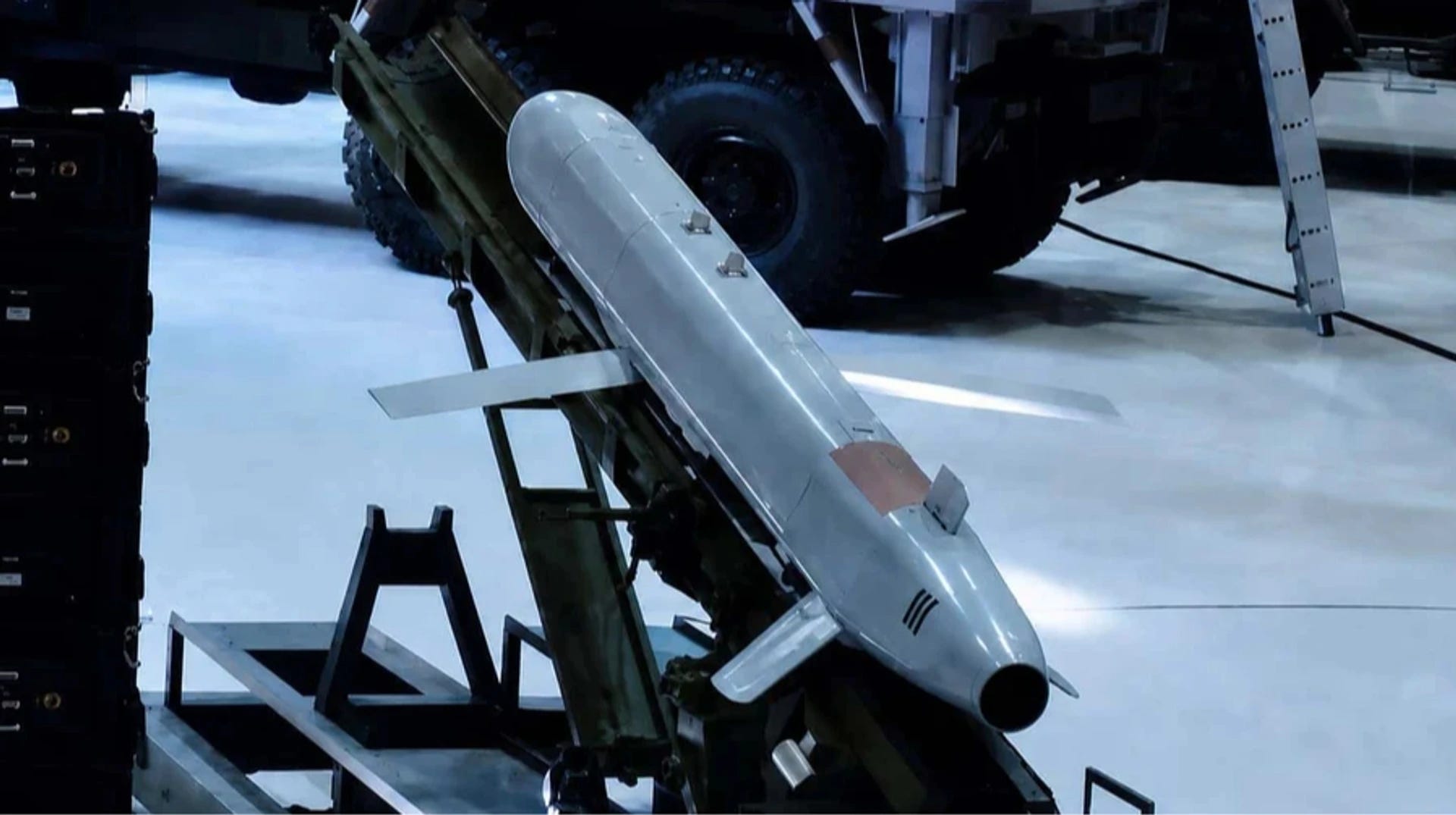
Both weapons are estimated to cost about $100,000 each, compared with more than $2 million for high-end US Tomahawk cruise missiles and comparable Russian systems. Russia relies heavily on Chinese jet engines, navigation computers and communications electronics, while engineers have adapted commercially available dual-use equipment to improve navigation, communications and resistance to jamming.
Ukraine has moved quickly on drone development but lacks comparable production resources, while the US and NATO are struggling to expand output of systems such as Patriot interceptors. Analysts say Western militaries must improve how quickly they move from experimentation to mass production.
Sources: Wall Street Journal, News Ukraine
Restacking or sharing this publication means more people can read it. Commenting extends the conversation. Liking shows your appreciation.
On this day …
On this day in 1960, Iran, Iraq, Kuwait, Saudi Arabia and Venezuela established the Organization of the Petroleum Exporting Countries in Baghdad. The five oil-producing states had spent several days discussing how to protect their interests and increase cooperation in an industry then dominated by major international oil companies.
OPEC would become one of the most consequential organisations in the global economy, giving producing countries a collective mechanism for influencing the international oil market. Its emergence also reflected a wider post-war shift towards greater national control over natural resources. More than six decades later, decisions made by oil producers can still reverberate through inflation, trade and geopolitics.
Energy has rarely been simply a commodity - it is also a source of political power.