


Trump Says Iran Truce Faces Collapse
Iran Adds Submarine Risk to Hormuz Closure
Americans Question Trump’s Iran War Goals
UAE Strikes Signal Gulf War Shift
Trump Seeks Petrol Tax Pause Over Iran Costs
EU Targets Ukraine Child Deportations
UK Targets Russian Information Warfare
Poll Shows Trump Attack Conspiracies Spreading
Trump Gala Suspect Denies Charges
Trump Brings CEOs Into China Talks
A succinct daily briefing delivered each weekday to help you stay on top of the stories shaping the world.
Donald Trump said the ceasefire between the US and Iran was on “massive life support” after rejecting Tehran’s latest proposal to end the war, exposing how far both sides remain from a settlement despite weeks of reduced fighting. Trump described Iran’s counter-offer as “totally unacceptable” and accused Tehran of retreating from earlier understandings over enriched uranium.
Iranian parliamentary speaker Mohammad Bagher Ghalibaf warned Iran’s armed forces were prepared to respond to further aggression, while Tehran insisted its demands were reasonable and centred on reopening the Strait of Hormuz, ending the US naval blockade and securing sanctions relief.
The dispute has intensified concerns over global energy markets as Iran continues restricting passage through Hormuz, through which roughly one fifth of the world’s oil and liquefied natural gas normally passes. Israeli Prime Minister Benjamin Netanyahu also said Iran’s enrichment facilities still had to be dismantled.
Sources: Euronews, BBC

Iran said it had deployed Ghadir-class mini-submarines in the Strait of Hormuz, presenting them as an “invisible guardian” of a waterway where commercial traffic remains heavily restricted. Rear Admiral Shahram Irani said the boats were operating under heightened readiness, while public reporting says Iran fields at least 16 of them.
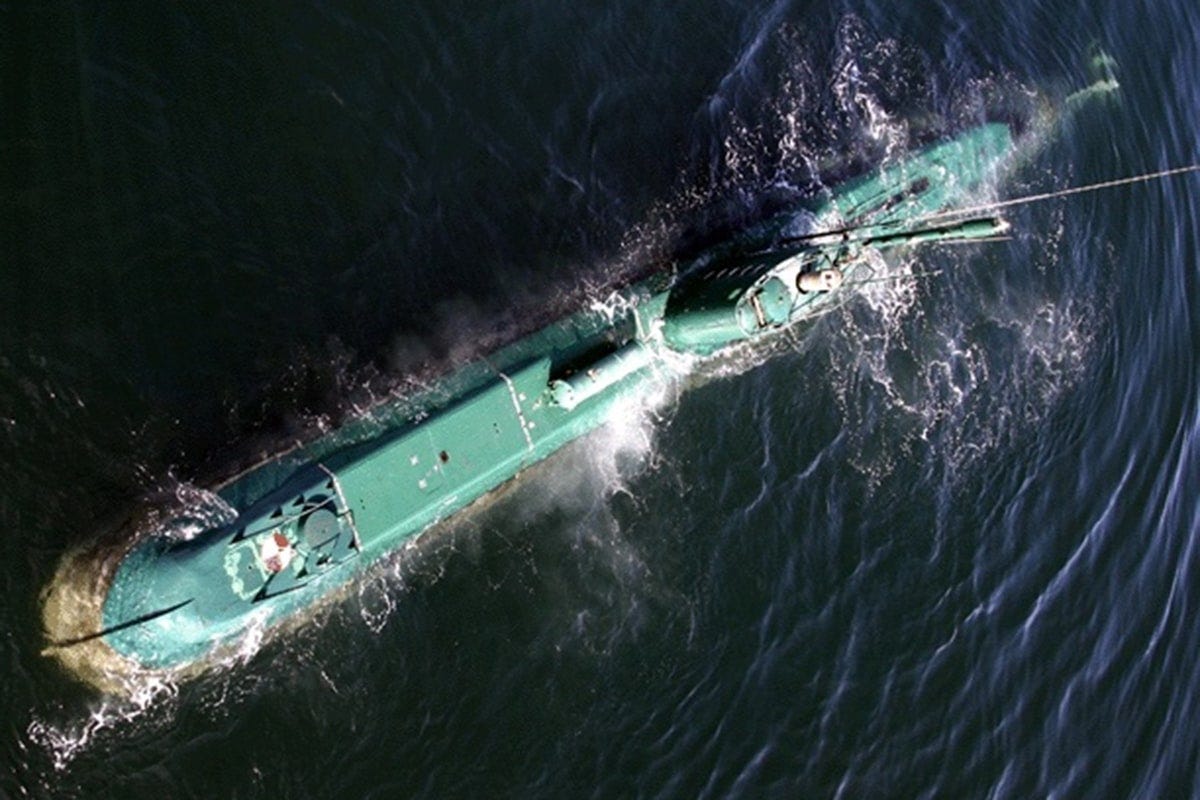
The deployment adds an underwater risk layer to a corridor already shaped by Iranian transit controls, higher insurance costs and sharply reduced shipping volumes. Iran introduced rules on May 5 requiring commercial ships to coordinate movements with its military authorities, while traffic through Hormuz had fallen to well below 10 per cent of normal levels by April 9.
The boats are small, shallow-water platforms carrying torpedoes or anti-ship missiles, but one person familiar with them said they were noisy, lightly experienced and prone to maintenance issues.
Sources: Bloomberg, Arabian Business
Two out of three Americans think Donald Trump has not clearly explained why the US went to war with Iran, according to a poll completed on Monday, even as his approval rating rose slightly from the lowest level of his current term.
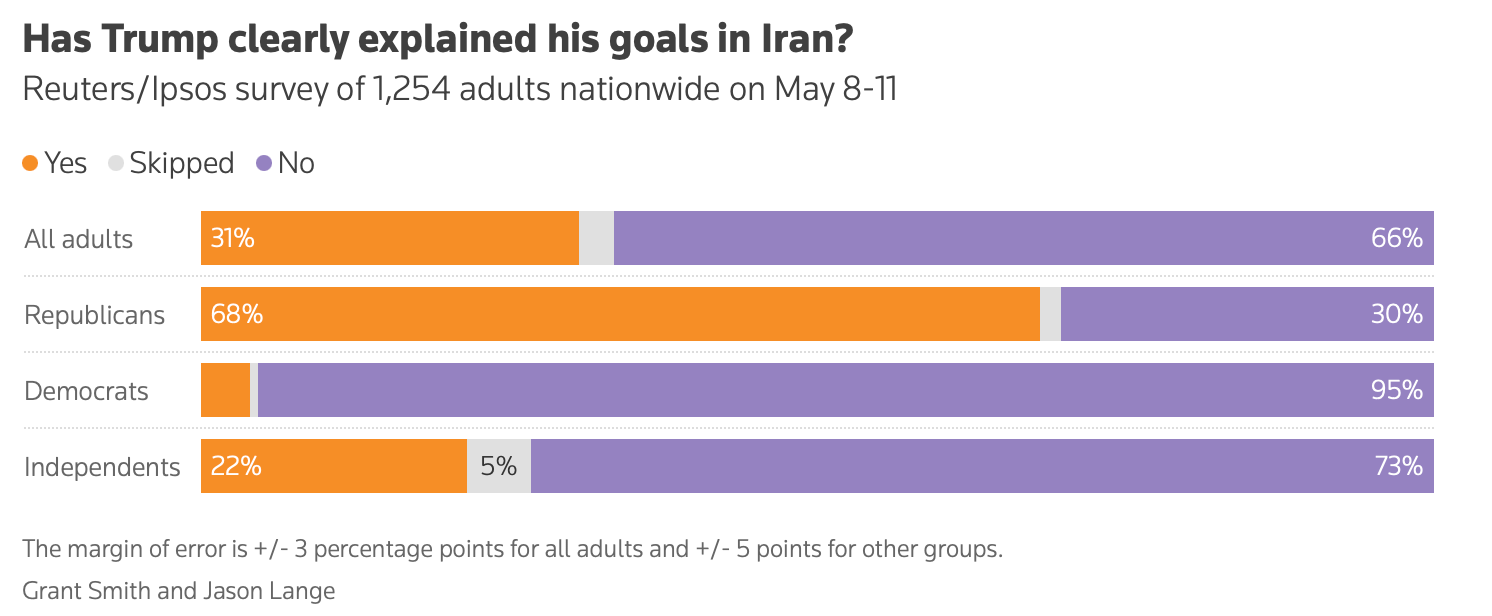
The survey found that about 66 per cent of respondents, including one in three Republicans and almost all Democrats, said Trump had not clearly explained the goals of US military involvement. The war began on 28 February with a US-Israeli bombing campaign and has pushed petrol prices roughly 50 per cent higher after Iran effectively closed the Strait of Hormuz.
The domestic pressure is now financial as well as political. Some 63 per cent of Americans said recent petrol price rises had hurt their household finances, while 65 per cent blamed Republicans more than Democrats.
Sources: Reuters, Hindustan Times
The United Arab Emirates secretly carried out military strikes on Iran during the war, including an attack on a refinery on Lavan Island in the Persian Gulf, according to people familiar with the matter. The UAE has not publicly acknowledged the strikes, while its foreign ministry declined to comment and pointed to earlier statements asserting its right to respond militarily to hostile acts.
The reported refinery attack took place in early April, around the time Donald Trump announced a ceasefire after a five-week air campaign. Iran said then that the site had been hit by an enemy attack and responded with missile and drone strikes against the UAE and Kuwait.
The attacks suggest a shift in Gulf involvement after Iran targeted the UAE heavily during the war, disrupting air traffic, tourism and property markets, and pushing Abu Dhabi towards a more confrontational posture.
Sources: Wall Street Journal, Times of Israel
Donald Trump said he would move to suspend the federal petrol tax to help Americans facing fuel prices pushed higher by the Iran war, but the change would require congressional approval. The tax is 18.4 cents per gallon on petrol and 24.4 cents on diesel, and raises more than $23 billion a year for highway and public transit programmes.
The proposal follows a national average petrol price of $4.52 a gallon on Monday, roughly 50 per cent above the level before the war began. Trump said the tax should be suspended “until it’s appropriate”, while Republican Senator John Thune warned that doing so would leave a hole in the highway trust fund.
Republican Senator Rand Paul said that “instead of suspending the tax, we should suspend the war”, as Republicans weigh the political impact of rising fuel costs before the midterms.
Sources: Associated Press, CBS News
Restacking or sharing this publication means more people can read it. Commenting extends the conversation. Liking shows your appreciation.

The European Union imposed sanctions on Russian officials and institutions accused of helping deport, forcibly transfer and indoctrinate Ukrainian children, expanding pressure over one of the war’s most sensitive crimes. The measures targeted 16 officials and seven centres suspected of involvement in forced assimilation, militarised education or unlawful adoption.
EU officials said about 20,500 Ukrainian children have been unlawfully deported or forcibly transferred to Russia or Russian-held territory since Moscow’s full-scale invasion began in February 2022. Around 2,200 have been returned, but identifying children taken young remains difficult and reintegration can take time.
Latvian Foreign Minister Baiba Braže said Russia was trying to erase the children’s identity, while Kaja Kallas called the removals a deliberate policy and a calculated attack on Ukraine’s future. The International Criminal Court has issued an arrest warrant for Vladimir Putin over the illegal deportation of children.
Sources: Al Jazeera, Associated Press
Britain imposed new sanctions on 85 people and entities accused of supporting Russian information warfare and the forced deportation and indoctrination of Ukrainian children. Two-thirds of the package targeted alleged propaganda operations, including recent attempts to interfere in forthcoming Armenian elections.
The measures included 49 people working for the Social Design Agency, which Britain said was tasked and funded by the Kremlin to deliver interference operations designed to undermine democracy and weaken support for Ukraine. The UK said such campaigns used fake websites, social media and bot accounts to spread misleading narratives backing Russia’s war.
Around a third of the package targeted what Britain called Russia’s systematic campaign to forcibly deport and militarise Ukrainian children. Yvette Cooper said Britain would continue supporting efforts to identify and trace children who had been taken, while the UK pledged another £1.2 million for verification and tracing work.
Sources: South China Morning Post, UK Government

Almost a quarter of Americans believe the attempted attack on the White House Correspondents’ Dinner was staged, according to a survey published on Monday, despite no evidence supporting claims that the incident was fabricated. Shots were heard at the Washington Hilton on April 25 before a suspected gunman was apprehended by the Secret Service.
Cole Tomas Allen has been indicted by a federal grand jury and charged with four felonies, including attempted assassination of Donald Trump. He pleaded not guilty during a Monday court appearance.
The survey found 24 per cent of US adults believed the incident was fake, while 45 per cent said it was legitimate and 32 per cent were unsure. Sofia Rubinson said the findings showed distrust of both the administration and the media, while Jared Holt said conspiratorial thinking had become a growing reflex in US politics.
Sources: The Independent, Washington Post
Cole Allen pleaded not guilty on Monday to all charges over an alleged attempt to assassinate Donald Trump at the White House Correspondents’ Dinner last month. The 31-year-old Californian faces counts including attempted assassination of the president, assault on a federal officer and firearms offences.
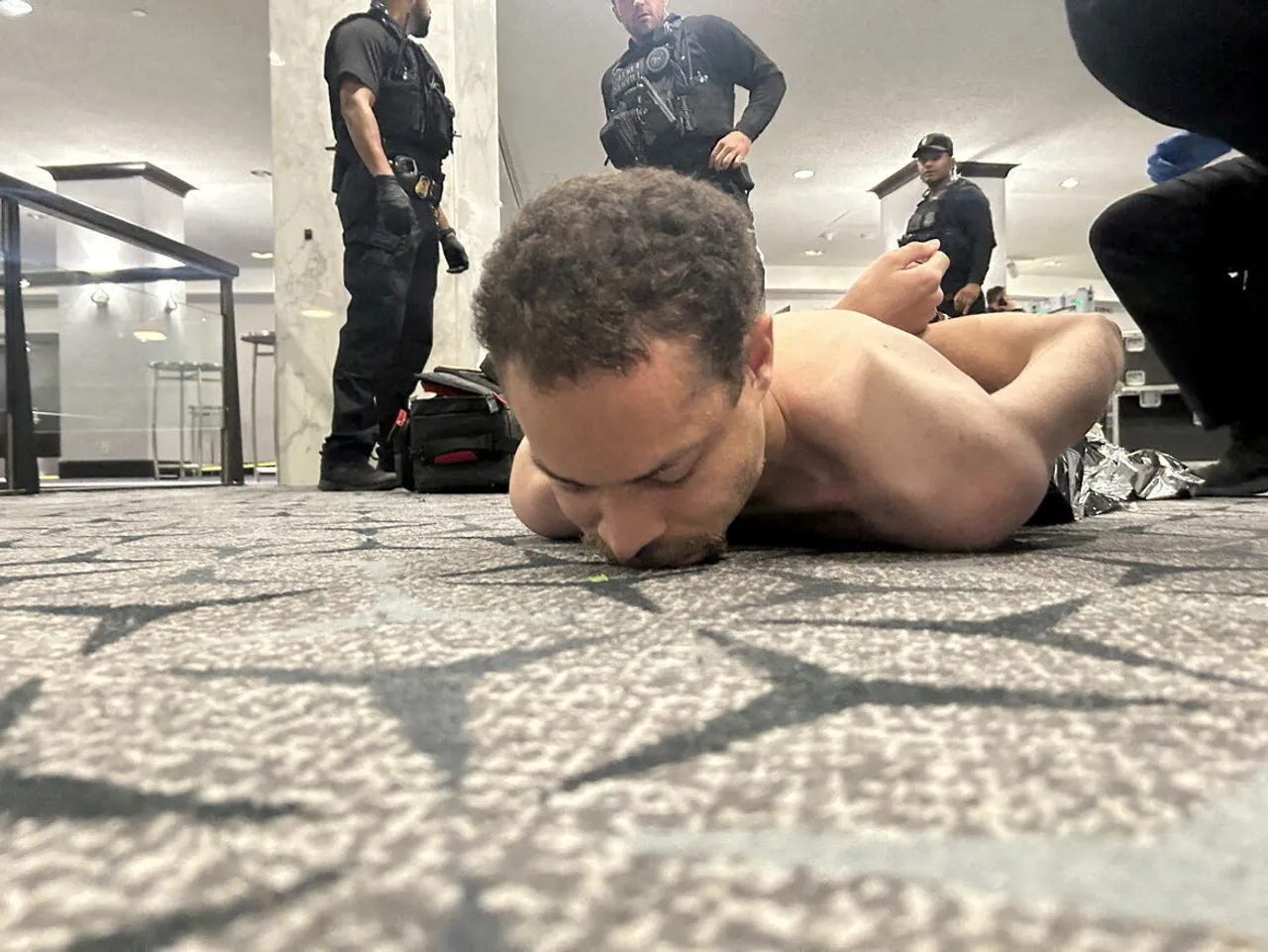
Prosecutors allege Allen fired a shotgun at a Secret Service agent and stormed a security checkpoint during a foiled attack on Trump and other administration members at the April 25 dinner. The agent was wounded slightly after being struck in the chest while wearing a bulletproof vest.
The case is already moving towards a dispute over who should prosecute it. Allen’s lawyers are seeking to remove acting Attorney General Todd Blanche and US Attorney Jeanine Pirro from the case because they attended the dinner and may have been among Allen’s alleged targets.
Sources: Le Monde, South China Morning Post
Donald Trump will travel to China with a large business delegation including Tim Cook of Apple and Elon Musk of Tesla, as he prepares to meet Xi Jinping later this week. The White House distributed a list on Monday of 16 chief executives scheduled to join the president in Beijing, though Cisco later said Chuck Robbins could not attend.
The delegation spans technology, finance, aviation, agriculture, payments and biotechnology, reflecting the breadth of US commercial interests tied to the visit. US officials said Trump wants to discuss creating a board of investment and a board of trade with China.
Jensen Huang of Nvidia was not invited, according to a person familiar with his plans, even as the company awaits approval from both governments to ship an early H200 artificial intelligence chip model to China.
Sources: BBC, New York Times
Restacking this post will help it reach more readers interested in the world.
On this day …
On this day in 1820, Florence Nightingale was born in Florence, Italy. During the Crimean War she became known for transforming military medical care through sanitation reforms, data analysis, and professional nursing standards at a time when hospital conditions were often chaotic and deadly.
Her influence extended far beyond wartime medicine. Nightingale helped establish nursing as a respected profession and demonstrated how statistics and public health policy could directly improve survival rates.
Many principles now considered basic to modern healthcare systems - hygiene standards, hospital administration, evidence-based care - were shaped by her work. More than a century later, healthcare systems around the world still operate in structures influenced by reforms she helped pioneer.
How much of modern medicine rests not on new technology, but on organisational discipline first imposed in the nineteenth century?